
On a cold winter evening, keeping the house warm becomes second nature. You close the windows, turn up the heat, make dinner, and settle in for the night.
Everything feels comfortable. But have you ever wondered what’s happening to the air inside your home?
Indoor air quality in winter can decline without any obvious warning. Cooking releases tiny particles, dust gets stirred up, and certain heating appliances can introduce additional pollutants. Meanwhile, your home may be getting less fresh outdoor air than it does during warmer months.
It’s a combination many homeowners overlook.
And the solution isn’t necessarily to buy an expensive air purifier or leave your windows open when it’s freezing outside.
Understanding where indoor pollution comes from is a much better starting point.
In this guide, we’ll explore why winter can affect the air inside your home, which everyday habits make the biggest difference, and nine practical ways to improve indoor air quality without sacrificing comfort.
Why Does Indoor Air Quality Get Worse in Winter?
Indoor air quality often gets worse in winter because reduced ventilation allows pollutants from cooking, heating, cleaning, and other household activities to build up indoors. Heating and humidity changes can create additional problems, especially in poorly ventilated homes.
Winter doesn’t automatically mean your home’s air is unhealthy. The real issue is how your home manages pollution once the cold weather arrives.
Your Home Gets Less Fresh Air
Think about how you use your home in July compared with January.
During summer, you might open the windows while cleaning or let a breeze move through the house. When temperatures drop below freezing, you’re far less likely to do that.
Many residential heating systems also recirculate indoor air rather than continuously bringing in fresh outdoor air.
As a result, pollutants generated inside the home may remain there longer.
Everyday Activities Continue Producing Pollution
A surprising amount of indoor air pollution comes from ordinary household activities.
Frying dinner, burning scented candles, spraying cleaning products, or using a wood-burning fireplace can introduce particles or gases into your living space.
These activities happen throughout the year. During winter, however, ventilation may be reduced just when families are spending more time indoors.
According to the U.S. Environmental Protection Agency (EPA), improving indoor air involves three complementary approaches: controlling pollution sources, ventilating with cleaner outdoor air, and using filtration when appropriate.
Heating and Humidity Create Different Challenges
Turning on the heat can also change how your home feels.
Cold outdoor air usually contains less moisture than warm air. When that air enters your home and is heated, its relative humidity often drops.
That’s one reason bedrooms can feel unusually dry during winter.
Yet other areas may develop the opposite problem. Steam from cooking and showering can condense on cold windows or poorly insulated surfaces.
A home can even have dry air in one room and a moisture problem in another.
Both deserve attention, but they require different solutions.
Common Signs Your Winter Indoor Air Needs Attention
You don’t need to become an air quality expert to notice when something deserves a closer look.
These everyday clues can help you decide where to start.
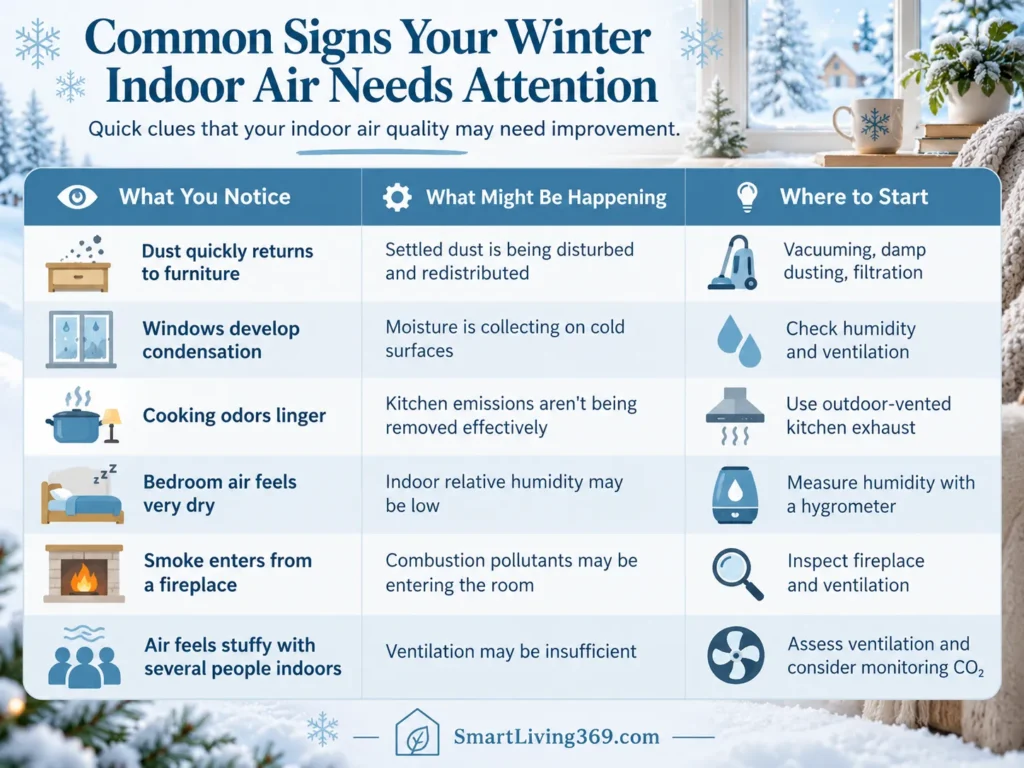
These signs aren’t diagnoses. A room can contain pollutants even when it looks and smells perfectly normal.
The important thing is to identify the likely source before choosing a solution.
9 Powerful Ways to Improve Indoor Air Quality in Winter
Improving indoor air quality in winter doesn’t require turning your house into a laboratory.
In fact, some of the most effective changes are inexpensive.
Here’s where to focus.
1. Stop Creating Unnecessary Indoor Pollution
Before worrying about how to remove pollutants, consider how many you can avoid introducing in the first place.
Take scented candles, for example.
They’re popular during winter because they create a warm atmosphere. But burning candles can release airborne particles into your home.
Incense, tobacco smoke, and some fragrance products can also contribute to indoor pollution.
You don’t have to give up everything that makes your house feel cozy. It simply helps to be selective.
Try flameless LED candles for evening lighting, avoid smoking indoors, and choose household products with fewer unnecessary fragrances when possible.
Pay attention to cleaning sprays as well. Some products release volatile organic compounds (VOCs), and mixing incompatible cleaners can create dangerous fumes.
The takeaway: Preventing pollution is often easier than trying to filter it out afterward.
An air purifier can be useful, but reducing the source comes first.
2. Bring in Fresh Air Without Freezing Your Home
Opening a window in January isn’t exactly appealing, especially if you live somewhere with snowy winters.
Fortunately, improving ventilation doesn’t mean leaving windows open all afternoon.
When outdoor air quality and weather conditions are suitable, opening windows briefly can help exchange indoor air with outdoor air.
The effectiveness depends on wind, temperature differences, window placement, and how much air can move through your home.
However, you should avoid relying on open windows when outdoor conditions are unsafe or polluted.
For example, if your neighborhood is affected by wildfire smoke or heavy wood-burning emissions, bringing that air indoors may make matters worse.
For homes that need more consistent ventilation, an appropriately designed mechanical ventilation system may be a better long-term option.
Some homeowners consider heat recovery ventilators (HRVs), which transfer heat between outgoing and incoming air streams to reduce ventilation-related heat loss.
A useful rule: Check outdoor air conditions before increasing natural ventilation.
You can use AirNow.gov to check air quality information for locations across the United States.
3. Turn On Your Kitchen Exhaust Fan Before Cooking
Here’s an indoor air quality habit that’s easy to underestimate: using the range hood.
Even if you aren’t burning food, cooking produces airborne particles. Frying, searing, grilling, and other high-temperature methods can generate especially high particle concentrations.
Gas cooking can also release combustion-related gases.
A properly installed range hood that exhausts outdoors helps capture pollutants before they spread through the rest of the house.
The EPA recommends using your range hood while cooking and leaving it running for approximately 10–20 minutes afterward.
There are a few simple habits worth adopting:
- Turn on the range hood when you start cooking.
- Use back burners when practical to improve capture.
- Keep the hood’s grease filter clean.
- Avoid letting cooking oil overheat.
If your hood simply recirculates air through a filter, remember that it doesn’t provide the same removal of indoor air to the outdoors.
A portable air purifier may help reduce some cooking particles, but it doesn’t replace an effective exhaust system.
For many households, better kitchen ventilation is one of the most practical ways to improve indoor air quality in winter.
4. Give Your HVAC Filter Some Attention
It’s easy to forget about your furnace filter until the heating system starts making unusual noises or your utility bill increases.
But filter maintenance matters for indoor air quality, too.
If your home has a forced-air heating system, air passes through its filter whenever the system’s fan operates.
An appropriate filter can capture airborne particles before they circulate back into your living spaces.
The EPA recommends considering a filter rated MERV 13, or the highest efficiency rating your HVAC system can safely accommodate.
MERV stands for Minimum Efficiency Reporting Value. Higher ratings generally indicate better filtration of certain particle sizes.
That doesn’t mean you should immediately install the thickest, highest-rated filter you can find.
Some systems cannot handle the airflow resistance of particular filters.
Check your manufacturer’s guidance or ask an HVAC professional before upgrading.
Also, don’t assume every filter needs replacement after exactly 30 days. Filter lifespan depends on the product, indoor conditions, and operating time.
Practical winter habit: Check the filter’s condition regularly and follow the manufacturer’s replacement instructions.
If you already use a smart thermostat, it may offer filter-maintenance reminders and useful heating schedules.
You can explore this further in our guide to smart thermostats.
5. Choose an Air Purifier That Actually Fits Your Room
If you’ve been researching indoor air quality in winter, you’ve probably seen plenty of advertisements for HEPA air purifiers.
Some promise cleaner air across an entire house. Others emphasize smart sensors, mobile apps, or ultra-quiet operation.
Those features can be helpful, but there’s something more important to check first.
Can the purifier clean enough air for the room where you plan to use it?
Look for the Clean Air Delivery Rate, usually shortened to CADR.
CADR indicates how much filtered air a purifier delivers for specific types of particles.
For a typical room with an 8-foot ceiling, the EPA recommends choosing a smoke CADR of at least two-thirds of the room’s floor area in square feet.
What Size Air Purifier Do You Need?
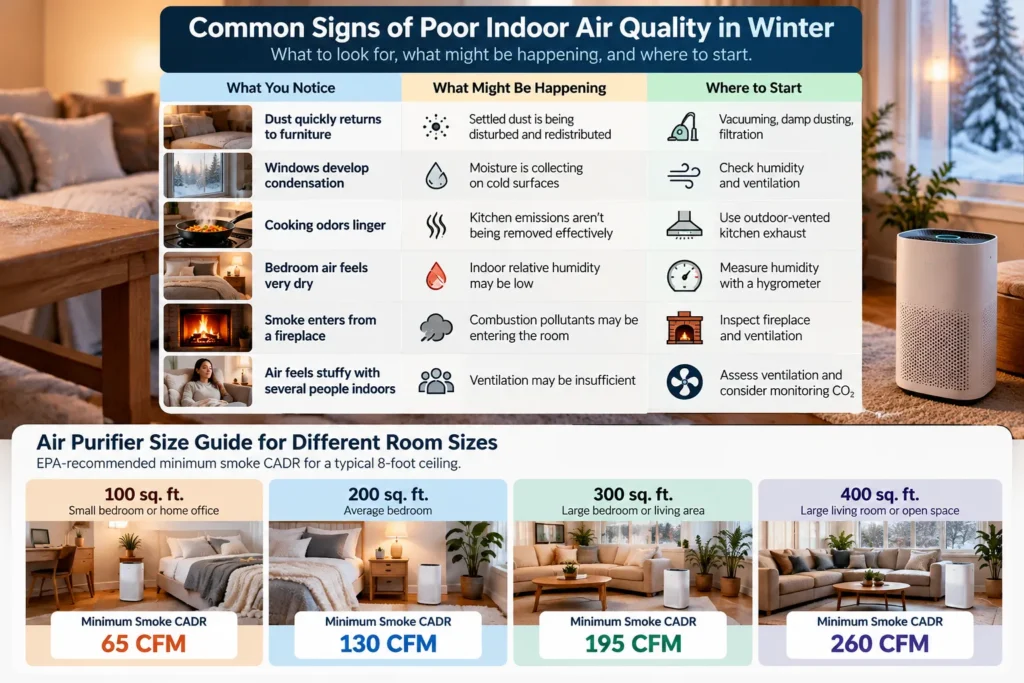
CFM means cubic feet per minute. These figures are EPA sizing estimates for rooms with approximately 8-foot ceilings. Rooms with higher ceilings may require more capacity.
For instance, if your bedroom is around 200 square feet, a purifier with a smoke CADR of at least 130 CFM is a reasonable starting point.
A purifier with a HEPA filter can capture many airborne particles, including fine dust, pollen, and some airborne allergens.
However, a standard HEPA filter is not designed to remove gases such as carbon monoxide.
Activated carbon filters may help with certain odors and gaseous pollutants, but effectiveness depends heavily on filter design and the amount of carbon used.
For a closer look at different technologies, read our guide to air purifiers for home.
Smart shopping tip: Compare CADR, replacement filter costs, noise, energy consumption, and ozone-related safety information rather than relying on advertised room coverage alone.
6. Put Your Air Purifier in the Right Place
Buying a capable air purifier is only half the job.
Where you place it matters.
Imagine buying a purifier for your bedroom, then tucking it into a narrow corner behind a chair because that’s the only place it looks good.
It may still operate, but restricted airflow can reduce how effectively it cleans the room.
Instead, place the device where air can move freely through its intake and outlet.
Follow the manufacturer’s clearance recommendations and avoid blocking it with curtains, furniture, or piles of laundry.
Should an Air Purifier Run All Day in Winter?
For many portable air purifiers, extended operation can help maintain lower concentrations of airborne particles.
A device only filters air while it’s running.
If you’re using one in a bedroom, select a fan setting that’s quiet enough for sleeping while still moving a useful amount of air.
Some smart models automatically adjust fan speed based on particle sensor readings.
That feature is convenient, but don’t assume the built-in sensor measures every indoor pollutant.
If pets are one of your main concerns, our guide to air purifiers for pets explains the differences between airborne dander, pet hair, and odors.
One more detail: avoid air-cleaning devices that intentionally produce ozone. Ozone is a lung irritant, not a substitute for safe particle filtration.
7. Keep Winter Humidity Under Control
You might associate winter with dry air, but humidity problems aren’t always straightforward.
A heated bedroom may feel dry, while the bathroom window develops condensation every morning.
Both conditions can exist in the same home.
The first step is to stop guessing.
A simple digital hygrometer can tell you your indoor relative humidity.
The EPA generally recommends keeping indoor humidity below 60%, ideally between 30% and 50%, to help limit moisture-related problems.
What Does Your Humidity Reading Mean?
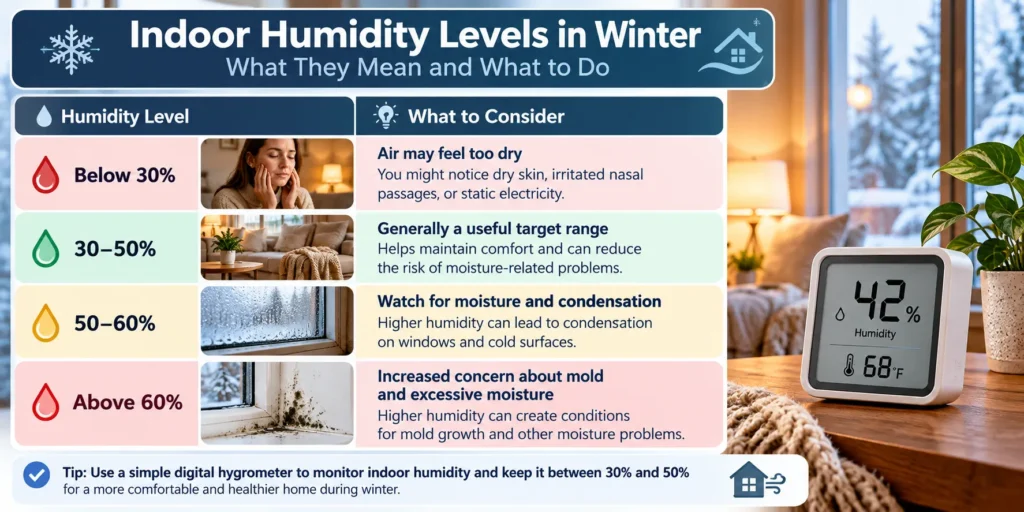
These are general guidelines, not a guarantee that every surface will remain dry.
In very cold climates, condensation may still develop on poorly insulated windows even when indoor humidity is within the suggested range.
If your air is excessively dry, a properly maintained humidifier may help.
But avoid adding more moisture than you need.
Humidifiers require regular cleaning, and some types can disperse minerals or microorganisms if used improperly.
If you’re noticing persistent condensation or mold, investigate the moisture source rather than trying to cover the problem with an air purifier.
For detailed guidance, see the EPA’s advice on mold and moisture control.
8. Make Your Cleaning Routine Work for Your Air
Have you ever cleaned a sunny room and noticed tiny particles floating in the light afterward?
Some dust becomes airborne when you sweep, shake fabrics, or move furniture.
Other particles settle back onto nearby surfaces.
That’s why improving indoor air quality in winter involves more than filtering the air. You also need to manage the dust that collects around your home.
Start with surfaces you touch and use frequently.
A damp microfiber cloth can pick up dust without scattering as much of it into the room as dry dusting might.
For floors and upholstery, a well-sealed vacuum with effective filtration can help prevent collected particles from escaping back into the air.
Pay particular attention to bedrooms.
Mattresses, pillows, blankets, carpets, and upholstered furniture can hold dust and allergens.
Wash bedding according to its care instructions, vacuum regularly, and clean the areas where pets spend the most time.
If dust is your biggest concern, our article on the best air purifiers for dust can help you understand which filtration features matter.
The goal isn’t a spotless house every hour of the day.
It’s reducing the buildup and redistribution of particles through consistent, manageable cleaning habits.
9. Maintain Your Heating Equipment and Check Carbon Monoxide Safety
Air purifiers and filters are helpful, but they cannot solve every indoor air problem.
This is especially important when it comes to heating equipment.
Gas furnaces, wood stoves, fireplaces, and other fuel-burning appliances require correct installation, ventilation, and maintenance.
If something goes wrong, they can release harmful pollutants.
One of the most serious is carbon monoxide (CO).
Carbon monoxide has no color or smell. Exposure can cause severe illness or death, and you cannot detect it reliably with your senses.
A standard HEPA air purifier does not remove carbon monoxide.
That’s why homes need functioning carbon monoxide alarms where required or recommended, along with appropriate heating-system maintenance.
If you’re preparing for winter, check that your heating equipment has been serviced as recommended and that smoke and CO alarms are working.
Never run a generator, charcoal grill, or other outdoor combustion equipment inside a house or garage.
According to the CDC’s winter safety guidance, generators should be operated outdoors, at least 20 feet from windows, doors, and vents.
If a carbon monoxide alarm sounds, follow the alarm’s emergency instructions, move to fresh air, and contact emergency services.
Remember: Better indoor air quality starts with eliminating dangerous sources, not trying to filter them away.
Can Smart Home Technology Improve Indoor Air Quality in Winter?
One of the most interesting developments in home technology is the growing availability of indoor air quality monitors.
Instead of relying entirely on how a room smells or feels, certain devices can track changes in environmental conditions.
Depending on the model, an indoor air quality monitor may measure:
- PM2.5 (fine airborne particles)
- Temperature and relative humidity
- Carbon dioxide (CO₂)
- Total volatile organic compounds (TVOCs)
These readings can help you recognize patterns.
For example, you may notice a rise in PM2.5 when frying food, or higher CO₂ readings when several people spend hours together in a poorly ventilated room.
A smart air purifier can sometimes respond automatically to measured particle levels.
You may also be able to create an automation that increases filtration when a compatible sensor detects elevated PM2.5.
However, consumer air quality monitors vary in accuracy.
A low PM2.5 reading does not prove that every indoor pollutant is absent, and a CO₂ sensor is not a substitute for a carbon monoxide alarm.
The real benefit of smart monitoring is awareness. It helps you understand when conditions change so you can respond more appropriately.
Air Purifier vs Humidifier: What Does Your Home Actually Need?
These two devices are often discussed together, especially during winter.
But they solve different problems.
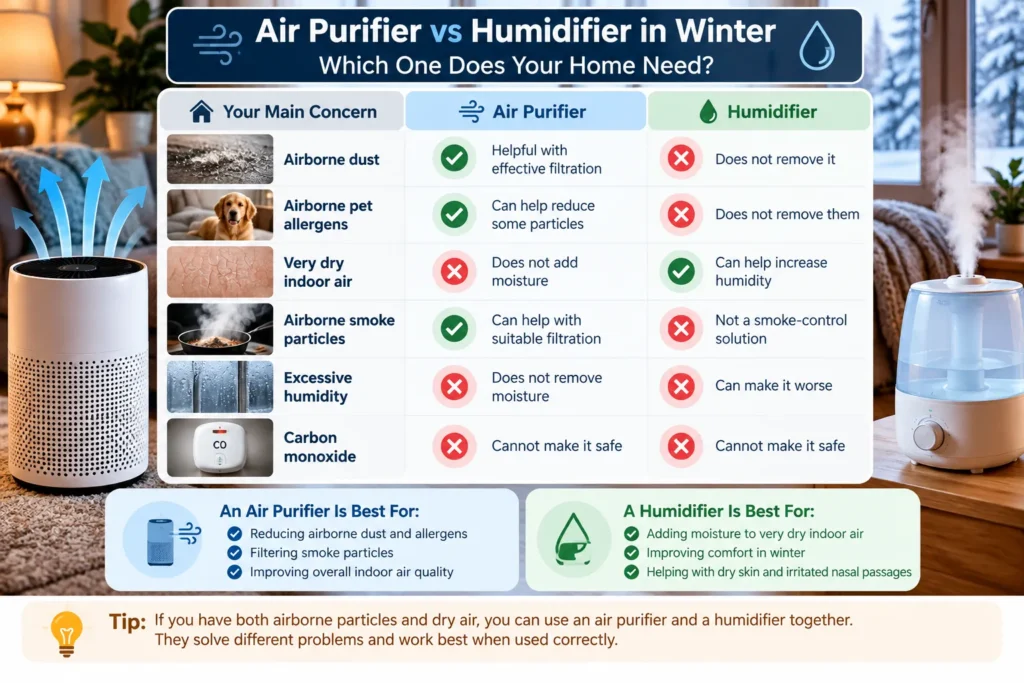
If you’re concerned about airborne particles, an appropriately sized air purifier may be useful.
If your home is genuinely too dry, a humidifier may address that specific issue.
And if you have both problems, you might benefit from using both devices correctly.
There’s no need to buy either one simply because winter has arrived.
Identify your home’s actual conditions before spending money.
A Simple Winter Indoor Air Quality Routine
You don’t need a complicated schedule to build better habits.
Here’s a routine that fits into an ordinary winter day.
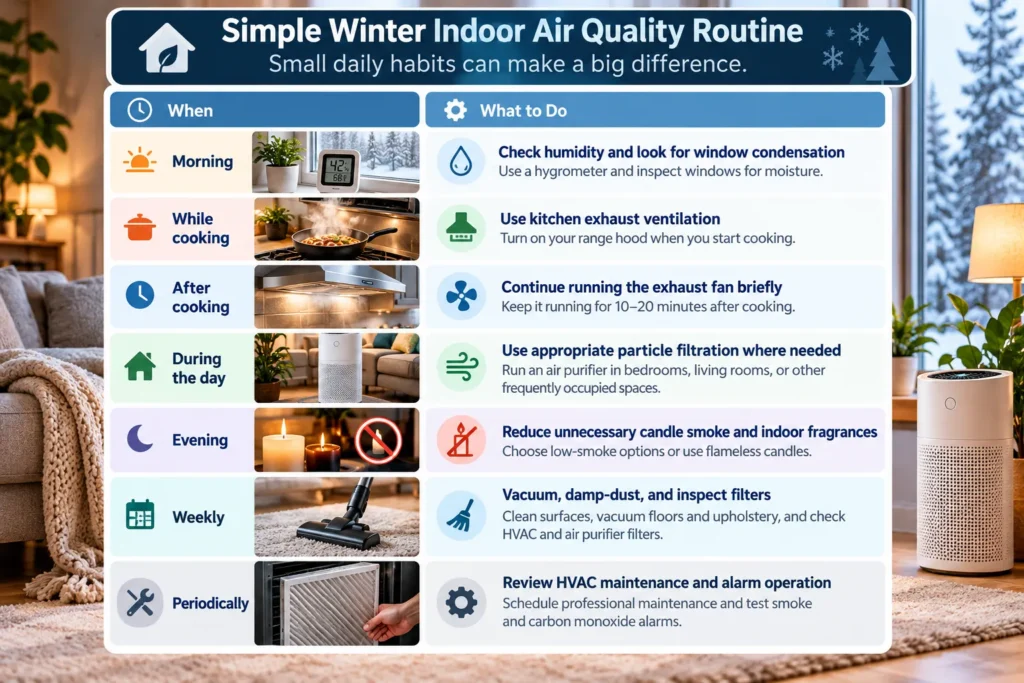
Even one or two changes can help address a specific problem.
For example, if your kitchen always smells smoky after dinner, improving the exhaust ventilation is a sensible first step.
If your bedroom collects dust, focus on cleaning, bedding, and filtration.
You don’t need every device on the market. You need the right solution for your home.
Frequently Asked Questions About Indoor Air Quality in Winter
Why is indoor air quality worse in winter than in summer?
Indoor air quality in winter can be worse because homes often have less ventilation while indoor pollutants continue to accumulate. Closed windows, heating appliances, cooking, and household dust can increase exposure to airborne contaminants. Unlike summer, when fresh outdoor air may circulate more frequently, winter conditions can allow pollutants to remain indoors longer.
Is it healthy to open windows during winter?
Yes, opening windows briefly can improve indoor air quality in winter when outdoor air is clean and weather conditions are safe. Even a short period of ventilation may help remove accumulated indoor pollutants. However, avoid opening windows during heavy outdoor pollution, wildfire smoke, or dangerous cold. Mechanical ventilation can provide a more consistent alternative.
Do air purifiers really help improve indoor air quality in winter?
Yes, air purifiers can improve indoor air quality in winter by reducing airborne particles such as dust, pet dander, pollen, and smoke. For the best results, choose a properly sized purifier with effective particle filtration and an appropriate Clean Air Delivery Rate (CADR). Remember that air purifiers supplement ventilation rather than replace it.
Is dry winter air the same as poor indoor air quality?
No, dry winter air and poor indoor air quality are not the same thing. Low humidity can cause discomfort, including dry skin and irritated nasal passages, while poor air quality involves pollutants such as particles and gases. Both can affect indoor comfort. Maintaining appropriate humidity and reducing pollutant sources are separate but complementary steps.
What is the best way to improve indoor air quality in winter?
The best way to improve indoor air quality in winter is to combine source control, proper ventilation, and effective air filtration. Start by reducing indoor smoke and unnecessary fragrances, using kitchen exhaust fans, maintaining HVAC filters, and monitoring humidity. A properly sized HEPA air purifier can provide additional particle filtration in frequently occupied rooms.
Should I leave my air purifier running overnight during winter?
Yes, many air purifiers can safely run overnight when used according to the manufacturer’s instructions. Continuous operation can help maintain lower airborne particle concentrations in bedrooms. Choose a quiet fan setting that still provides adequate filtration, keep air intakes unobstructed, and replace filters as recommended.
Can indoor plants improve indoor air quality in winter?
Indoor plants are not an effective replacement for air purifiers or ventilation systems. Although plants can make living spaces feel more welcoming, ordinary household plant collections do not remove indoor pollutants at a meaningful rate. Overwatering can also encourage mold growth in potting soil. For cleaner winter air, prioritize ventilation, source control, and proven filtration methods.
What is the ideal indoor humidity level during winter?
The EPA generally recommends keeping indoor relative humidity between 30% and 50%, where practical. Maintaining this range can support comfort and help reduce moisture-related problems. Excessive humidity may encourage condensation and mold, while very low humidity can cause discomfort. A digital hygrometer helps you monitor indoor conditions throughout winter.
Can HVAC filters improve indoor air quality in winter?
Yes, properly selected HVAC filters can improve indoor air quality in winter by capturing airborne particles as air circulates through your heating system. The EPA recommends considering MERV 13 filtration, or the highest-rated filter your system can safely accommodate. Replace filters according to manufacturer instructions and ensure your heating system maintains adequate airflow.
Can poor indoor air quality in winter affect your health?
Yes, poor indoor air quality in winter can contribute to respiratory irritation and other health concerns, depending on the pollutants and exposure levels. Fine particles, smoke, and certain combustion gases can be harmful. Improving ventilation, limiting pollution sources, and using suitable filtration can reduce exposure. Remember that HEPA air purifiers do not protect against carbon monoxide.
[…] You can learn more about seasonal household conditions in our guide to indoor air quality in winter. […]