
You know that empty corner beside your living room window?
The one that seems to need something, but another lamp or piece of furniture just doesn’t feel right?
Now imagine adding a tall snake plant, a trailing pothos on the bookshelf, and a little spider plant catching the afternoon light.
Suddenly, the room feels different.
A little softer. More alive. Maybe even fresher.
But here’s the question worth asking: Is the air actually cleaner, or does the room simply feel that way?
The idea of using indoor plants for air quality has become incredibly popular. You’ve probably seen lists promising that certain houseplants remove toxins, release fresh oxygen, and turn ordinary bedrooms into healthier spaces.
There’s some fascinating science behind those claims, but there’s also plenty of misunderstanding.
And the truth is more interesting than another list of supposedly magical plants.
Let’s explore nine surprising facts about indoor plants, what they really contribute to your home, and how to enjoy their benefits without falling for exaggerated promises.
Quick Answer: Are Indoor Plants Good for Air Quality?
Indoor plants can absorb small amounts of certain gases under specific conditions, but ordinary numbers of houseplants have not been shown to meaningfully purify the air in typical homes.
Their most practical benefits involve greenery, interior design, the enjoyment of plant care, and creating a pleasant living environment.
According to the U.S. Environmental Protection Agency, controlling pollution sources, improving ventilation, and using effective filtration are more reliable approaches to cleaner indoor air.
That doesn’t mean you should stop buying plants.
It means you can appreciate them for what they genuinely offer.
1. Indoor Plants for Air Quality Became Famous Because of Laboratory Research
The idea didn’t come from nowhere.
Research conducted decades ago explored whether plants and their growing systems could remove certain chemicals from enclosed air.
Some experiments produced encouraging results.
But those experiments weren’t conducted in ordinary living rooms with people walking through doors, cooking dinner, and opening windows.
They involved carefully controlled environments.
That’s a crucial distinction.
A result observed in a small enclosed chamber doesn’t necessarily translate into a measurable improvement across a busy, ventilated home.
What to remember: Laboratory results help researchers understand what plants can do. They don’t automatically prove how well plants work as household air cleaners.
2. A Beautiful Green Room Isn’t Necessarily a Cleaner Room
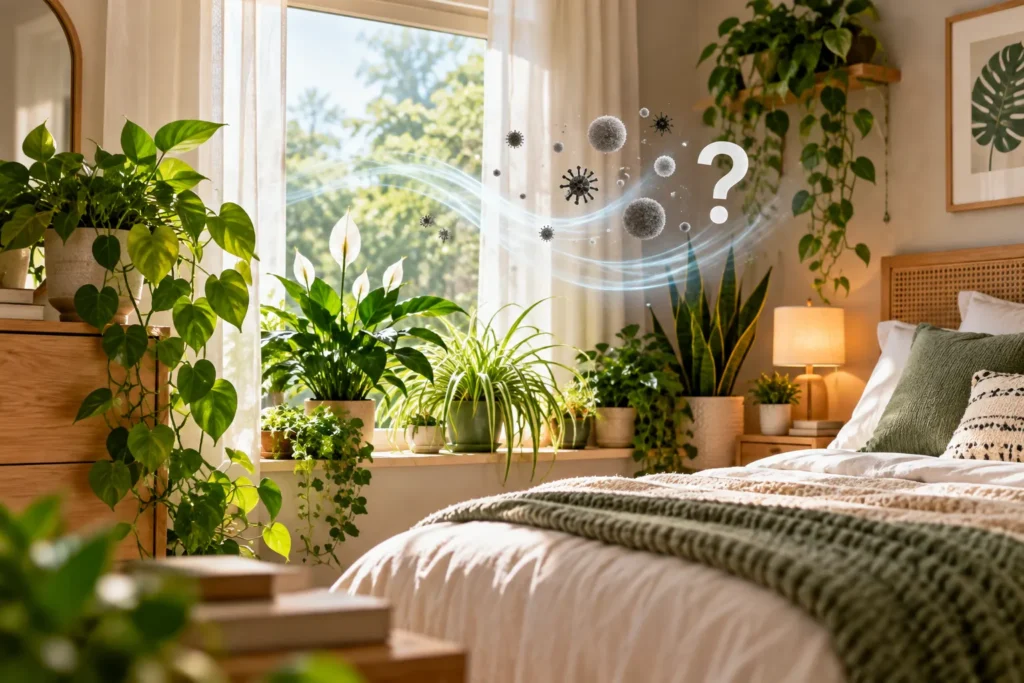
Here’s something that surprises many first-time plant owners.
A living room filled with greenery can look and feel refreshing even when the concentration of airborne pollutants hasn’t changed significantly.
Visual comfort and measurable air quality are two different things.
Think about walking into a freshly decorated bedroom.
Soft lighting, clean bedding, and a beautiful plant can make the room seem more peaceful.
But none of those details tells you how much PM2.5, nitrogen dioxide, or other pollutants are present.
If cleaner air is your objective, you’ll need to address the actual sources of pollution.
If a more inviting home is your objective, houseplants can be a wonderful design choice.
Both goals are worthwhile. They just shouldn’t be confused.
3. The Number of Plants Matters More Than Most People Realize
Could adding five or six popular air-purifying plants make a measurable difference?
Not necessarily.
A scientific review published in the Journal of Exposure Science & Environmental Epidemiology examined experimental evidence on potted plants and volatile organic compounds (VOCs).
The researchers found that the pollution-removal rates of individual potted plants were extremely small compared with typical indoor air exchange.
Their analysis suggested that matching normal building ventilation would require an impractically large number of plants.
In other words, turning your apartment into a miniature jungle still wouldn’t necessarily replace proper ventilation.
The practical lesson: Buy houseplants because you enjoy them, not because a particular number promises to eliminate airborne pollution.
For a closer look at popular varieties, explore our guide to the 8 best indoor plants for air quality and what science really says.
4. Some Indoor Plants Can Create Moisture Problems
Most plant owners worry about underwatering.
But overwatering deserves just as much attention.
When potting soil remains excessively wet, it may encourage fungal growth and attract fungus gnats.
That’s especially relevant in homes with limited ventilation or existing humidity problems.
You might notice tiny flies hovering around a planter or a musty smell coming from persistently damp soil.
The solution usually isn’t another air purifier.
It’s improving your plant-care routine.
Simple Indoor Plant Care Tips
- Choose pots with adequate drainage.
- Empty excess water from saucers.
- Allow the soil to dry as appropriate for the plant species.
- Remove decaying leaves from the soil surface.
- Avoid placing plants against walls that already have moisture damage.
A healthy plant collection should complement your home—not create another moisture problem.
5. Air-Purifying Plants Aren’t All Safe for Pets
That gorgeous peace lily at the garden center might look perfect on your coffee table.
But if you share your home with a curious cat or dog, the decision becomes more complicated.
Several popular indoor plants can cause harmful reactions when chewed or swallowed.
For example, the ASPCA identifies pothos and peace lilies as potentially toxic to pets.
Snake plants also contain substances that may cause gastrointestinal upset.
Fortunately, you have alternatives.
Pet-Safety Comparison
| Plant | ASPCA Pet-Safety Classification |
|---|---|
| Spider plant | Non-toxic to cats and dogs |
| Boston fern | Non-toxic to cats and dogs |
| Parlor palm | Non-toxic to cats and dogs |
| Snake plant | Toxic to cats and dogs |
| Golden pothos | Toxic to cats and dogs |
| Peace lily | Toxic to cats and dogs |
Non-toxic doesn’t mean a plant should be eaten. Chewing plant material can still cause digestive discomfort.
6. Indoor Plants Need Light, Even When Labels Say “Low Light”
A plant described as low-light tolerant isn’t the same as a plant that can live in complete darkness.
This is a common source of disappointment.
You buy a supposedly easy-care houseplant, place it in a windowless hallway, and wonder why it slowly loses its color.
Plants need light for photosynthesis.
Some species tolerate lower light levels much better than others, but their growth may slow considerably.
Snake plants and ZZ plants are popular because they adapt to a range of indoor conditions.
Spider plants generally prefer brighter, indirect light.
Before choosing an indoor plant, look at the room itself.
Does it receive daylight? Is the window north-facing? Does it get harsh afternoon sun?
The right plant for the location usually performs better than a fashionable plant placed somewhere unsuitable.
7. Your Plant Collection Needs Different Care in Winter
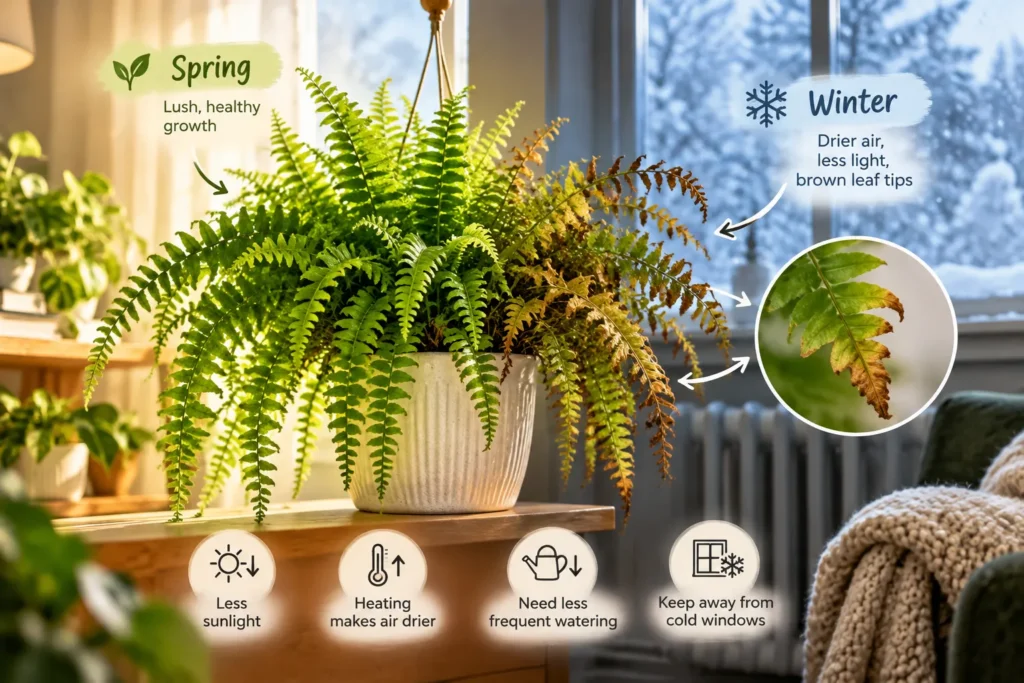
Imagine buying a beautiful Boston fern in spring.
For months, it looks wonderful.
Then December arrives.
The heating comes on, sunlight becomes weaker, and the leaves begin turning brown around the edges.
What’s happening?
Winter changes indoor growing conditions.
Shorter days reduce available light, heating can make the air drier, and some plants grow more slowly.
During this period, many houseplants need less frequent watering than they do in warmer months.
The most useful habit is checking the soil rather than following a rigid watering calendar.
Also, keep sensitive leaves away from hot vents and cold window glass.
You can learn more about seasonal household conditions in our guide to indoor air quality in winter.
8. Indoor Plants Cannot Replace HEPA Air Purifiers
This is probably the most important distinction in the entire discussion.
Houseplants and air purifiers serve different practical purposes.
An appropriately sized air purifier draws room air through filtration media designed to capture airborne particles.
A potted plant does not continuously process large volumes of room air in the same way.
Indoor Plants vs. Air Purifiers
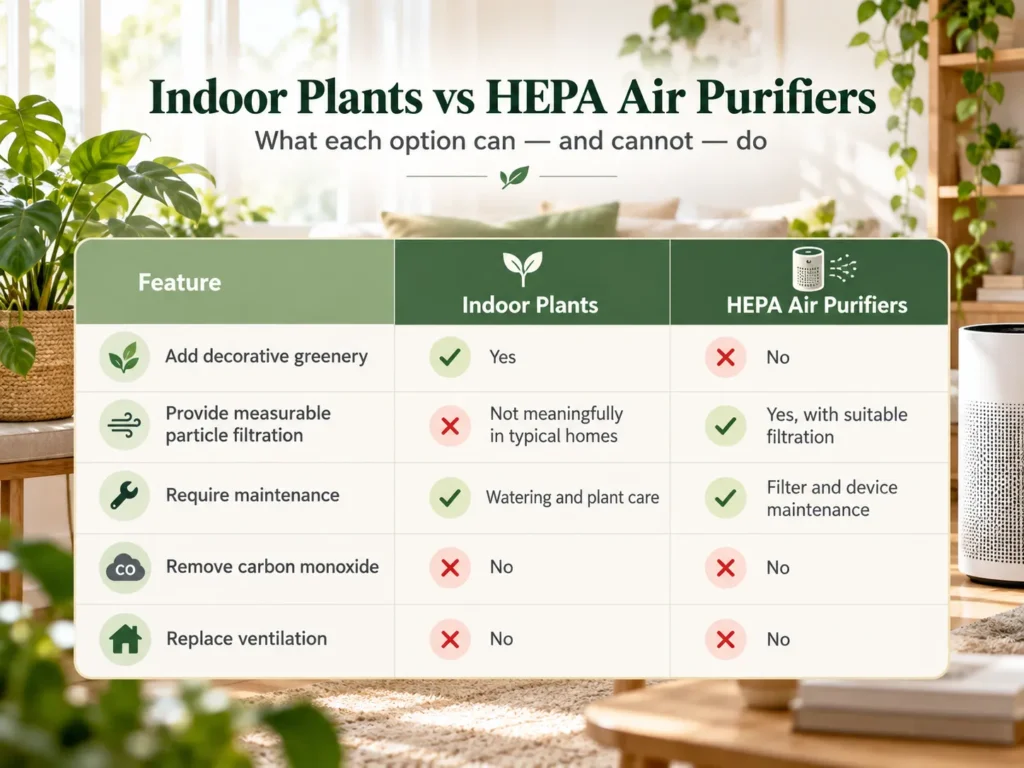
If airborne dust, smoke, or pet dander is your main concern, proper source control and filtration are generally more effective than adding plants.
Our complete guide to air purifiers for home explains how these devices work and what to look for.
9. The Best Indoor Plants Are the Ones That Fit Your Life
This final fact might be the most useful.
There isn’t one perfect houseplant for every home.
A snake plant may suit someone who travels frequently.
A spider plant may be a better starting point for a household with pets.
A Boston fern might look stunning in a bright bathroom, but its moisture needs can make it less forgiving in a very dry bedroom.
Choosing plants based on your actual lifestyle makes caring for them easier.
Before buying, ask yourself:
- How much natural light does this room receive?
- Do I have pets or young children who might chew plants?
- Am I comfortable with regular watering?
- Will the plant fit the space when fully grown?
- Can I keep the soil and container properly maintained?
A plant that thrives in your home is more rewarding than one purchased for an unrealistic promise.
Frequently Asked Questions About Indoor Plants for Air Quality
Which indoor plants for air quality are easiest for beginners?
Snake plants, spider plants, pothos, and ZZ plants are popular beginner-friendly choices. Select them according to available light, watering needs, and pet safety rather than expecting significant air purification.
Are indoor plants for air quality safe in bedrooms?
Many houseplants can be grown in bedrooms if lighting and care conditions are suitable. Check pet toxicity, avoid excessive watering, and don’t rely on plants to resolve ventilation problems or eliminate airborne pollutants.
What improves indoor air quality more than plants?
Reducing pollution sources, ventilating with cleaner outdoor air, using kitchen exhaust fans, and choosing appropriate HVAC or portable air filtration are more reliable approaches.
Final Thoughts: A Greener Home Without the Myths
A home filled with plants can be wonderful.
Not because each leaf is quietly performing the work of an expensive filtration system, but because greenery brings color, texture, and a living element into everyday spaces.
And there’s real value in that.
Just don’t let the appeal of natural decor distract you from the practical steps that matter most for indoor air quality.
Enjoy your plants.
Take care of them.
And when you want cleaner air, focus on controlling pollutants, improving ventilation, and using filtration where appropriate.
Ready to choose your next houseplant? Explore our 8 best indoor plants for air quality: popular choices, care tips, and what science actually says.