
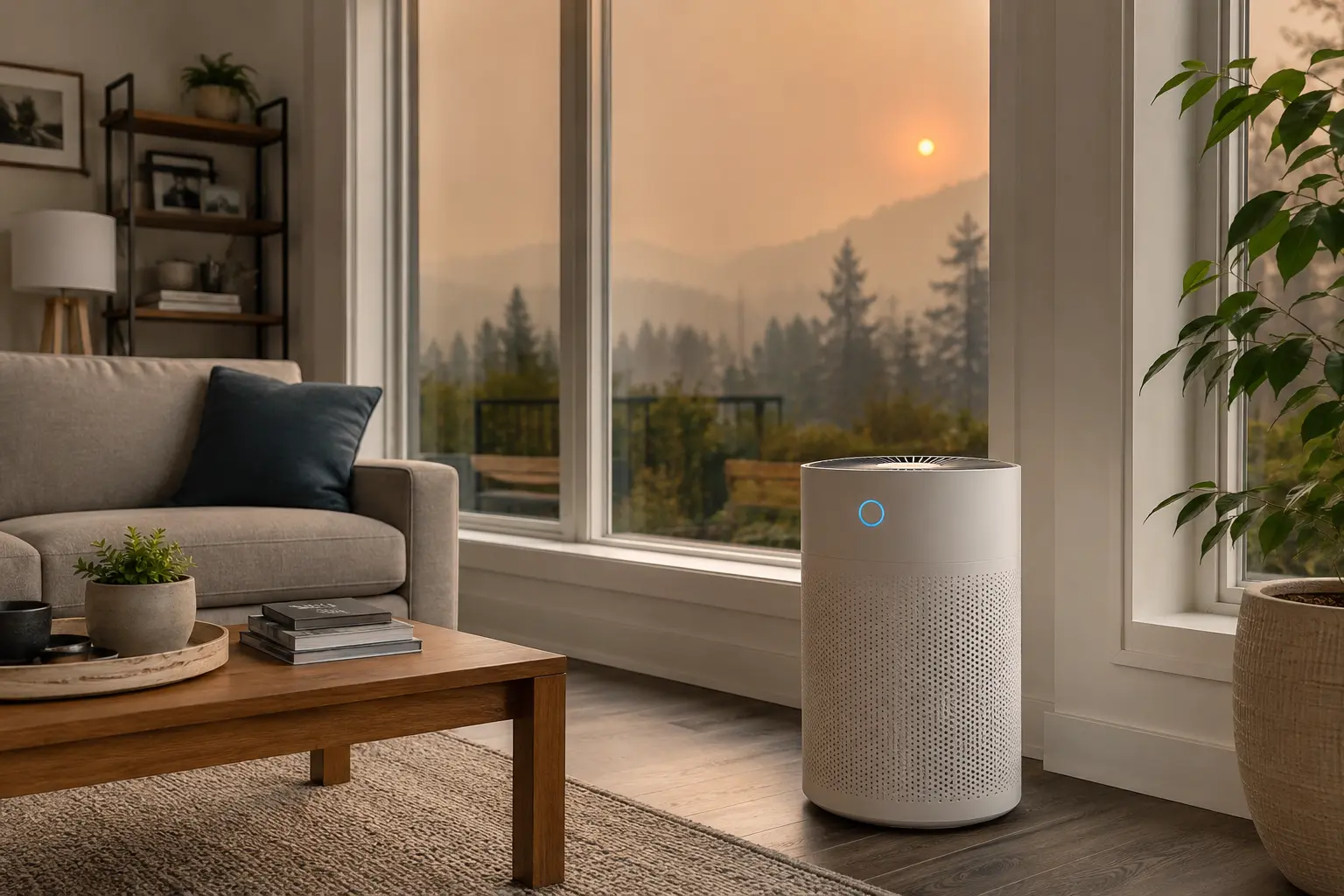
You don’t always notice wildfire smoke when it first reaches your home.
Sometimes there’s a smell.
Sometimes the sky simply looks strange.
And sometimes…
you close every window, walk into your bedroom, and still feel like something is wrong with the air.
That’s because wildfire smoke doesn’t necessarily stay outside.
Fine particles can enter your home through doors, windows, ventilation systems, and small gaps in the building.
And once they’re inside, simply closing the windows isn’t always enough.
That’s where finding the best air purifier for wildfire smoke becomes important.
But here’s something I learned while researching air purification:
Buying the biggest air purifier isn’t automatically the smartest solution.
Room size matters.
Filter technology matters.
Airflow matters.
And perhaps most importantly, you need to know what the purifier is actually designed to remove.
So let’s simplify it.
What Makes Wildfire Smoke Different?
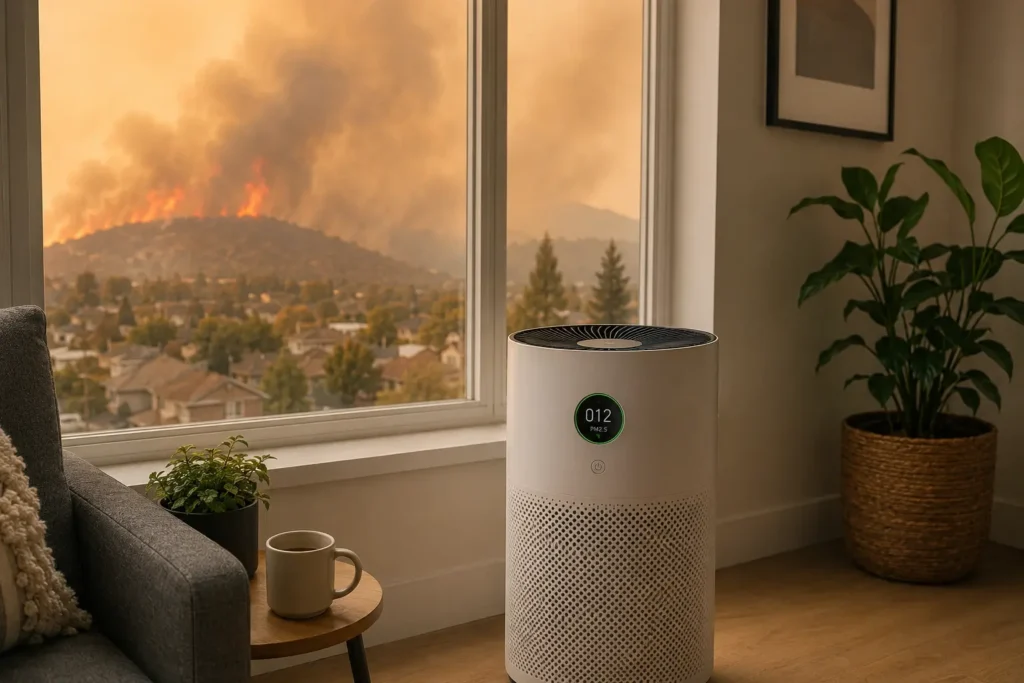
Wildfire smoke isn’t just an unpleasant smell.
It contains a mixture of gases and extremely small particles, including fine particulate matter such as PM2.5.
These particles are small enough to remain suspended in indoor air and can penetrate deep into the respiratory system.
That’s why wildfire smoke can remain a problem even after you escape the visible smoke outside.
The EPA recommends using portable air cleaners to reduce indoor particle levels during wildfire smoke events.
But there’s an important detail:
The purifier needs to be correctly sized for the room.
A tiny purifier working in a large living room may simply not move enough air to make a meaningful difference.
So, What Is the Best Air Purifier for Wildfire Smoke?
If I had to reduce the answer to one sentence:
Look for a properly sized mechanical air purifier with a high-efficiency filter, strong smoke CADR, and little or no ozone production.
That’s the combination I’d prioritize.
The EPA specifically recommends portable air cleaners with a smoke CADR appropriate for the room and advises choosing models that produce little or no ozone.
And this is where things get interesting.
Because the word HEPA alone doesn’t tell you everything.
HEPA Is Important — But Airflow Matters Too
A high-efficiency filter can capture very small airborne particles.
That’s obviously important when you’re dealing with wildfire smoke.
But imagine putting an excellent filter inside a machine that barely moves air.
You wouldn’t get the same result as a purifier that combines good filtration with strong airflow.
That’s why I wouldn’t choose an air purifier based only on:
“Does it have a HEPA filter?”
I’d also ask:
How much clean air can it actually deliver to my room?
The EPA recommends choosing a portable air cleaner with a smoke CADR of at least two-thirds of the room’s area in square feet.
For example, if your room is 300 square feet, you’re looking for a smoke CADR of roughly 200 CFM or higher.
That’s a much more useful starting point than simply choosing the purifier with the most impressive-looking filter.
Don’t Forget About Ozone
This is one of the details I would never ignore.
Some air-cleaning technologies can produce ozone.
And ozone isn’t something you want to intentionally add to your indoor environment.
For wildfire smoke, the EPA recommends mechanical filtration and advises against technologies that may produce ozone, including certain electronic air cleaners and some other air-cleaning technologies.
So when you’re comparing the best air purifier for wildfire smoke, don’t just ask:
“Does it remove smoke?”
Also ask:
“What does this machine put back into my air?”
That question can completely change your shortlist.
How Big Should Your Air Purifier Be?
This is where many people make a mistake.
They buy according to the size of the purifier instead of the size of the room.
A compact bedroom needs a very different amount of airflow than a large open-plan living room.
And if you have a larger home, one small purifier probably isn’t going to clean the entire house effectively.
The EPA notes that portable air cleaners are generally intended for individual rooms. Multiple properly placed units can sometimes be more practical than trying to rely on one device for the entire home.
So think room by room.
Where do you spend most of your time?
That’s where I’d start.
Should You Run an Air Purifier During a Wildfire?
Yes — but there’s more to it than simply pressing the power button.
During a smoke event, the EPA recommends running a portable air cleaner as much as possible, particularly at a higher fan speed when conditions are smoky.
I’d also keep the purifier in the room where you spend the most time.
And don’t push it into a corner.
Give the unit enough space for air to circulate freely around it.
A purifier can’t clean air effectively if its intake or outlet is blocked by furniture.
What About Windows?
This part is surprisingly important.
If wildfire smoke is affecting outdoor air quality, opening your windows can allow more smoke particles into your home.
The EPA recommends keeping doors and windows closed during high outdoor pollution events when it is safe and practical to do so.
If you have central HVAC, using a high-efficiency filter can also help.
The EPA recommends MERV 13 or higher, or the highest-efficiency filter your HVAC system can safely accommodate.
So the strategy isn’t necessarily:
Air purifier OR HVAC.
Sometimes the better answer is:
Air purifier + HVAC filtration + keeping smoke outside.
Create a “Cleaner Air Room”
This is one of my favorite practical ideas.
Instead of trying to make every room perfect, choose one room where you can maintain cleaner indoor air.
A bedroom can be a good option.
Keep the windows and doors closed when outdoor smoke is high, avoid activities that create additional particles, and run an appropriately sized air purifier in that room.
It gives you somewhere to retreat when outdoor conditions become particularly unpleasant.
What Should You Avoid During Wildfire Smoke?
This is the part people sometimes forget.
You can have a great purifier…
and then accidentally create more indoor pollution.
During smoky conditions, avoid activities such as:
- Burning candles or incense
- Smoking or vaping
- Using fireplaces
- Spraying aerosols
- Heavy frying or broiling
- Vacuuming without a HEPA-equipped vacuum
These activities can increase indoor particle levels.
Your purifier shouldn’t have to fight against a new pollution source every few minutes.
How Often Should You Change the Filter?
Don’t blindly follow the calendar.
During heavy wildfire smoke, filters can become dirty much faster than under normal conditions.
The EPA recommends checking filters frequently and replacing them when they become dirty; during heavy smoke periods, replacement may be needed more often than the manufacturer’s usual schedule.
That’s one of those boring maintenance details that can make a surprisingly big difference.
Final Thoughts
The best air purifier for wildfire smoke isn’t necessarily the most expensive one.
It isn’t necessarily the largest one.
And it definitely isn’t simply the one with the longest list of features.
I’d look for four things:
Good particle filtration.
Enough airflow for your room.
Low or no ozone production.
A filter you can realistically maintain and replace.
And remember something even more important:
An air purifier is only one part of wildfire-smoke protection.
Keeping smoke from entering your home, using appropriate HVAC filtration, reducing indoor pollution sources, and creating a cleaner-air room can all work together.
Because when the air outside turns smoky…
the goal isn’t to make your home smell better.
The goal is to make the air inside genuinely cleaner.
Want to Improve Your Indoor Air Even Further?
Choosing the right air purifier is only the first step toward creating a cleaner and more comfortable home.
If you’re still wondering which purifier is right for your specific situation, we’ve prepared a few more practical guides to help you make the right choice without wasting money on features you don’t actually need.
🏠 Have a Small Room or Dorm?
If you’re living in a dorm, bedroom, or other compact space, the best purifier for you may be very different from the models designed for wildfire smoke.
👉 Discover the Best Air Purifiers for Dorm Rooms and see which compact, quiet models are worth considering for studying, sleeping, and everyday use.
🌲 Worried About Wildfire Smoke?
If wildfire smoke is a recurring concern where you live, choosing a purifier is only part of the solution. Room size, filtration, activated carbon, airflow, and proper placement all matter.
👉 Read our complete guide to Air Purifiers for Wildfire Smoke to understand what actually matters when smoke enters your area.
💧 Air Purifier or Humidifier?
Cleaner air isn’t always about removing particles. Sometimes the problem is dry indoor air, especially during certain seasons.
👉 Air Purifier vs. Humidifier: The Ultimate Guide to Better Air in 2026 explains the difference between the two devices and helps you decide which one makes sense for your home.
🌿 Your Next Step
You don’t need to buy the most expensive device or fill your home with smart gadgets.
You simply need to understand what your indoor air actually needs.
Start with the guide that matches your situation, compare your options, and choose the solution that makes the most sense for your space.
Cleaner air starts with making the right choice.
[…] our best air purifiers for wildfire smoke for more […]