
It’s 7:15 on a chilly Monday morning.
You’re standing in front of your furnace, holding a dusty air filter that looks like it has collected everything your house has been through lately.
Pet hair. Dust. Maybe even remnants of that home renovation from last month.
You check the label: MERV 8.
Then you remember seeing a MERV 13 filter online, advertised as a better choice for capturing smaller airborne particles.
The price is higher. The promises sound impressive.
And suddenly, a simple filter replacement becomes another confusing home-maintenance decision.
Should you upgrade? Will it make the air cleaner? Could it affect your heating system?
That’s exactly why the MERV 8 vs MERV 13 comparison matters.
The difference isn’t just a number on the packaging. It’s about particle filtration, airflow, equipment compatibility, and what your household actually needs.
Before buying your next filter, let’s uncover seven differences that can help you make a confident decision.
Quick Answer: Is MERV 13 Better Than MERV 8?
MERV 13 captures a greater proportion of smaller airborne particles than MERV 8 under standardized testing. It is particularly useful for fine particles associated with smoke, provided your HVAC system can accommodate it.
MERV 8 offers practical filtration of many larger household particles and may be appropriate for systems designed around that rating.
The EPA recommends MERV 13 or the highest-efficiency HVAC filter your system can safely support.
The best filter is one that combines effective particle capture, proper fit, acceptable airflow resistance, and consistent maintenance.
What Does MERV Actually Mean?
MERV stands for Minimum Efficiency Reporting Value.
It’s a rating system developed through ASHRAE Standard 52.2 to describe how effectively air filters capture particles of different sizes.
The scale typically runs from 1 to 16 for conventional HVAC filters.
Higher ratings indicate greater minimum filtration efficiency for specified particle-size ranges.
But here’s an important distinction: MERV measures filter performance under defined testing conditions.
It doesn’t tell you whether your HVAC fan is powerful enough, whether the filter fits properly, or how much air circulates through your home.
That’s why choosing a filter based on its rating alone can be misleading.
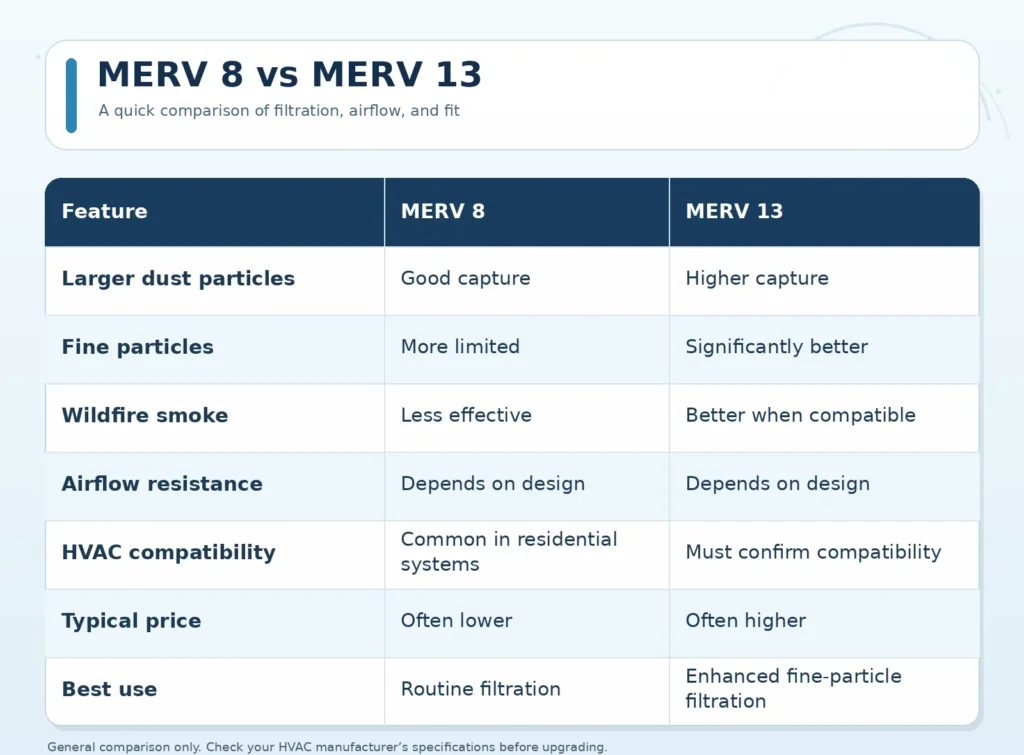
These comparisons describe general performance differences, not guarantees for every product.
Two filters with different MERV ratings can also have surprisingly different airflow resistance depending on their construction.
1. MERV 13 Captures More Fine Airborne Particles
Imagine sunlight entering your living room.
You can see some larger dust particles floating around, but many airborne particles are far too small to notice.
That’s where filtration efficiency becomes important.
According to ASHRAE’s MERV classification, MERV 8 filters capture at least 70% of particles in the 3–10 micron range under the relevant standardized test criteria.
MERV 13 filters meet higher minimum efficiencies, including at least 50% capture in the challenging 0.3–1 micron range.
These numbers refer to particles passing through the filter during testing—not a guaranteed percentage reduction in your home’s overall airborne pollution.
The takeaway: MERV 13 provides a meaningful advantage for smaller particles, but actual indoor-air results also depend on system airflow and operating time.
2. MERV 8 Can Still Be Useful for Everyday Household Dust
It’s easy to assume that a lower-rated filter is practically useless.
That’s not true.
A properly fitted MERV 8 filter can capture many larger particles circulating through your HVAC system, including some household dust, pollen, and lint.
For homes without a particular fine-particle concern, MERV 8 may be a practical option—especially when recommended by the equipment manufacturer.
However, it cannot stop dust from being produced.
Pet hair, textiles, carpets, outdoor dirt, and everyday activities continually introduce new material into your home.
Regular vacuuming and appropriate cleaning remain important.
The better question isn’t whether MERV 8 removes every speck of dust.
It’s whether its filtration level meets your needs and equipment requirements.
3. MERV 13 Is a Stronger Option for Wildfire Smoke
You wake up one summer morning and notice the sky looks unusually hazy.
Checking the local air quality report reveals wildfire smoke in your area.
Now the filter sitting inside your HVAC system suddenly matters a lot more.
Wildfire smoke contains fine particles that can enter buildings and remain suspended in indoor air.
The EPA’s wildfire filtration guidance recommends MERV 13 or higher-efficiency filtration when the HVAC system can accommodate it.
MERV 8 generally captures these smaller particles less efficiently.
During smoke events, reducing outdoor smoke entry and following local public health guidance are also essential.
A properly sized portable air cleaner may offer additional room-level filtration.
Explore our best air purifiers for wildfire smoke for more options.
4. Higher MERV Doesn’t Always Mean Worse Airflow
Here’s one of the biggest misunderstandings about furnace filters.
People often assume that every MERV 13 filter restricts airflow more than every MERV 8 filter.
In reality, filter resistance also depends on pleat design, filter thickness, surface area, materials, and how much dust has accumulated.
An efficiently designed MERV 13 product may have a lower pressure drop than a poorly designed lower-rated filter at the same airflow.
Pressure drop describes the resistance air encounters as it passes through the filter.
If that resistance is too high for your HVAC system, airflow may suffer.
This is why the filter’s specifications matter as much as its MERV rating.
Before upgrading, compare manufacturer pressure-drop data at relevant airflow conditions or consult an HVAC technician.
5. HVAC Compatibility Matters More Than the Packaging
Picture installing an expensive MERV 13 filter and noticing that airflow from your vents seems weaker afterward.
That isn’t the result you wanted.
Some HVAC systems can handle higher-efficiency filters comfortably. Others may require evaluation or equipment adjustments.
Start with your furnace or air-handler manual.
Check the allowed filter specifications, dimensions, and airflow requirements.
If the information is unclear, ask a qualified HVAC professional.
Don’t bend a filter to fit the slot, and don’t leave gaps around its edges.
Air that bypasses the filter isn’t receiving the intended filtration.
Remember: A correctly installed, compatible filter is more valuable than a higher-rated filter that interferes with system operation.
6. MERV 8 vs MERV 13: Which Costs More?
At the store, a MERV 13 filter often costs more than a basic MERV 8 alternative.
But purchase price tells only part of the story.
Replacement frequency, filter construction, system operation, and airflow resistance influence long-term costs.
If your household experiences heavy dust, has pets, or runs the HVAC fan frequently, you may need to inspect filters more often.
A low-cost filter that requires frequent replacement isn’t automatically the most economical option.
Likewise, an expensive filter isn’t necessarily the best investment for every system.
Compare the price of compatible filters in your exact size, and consider the maintenance schedule.
Don’t pay extra for a filtration level your equipment cannot safely use.
7. Filtration Only Works When Air Passes Through the Filter
There’s one detail homeowners sometimes overlook.
Your furnace filter isn’t continuously cleaning every room.
It captures particles only when air moves through the HVAC system.
When the fan stops, so does active filtration through that filter.
You may be able to increase air circulation using the fan setting, but longer operating times can increase electricity consumption and affect humidity management.
And even with a high-quality filter, room layout and airflow patterns influence how much air reaches the equipment.
For targeted filtration in a bedroom or living room, consider whether a portable device would complement your central system.
Our complete home air purifier guide explains room sizing and filtration options.
Two HVAC Filters Worth Comparing on Amazon
If you’re considering a replacement, here are two examples representing different filtration levels.
These are manufacturer-documented products, not filters independently tested by SmartLiving369.
Filtrete MPR 700 — MERV 8 Air Filter
The Filtrete MPR 700 is a pleated residential HVAC filter rated MERV 8.
It’s designed to capture particles including dust, pollen, and pet dander passing through a compatible system.
It may be worth comparing if your HVAC manufacturer recommends MERV 8.
Best for: Routine household particle filtration in systems designed for this rating.
Filtrete MPR 700 — MERV 8 Air Filter
A four-pack designed to capture common household particles such as dust, pollen, and pet dander as air passes through a compatible HVAC system.
Check your HVAC system’s manual and confirm the filter dimensions before ordering. Amazon prices may change. As an Amazon Associate I earn from qualifying purchases.
Filtrete MPR 1900 — MERV 13 Air Filter
The Filtrete MPR 1900 carries a MERV 13 rating and is designed to capture a greater proportion of fine airborne particles.
Its manufacturer highlights fine-particle filtration and airflow-focused construction.
It’s worth investigating if you want enhanced filtration and your HVAC system supports the selected filter.
Best for: Homes seeking better fine-particle filtration, subject to HVAC compatibility.
Filtrete 413 Replacement Air Filter — MERV 13
A higher-efficiency filter designed for compatible Aprilaire 413 systems. Check your HVAC system’s requirements before choosing this filter.
Confirm that your HVAC system accepts this filter style before ordering. Amazon prices may change. As an Amazon Associate I earn from qualifying purchases.
How Often Should You Replace Your HVAC Filter?
There’s no replacement interval that applies to every home.
The correct schedule depends on filter thickness, manufacturer instructions, HVAC runtime, household conditions, and accumulated dust.
For example, Filtrete recommends replacing many of its one-inch pleated filters approximately every 90 days or sooner when conditions require it.
Deeper filters may have different service intervals.
Inspect the filter regularly and follow the equipment manufacturer’s directions.
If airflow changes or the system behaves unusually, have it checked rather than assuming a filter upgrade is harmless.
A calendar reminder can make this maintenance task much easier.
Which Should You Choose? Three Realistic Situations
Scenario 1: An older HVAC system
Your equipment manual specifies MERV 8, and you’re unsure whether a higher rating is supported.
Stay with the approved specifications until you’ve confirmed that an upgrade is suitable.
Scenario 2: A compatible modern system
Your HVAC documentation permits MERV 13, and you’re interested in reducing fine airborne particles.
A properly fitted MERV 13 filter may be the more useful option.
Scenario 3: A home affected by wildfire smoke
You want stronger fine-particle filtration, but your system has airflow limitations.
Use the highest compatible HVAC filter and consider properly sized portable filtration alongside measures that reduce smoke entry.
In every situation, the equipment’s actual requirements determine the safest choice.
Frequently Asked Questions About MERV 8 vs MERV 13
Is MERV 13 better than MERV 8?
MERV 13 provides greater filtration efficiency for smaller airborne particles. However, MERV 8 may be appropriate when specified by your HVAC manufacturer. Compatibility, airflow, and maintenance should guide the decision.
Can I replace MERV 8 with MERV 13?
Possibly. Check your HVAC manufacturer’s specifications or ask a qualified technician. Don’t assume every system can accommodate the higher rating without evaluation.
Does MERV 13 remove wildfire smoke?
MERV 13 filters can capture many fine smoke particles that pass through them. They do not remove all smoke-related pollutants, and they cannot prevent polluted outdoor air from entering a home.
Does MERV 13 remove odors?
Not necessarily. MERV ratings measure particle filtration, not the removal of gases or odors. Odor problems may require source control or specialized filtration.
Is MERV 13 the same as HEPA?
No. HEPA and MERV use different performance standards. A MERV 13 furnace filter is not equivalent to a HEPA filter.
Is MERV 13 worth the extra money?
It may be worthwhile when smaller-particle filtration is important and the system supports it. Compare filter costs, pressure drop, replacement requirements, and your home’s actual needs.
Final Thoughts: The Best Filter Isn’t Always the Highest Number
Remember that dusty furnace filter you were holding on Monday morning?
At first, choosing a replacement seemed like a simple question of buying the bigger number.
But now you know there’s more to it.
The MERV 8 vs MERV 13 decision depends on what you want to filter, what your HVAC system can handle, and whether you’ll maintain the filter properly.
MERV 8 can provide useful everyday filtration. MERV 13 offers stronger protection against many smaller airborne particles when compatible.
Start with your equipment manual, choose a properly fitting filter, and keep up with maintenance.
Because smarter home maintenance isn’t about buying the most impressive product.
It’s about choosing what genuinely works for your home.