
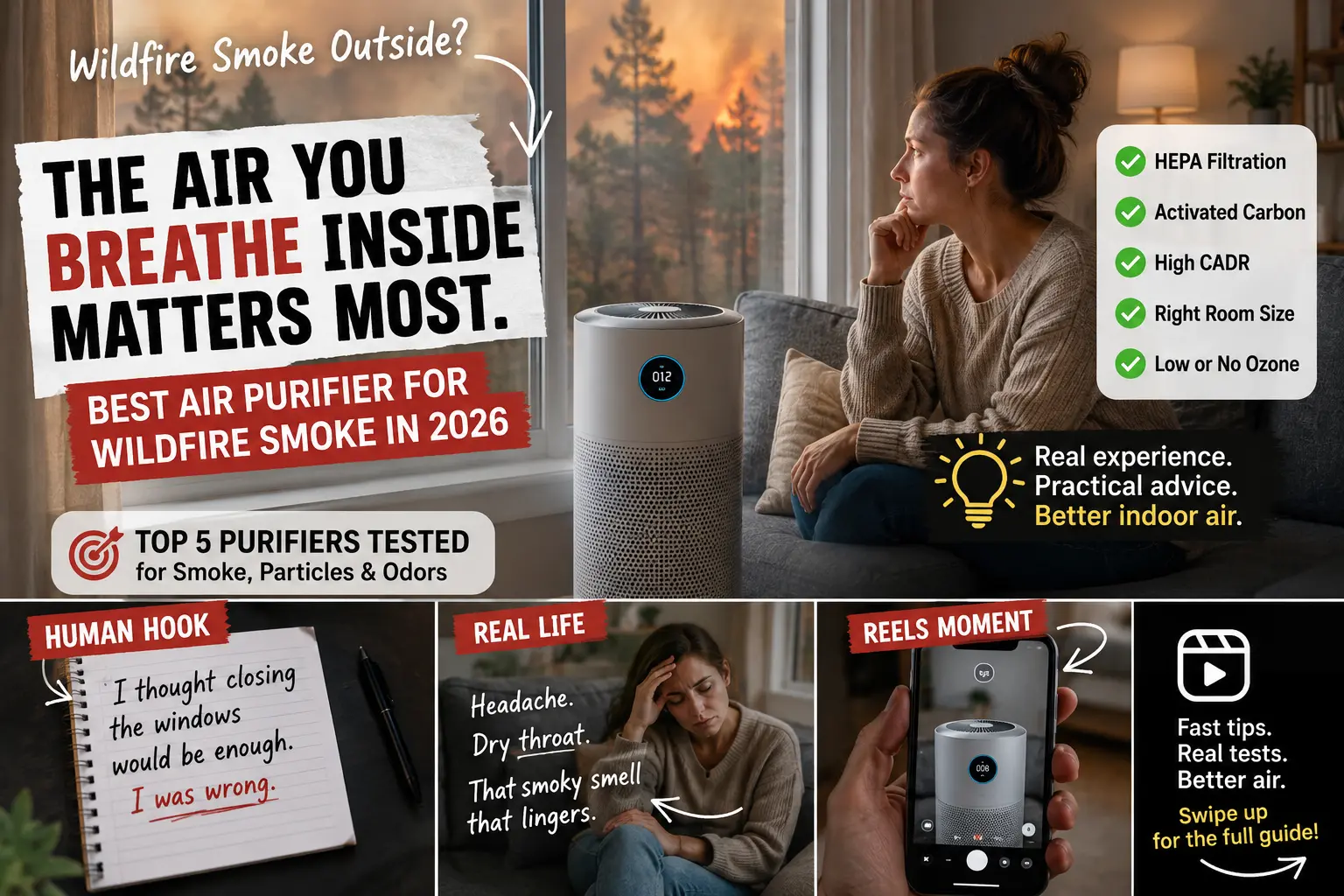
The first time wildfire smoke reached my neighborhood, I made the mistake of thinking that closing the windows would be enough.
I shut everything.
Windows closed.
Doors closed.
AC running.
I thought, “Okay. We’re safe from the smoke now.”
Then I noticed the smell.
It was still there.
That smoky, almost burnt smell that somehow finds its way into your home even when everything is closed.
And that’s when I started looking seriously at what an Air Purifier for Wildfire Smoke actually needs to do.
Because wildfire smoke isn’t just an unpleasant smell.
It contains extremely fine particles, including PM2.5, along with gases and other pollutants. The EPA recommends using a portable air cleaner during wildfire smoke events and choosing one that’s appropriately sized for the room and produces little or no ozone.
But here’s the part that surprised me:
Not every air purifier is equally good at dealing with wildfire smoke.
Some are excellent at dust.
Some are great for allergies.
And some simply aren’t designed to handle the combination of fine particles, smoke and odors that comes with a wildfire.
So I spent time comparing the features that actually matter.
And if you’re trying to choose an Air Purifier for Wildfire Smoke, here’s what I’d look for first.
What Makes an Air Purifier Good for Wildfire Smoke?
This is where things get interesting.
When I started researching smoke filtration, I realized that there are really two different problems to solve.
The first is particles.
The second is gases and odors.
A HEPA or high-efficiency mechanical filter is designed to capture airborne particles. That’s important because wildfire smoke contains very fine particulate matter.
But HEPA filtration isn’t the whole story.
Activated carbon matters too.
Carbon can help reduce certain gases and smoke-related odors that aren’t captured in the same way as particles. California’s Air Resources Board specifically notes that charcoal/carbon filters can help with some gases produced by fires.
That’s why my ideal setup looks something like this:
High particle filtration + strong airflow + meaningful carbon filtration + no unnecessary ozone generation.
And there’s one more thing people often overlook.
Room size.
A fantastic purifier that’s too small for your room can still disappoint.
My 5 Best Air Purifiers for Wildfire Smoke
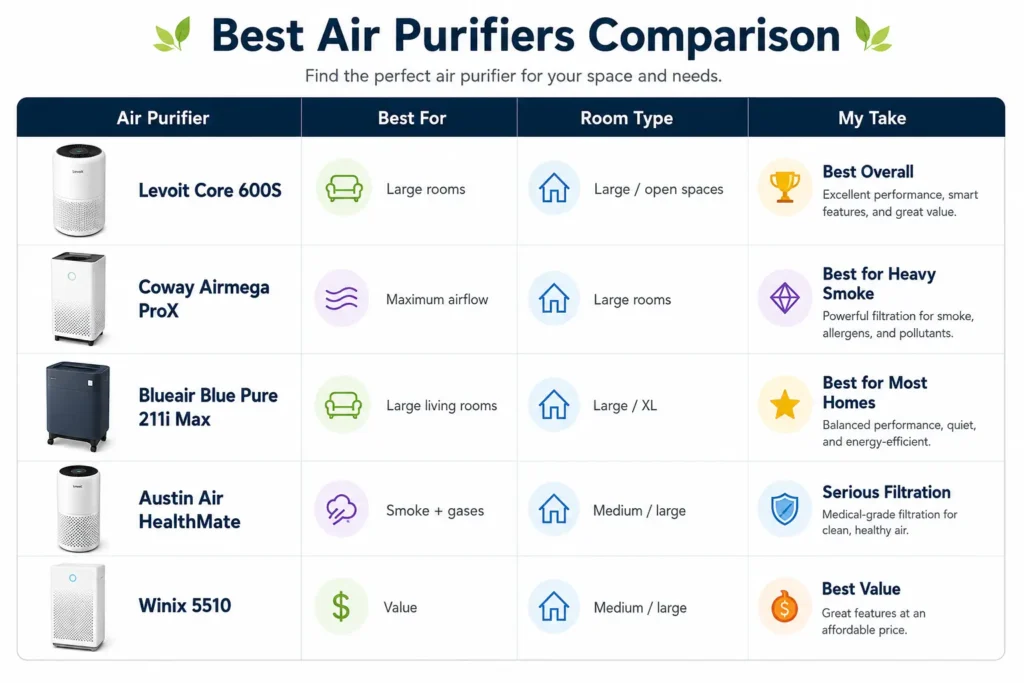
These aren’t simply five random popular purifiers.
For wildfire smoke, I’m looking for air-moving capacity, particle filtration and carbon filtration, rather than choosing a model because it has the biggest advertised coverage number.
Recent smoke-focused testing and buying guides also emphasize CADR, room sizing, HEPA filtration and activated carbon when evaluating purifiers for wildfire conditions. (Forbes)
And that brings us to my first pick.
Levoit Core 600S
If I wanted one purifier for a large living room during wildfire season, this is where I’d start.
The Core 600S makes sense because it combines strong airflow with smart controls and large-room capability.
I also like the fact that you can monitor air quality instead of simply turning the machine on and hoping for the best.
That’s useful during smoke events because indoor conditions can change surprisingly quickly.
My Take:
For most people who want a practical Air Purifier for Wildfire Smoke, this is the type of balance I’d look for: strong airflow, good filtration and useful smart controls without going straight into the most expensive category.
And if your room is particularly large, there’s another model worth considering.
Levoit Core 600S-P
- ✅ 3-Stage Filtration for Fine Particles & Smoke
- ✅ High-Efficiency Activated Carbon Filter
- ✅ PM2.5 Air Quality Monitoring
- ✅ Auto Mode + Smart App Control
If you’re dealing with wildfire smoke, dust, pet dander, or a large living space, the Levoit Core 600S-P is one of the models I’d seriously consider. Its combination of strong airflow, particle filtration, activated carbon, and real-time air quality monitoring makes it a practical choice when you want more than just a basic air purifier.
Coway Airmega ProX 💨 — Best for Heavy Smoke
The ProX is the kind of purifier I’d consider when the room is large and smoke is a serious concern.
Why?
Because during wildfire events, airflow matters enormously.
You don’t just want a filter sitting quietly in the corner.
You want the machine to move a lot of air through that filter.
Consumer Reports testing highlighted the Airmega ProX among its top-performing options for smoky air, particularly for extra-large spaces. (Quartz)
My Take:
If you have a big open living area and regularly deal with wildfire smoke, this is one of the models I’d put on the shortlist.
But if you’re looking for something slightly more affordable and easier to live with every day, I’d look at Blueair next.
Blueair Blue Pure 211i Max
This is one of those purifiers that makes sense even when there isn’t a wildfire outside.
It’s powerful enough for large rooms, has strong airflow and is relatively straightforward to operate.
That’s important to me because I don’t want a device that only gets used when the air quality becomes terrible.
I want something I can run regularly.
My Take:
For a large living room, open floor plan or family space, the 211i Max is an excellent option.
And if you want something more focused on deep filtration, there’s another direction I’d consider.
Blueair Blue Pure 211i Max
- ✅ Powerful HEPASilent Filtration
- ✅ Perfect for Large & Open Rooms
- ✅ Quiet Operation
- ✅ Smart App & Wi-Fi
If you need a powerful air purifier for a large living room or open space, the Blueair Blue Pure 211i Max is an excellent choice. It combines strong HEPASilent filtration, impressive airflow, quiet operation, and smart controls through the Blueair app. It’s especially well suited for large homes, open floor plans, pets, allergies, smoke, and dust.
Austin Air HealthMate 🛡️
The Austin Air HealthMate is different from the typical smart purifier.
It’s less about flashy features and more about filtration.
That’s exactly why it gets interesting for wildfire smoke.
The HealthMate combines HEPA filtration with a substantial carbon-based filtration system, making it particularly interesting for people concerned about both particles and gases.
My Take:
If your priority is filtration rather than apps, screens and smart-home features, I’d seriously consider this one.
It’s also the type of purifier I’d look at when wildfire smoke isn’t the only air-quality problem you’re dealing with.
But not everyone wants to spend that much.
That’s where my value pick comes in.
Austin Air HealthMate Plus
- ✅ Medical-Grade HEPA Filtration
- ✅ Large Carbon & Mineral Filtration System
- ✅ 360° Air Intake
- ✅ Designed for Smoke, VOCs, Dust & Pollutants
This is not the purifier I’d recommend if you’re simply looking for something inexpensive for a bedroom. The HealthMate Plus is a serious filtration machine built for people who want more than basic particle removal. Its combination of medical-grade HEPA and a large carbon filtration system makes it particularly interesting for smoke, VOCs, odors, dust, and heavily contaminated indoor air.
Winix 5510 💰
The Winix 5510 is interesting because it gives you a lot of useful filtration features without jumping into premium pricing.
It’s particularly appealing for bedrooms, offices and medium-to-large rooms.
One important note, though:
Some Winix models use an ionization feature.
During wildfire smoke events, I’d personally prefer to keep unnecessary ionization features turned off unless there’s a specific reason to use them. Bay Area Air Quality Management District guidance similarly recommends turning off ionizer functions on models that have them because of potential ozone/byproduct concerns. (Baaqmd)
WINIX 5510 Air Purifier
- ✅ True HEPA Filtration for fine particles
- ✅ Covers rooms up to 1,881 ft² in 1 hour
- ✅ High-Deodorization Carbon Filter for odors & smoke
- ✅ Captures pet allergens, dust, pollen & smoke
- ✅ Auto Mode + App Support
The WINIX 5510 is one of the best-value air purifiers for medium and large rooms. It combines True HEPA filtration with a high-deodorization carbon filter to help capture dust, pollen, pet allergens, smoke, and unwanted odors. With coverage of up to 1,881 ft², Auto Mode, and app support, it offers a strong combination of performance and convenience without the higher price of premium models.
My Take:
If you’re looking for a more affordable way to prepare for wildfire season, this is a model worth considering.
So, What Should You Actually Buy?
Here’s how I’d simplify the decision.
Small or medium bedroom?
You probably don’t need a giant industrial-looking machine.
Large living room?
Prioritize airflow and CADR.
Very smoky conditions?
I’d put more emphasis on both particle filtration and activated carbon.
Sensitive to odors?
Carbon becomes even more interesting.
And if you’re dealing with a whole house?
That’s where things get more complicated.
One portable purifier doesn’t magically clean every room.
Don’t Make This Mistake During Wildfire Season
There’s something important I want to make clear.
An air purifier is not a substitute for keeping wildfire smoke out of your home.
When outdoor smoke levels are high, the EPA recommends keeping doors and windows closed and using recirculation where appropriate. It also recommends creating a cleaner-air room with a properly sized portable air cleaner.
So my routine would be:
Close the windows.
Keep the smoke outside.
Choose one room as your cleaner-air space.
Run the purifier continuously.
And when smoke levels become particularly bad, increase the fan speed.
Simple?
Yes.
But surprisingly effective.
How Long Should You Run an Air Purifier During Wildfire Smoke?
Honestly?
As long as the smoke event continues.
I wouldn’t treat a wildfire smoke event like a normal dusty day where you run the purifier for an hour and turn it off.
During prolonged smoke events, the goal is to continuously reduce the amount of airborne pollution entering and remaining in the room.
And don’t forget the filter.
Wildfire smoke can load filters faster than normal household dust.
So check the filter regularly and replace it when needed. The EPA specifically recommends replacing filters when they’re dirty, potentially more often than the manufacturer’s normal schedule during smoke events.
My Final Take
If you asked me, “What is the best Air Purifier for Wildfire Smoke?”, I wouldn’t give you one universal answer.
I’d ask:
How big is your room?
How severe is the smoke?
Do you care more about particles, odors or both?
And most importantly:
How much air can the purifier actually clean?
For most large homes, I’d start with the Levoit Core 600S or Blueair Blue Pure 211i Max.
For heavier smoke and larger spaces, the Coway Airmega ProX becomes very interesting.
And if filtration is your absolute priority and you don’t care about smart features, I’d take a serious look at the Austin Air HealthMate.
Wildfire smoke is one of those situations where buying the right purifier matters.
But using it correctly matters just as much.
And if you’re preparing before the next smoke event arrives, don’t wait until you can smell the smoke inside to start thinking about your indoor air.
Why Wildfire Smoke Is Different From Regular Dust
At first, I thought wildfire smoke was basically just another type of dust.
I was wrong.
Wildfire smoke is a much more complicated mix of fine particles, gases, and other pollutants. And the smallest particles are the ones that concern me most because they can stay suspended in indoor air for hours.
That changed the way I looked at air purifiers.
A purifier that works well for everyday dust isn’t automatically the best choice when air purifier wildfire performance is what you’re really looking for.
What Makes Wildfire Smoke So Difficult to Remove?
The biggest problem is PM2.5.
These are extremely small particles produced by combustion. Because they’re so tiny, they can travel deep into the respiratory system.
And here’s the frustrating part:
You might not even see them.
Your living room can look completely clean while outdoor smoke is slowly entering through windows, doors, ventilation systems, or small gaps around the house.
That’s why I don’t rely on my eyes when wildfire smoke is involved.
I look at three things instead:
- HEPA filtration for fine particles
- Activated carbon for smoke odors and certain gases
- Strong air circulation to clean the room efficiently
But there’s another detail many people overlook…
Don’t Just Look at the HEPA Label
This is where shopping for an air purifier wildfire solution gets interesting.
A purifier can have a HEPA filter and still perform very differently from another HEPA purifier.
Why?
Because filtration isn’t only about the filter itself.
The purifier also needs to move enough air through that filter to make a meaningful difference in the room.
For example, a small desktop purifier might be excellent beside your bed.
But put that same machine in a large open living room during a smoky day, and you may quickly realize that it’s simply not moving enough air.
Room size matters. A lot.
And that’s exactly why I prefer to choose the purifier based on the room first, rather than buying whatever model has the biggest marketing claims.
The Features I Look For During Wildfire Smoke
When I’m choosing an air purifier wildfire setup, I keep my checklist surprisingly simple.
1. True HEPA Filtration
This is the first thing I’d look for.
A good HEPA filter is designed to capture very small airborne particles, making it particularly relevant when smoke contains large amounts of fine particulate matter.
But I don’t stop there.
2. Activated Carbon
This is especially useful when your house starts smelling like a campfire.
HEPA filtration is primarily about particles. Activated carbon, on the other hand, can help reduce odors and certain gaseous pollutants.
And believe me, when wildfire smoke gets inside, odor becomes a problem very quickly.
That’s why I like having both technologies working together.
3. Enough CADR for Your Room
This is probably the least exciting specification on the product page.
It’s also one of the most important.
A purifier with stronger airflow can clean a room faster than a tiny unit that’s technically equipped with a good filter but moves very little air.
So before clicking “Buy,” I always ask myself:
How big is the room I’m actually trying to clean?
If the answer is “large living room,” I don’t want a purifier designed for a small bedroom.
What I Would Do Before the Smoke Gets Bad
Here’s something I learned the hard way:
Don’t wait until the house already smells like smoke.
When wildfire conditions are approaching, I prefer to prepare the room beforehand.
I close windows and doors, check that the HVAC system is operating properly, and move the air purifier into the room where we spend the most time.
Then I let it run.
If the purifier has an automatic mode or an air-quality sensor, even better.
That way, I don’t have to keep checking the air every few minutes.
And there’s one more thing I’d absolutely recommend…
Don’t forget the bedroom.
A lot of people put the biggest purifier in the living room because that’s where everyone gathers.
That makes sense.
But if smoke levels remain high overnight, having cleaner air where you sleep can be just as important.
That’s why my next comparison focuses on something many buyers completely overlook: how to choose between a powerful large-room purifier and a quieter bedroom model when wildfire smoke hits.
Large Room or Bedroom? The Right Purifier Depends on Where You Live
Here’s the mistake I see people make when shopping for an Air Purifier for Wildfire Smoke:
They find a model with excellent reviews, see a big number next to “coverage,” and assume it’s going to work perfectly everywhere.
I wouldn’t do that.
A purifier that’s fantastic in a bedroom can struggle in a large open-plan living room. And a powerful large-room machine might be completely unnecessary next to your bed.
So before choosing a model, I would start with the room, not the brand.
If You’re Cleaning a Bedroom
I’d prioritize:
- Quiet operation
- Appropriate room coverage
- Good particle filtration
- Easy filter replacement
- Low or no ozone generation
You want something you can leave running for hours without constantly noticing it.
And honestly, that’s where a quieter purifier can sometimes be a better choice than a much more powerful machine.
If You’re Cleaning a Large Living Room
This is different.
Here, airflow becomes much more important.
An open living room, kitchen and dining area can represent a surprisingly large volume of air.
That’s why I’d rather have a powerful purifier working in the main living space than several tiny units that barely move enough air.
And if wildfire smoke is particularly heavy, I’d consider running the purifier at a higher speed rather than relying entirely on automatic mode.
What About the Rest of the House?
This is where expectations need to be realistic.
One portable purifier isn’t going to instantly clean a 2,500-square-foot house.
If smoke is coming from outside, every room can potentially have different air quality.
That’s why the idea of a cleaner-air room is so useful.
Instead of trying to purify everything at once, choose one room where you can spend several hours comfortably.
Close the door.
Keep outdoor smoke out as much as possible.
Run the purifier continuously.
The EPA recommends this type of approach during wildfire smoke events, particularly when outdoor air quality is poor.
And suddenly, choosing the right purifier becomes much easier.
You’re not asking:
“What’s the best air purifier for my entire house?”
You’re asking:
“What’s the best purifier for the room where I need the cleanest air?”
That’s a much better question.
One More Thing: Don’t Ignore Your HVAC System
If your home has central heating or cooling, your HVAC system can also play a role during wildfire smoke.
When conditions allow, using the system’s recirculation mode can help avoid continuously bringing smoky outdoor air inside.
And if your system uses a replaceable filter, make sure it’s clean and appropriate for your system.
But there’s an important distinction:
Your HVAC filter and your portable air purifier aren’t necessarily doing the same job.
The HVAC system circulates air throughout the house.
A portable purifier can provide more concentrated filtration in the room you’re actually occupying.
For serious smoke events, I like thinking of them as two different layers rather than choosing one over the other.
How I Would Set Up a Room During a Wildfire
If I knew wildfire smoke was going to be bad that day, this would be my basic setup.
Step 1: Close the windows.
Simple, but important.
Step 2: Close exterior doors whenever possible.
Every opening can allow outdoor air to enter.
Step 3: Choose one cleaner-air room.
Ideally somewhere you can spend most of your day.
Step 4: Put the purifier where air can circulate freely.
I wouldn’t hide it behind a sofa or push it tightly against a wall.
Step 5: Turn it on before the room gets smoky.
If possible, don’t wait until the air already smells bad.
Step 6: Keep an eye on the filter.
Heavy smoke can mean more frequent filter replacement.
That last point is particularly important.
During a normal month, you might barely think about your filter.
During a prolonged wildfire event?
You should.
What I Wouldn’t Buy for Wildfire Smoke
This is probably just as important as what I would buy.
I wouldn’t choose a purifier simply because it has:
❌ A huge advertised square-footage number
❌ A flashy touchscreen
❌ An attractive design
❌ Thousands of reviews without checking the actual specifications
❌ An ionizer that I don’t need
❌ A tiny filter for a very large room
And I definitely wouldn’t assume that more expensive automatically means better.
A $200 purifier that’s correctly sized for your bedroom can be much more useful than an $800 purifier sitting in the wrong room.
That’s why I keep coming back to the same three questions:
How much air does it move?
What does it filter?
Is it appropriately sized for my room?
Those questions tell me much more than the marketing on the front of the box.
The Bottom Line
Wildfire smoke changed the way I think about air purifiers.
Before, I mostly looked at them as devices for dust, allergies and everyday indoor air.
Now, when I see the words Air Purifier for Wildfire Smoke, I’m looking for something more specific.
I want strong particle filtration.
I want enough airflow for the room.
I want activated carbon if smoke odors and gases are a concern.
And I want to avoid unnecessary ozone-producing features.
Most importantly, I want a purifier that I’ll actually run when it matters.
Because the best purifier isn’t necessarily the one with the longest list of features.
It’s the one that’s powerful enough for your room, appropriate for your needs, and ready to run before the smoke takes over.
And if I were buying one today?
I’d choose the Levoit Core 600S for most large living spaces, the Coway Airmega ProX when maximum airflow is the priority, and the Austin Air HealthMate when serious filtration matters more than smart features.
For smaller rooms, I’d rather choose a properly sized purifier than overspend on something designed for an entire house.
That’s the approach I’d take—and it’s also the approach I’d recommend to a friend preparing for the next wildfire smoke event.
Frequently Asked Questions
Does an air purifier really help with wildfire smoke?
Yes. A properly sized portable air cleaner can reduce indoor airborne particles from wildfire smoke. The EPA recommends portable air cleaners as one of the steps for reducing indoor smoke exposure.
What type of filter is best for wildfire smoke?
For an Air Purifier for Wildfire Smoke, I’d prioritize a high-efficiency mechanical/HEPA filter for fine particles and activated carbon for some gases and odors.
Can an air purifier remove the smell of wildfire smoke?
It can reduce smoke odors, especially when the purifier has a meaningful activated-carbon filter. However, no portable purifier should be expected to completely eliminate smoke odors from a home.
Should I run my air purifier all night during wildfire smoke?
If smoke is affecting outdoor air quality, continuous operation can make sense, particularly in the room you’ve designated as your cleaner-air space. Keep doors and windows closed as appropriate.
Is ozone safe during wildfire smoke?
I would avoid intentionally generating ozone indoors. For wildfire smoke, mechanical filtration is the safer direction. If a purifier has an ionizer or similar feature, check its certification and consider turning the feature off; California regulators specifically warn about ozone-emitting air cleaners.
Should I buy an Air Purifier for Wildfire Smoke before wildfire season?
Absolutely.
That’s actually the approach I’d recommend.
When smoke is already everywhere, that’s the worst time to discover that your purifier is too small for your room or that the replacement filter is out of stock.