
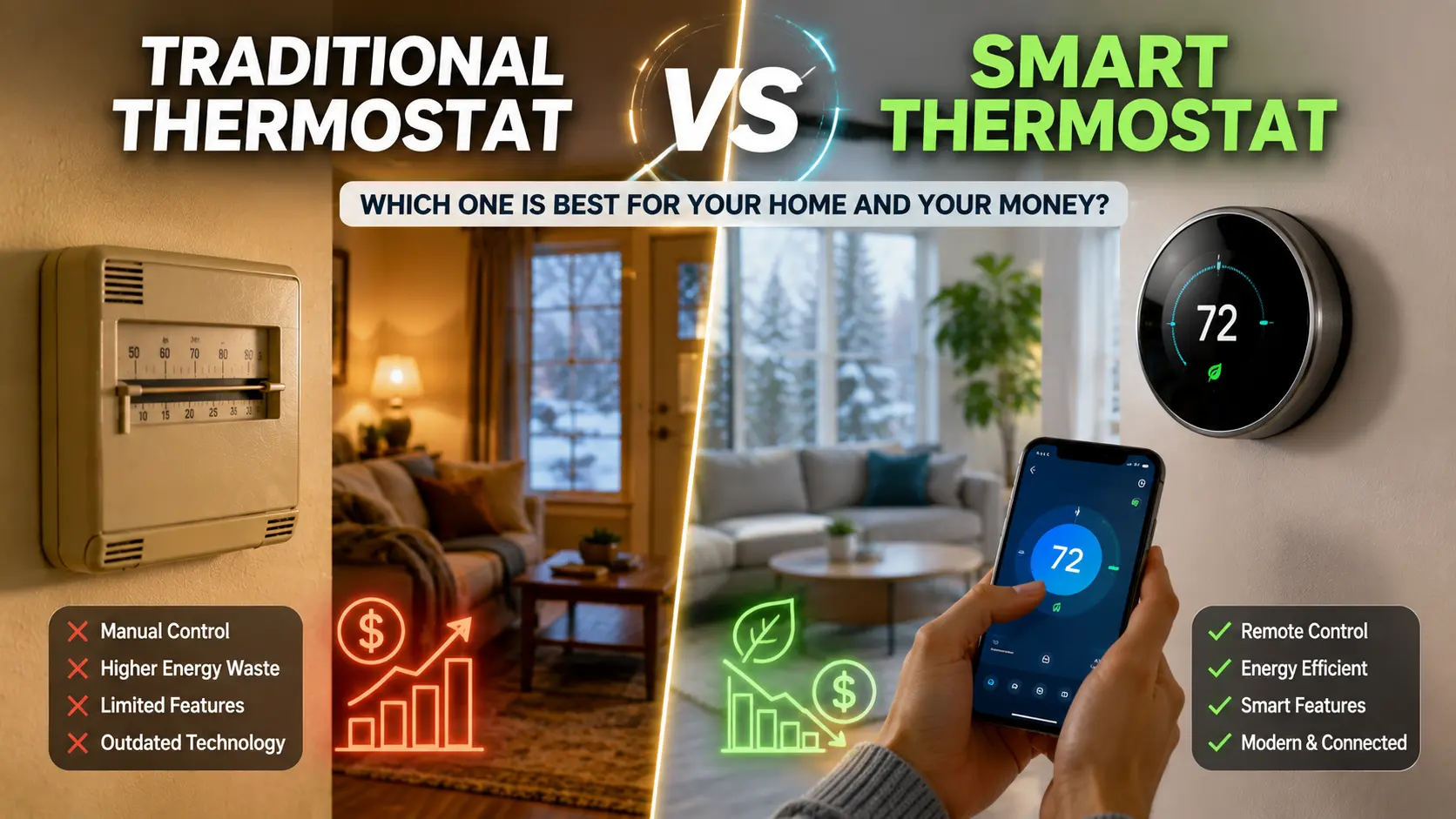
Your Thermostat Might Be Quietly Wasting Your Money
Imagine this: You leave your house on a cold winter morning, drive to work, and suddenly you remember… “Wait, did I turn down the heat?”
You check your phone. Nothing.
Your old thermostat is still heating an empty house like it is preparing for a family reunion.
Sounds familiar?
For decades, the Traditional Thermostat has been the silent controller of American homes. It does one main job: turning your heating and cooling system on and off. Simple, reliable, and affordable.
But today, our homes are changing. We have smart TVs, smart locks, smart speakers, and even smart refrigerators that can tell us when we need milk. So why are many homes still using a thermostat technology that belongs to another generation?
This is where the Smart Thermostat enters the picture.
A smart thermostat can learn your habits, adjust temperatures automatically, connect with your smartphone, and help reduce unnecessary energy consumption.
But does that mean every homeowner should replace their traditional thermostat immediately?
Not necessarily.
In this guide, I will compare Traditional Thermostat vs Smart Thermostat, explain the real differences, share practical advantages and disadvantages, and help you decide which option makes sense for your home and lifestyle.
👉 If you want to make your home more comfortable while potentially lowering energy waste, keep reading. By the end of this article, you’ll know exactly which thermostat fits your needs.
1. Traditional Thermostat vs Smart Thermostat: Quick Answer
A Traditional Thermostat is a basic temperature control device that requires manual adjustments. It is inexpensive, easy to install, and works well for homeowners who prefer simplicity.
A Smart Thermostat uses Wi-Fi connectivity, sensors, automation, and artificial intelligence to optimize your home’s temperature automatically. It offers remote control, energy reports, scheduling, and smart home integration.
For most modern homeowners, a smart thermostat provides more convenience and energy management features, while a traditional thermostat remains a budget-friendly solution.
2. What Is a Traditional Thermostat?
A traditional thermostat is the classic temperature control system that many American homes have used for decades.
You probably recognize the design:
- A small wall-mounted device
- A temperature dial or buttons
- A simple display
- Manual temperature adjustments
The concept is straightforward.
You set your desired temperature, and when your home becomes colder or warmer than that setting, your HVAC system turns on.
For example:
You set your thermostat to 72°F.
When the temperature drops below that level, your heater starts working.
When it reaches 72°F again, it stops.
Simple.
Reliable.
Almost impossible to confuse.
And honestly, there is something comforting about technology that does exactly what you expect.
However, traditional thermostats have limitations.
They cannot:
- Learn your daily routine
- Know when nobody is home
- Adjust automatically based on weather
- Send energy reports
- Be controlled remotely
Your traditional thermostat basically waits for instructions from you.
It does not think.
It does not adapt.
It does not care if you are wasting energy while you are on vacation.
3. What Is a Smart Thermostat?
A smart thermostat is like upgrading from an old flip phone to a smartphone.
The basic function remains the same — controlling your home’s temperature — but the possibilities are completely different.
A smart thermostat connects to your home’s Wi-Fi network and allows you to control your HVAC system through:
- Smartphone apps
- Voice assistants
- Smart home platforms
- Automated schedules
Modern smart thermostats can analyze your habits and adjust temperatures automatically.
For example:
You usually leave home at 8 AM.
A smart thermostat can learn this pattern and reduce heating or cooling when you are away.
You normally return at 6 PM.
It can prepare your home before you arrive.
So instead of constantly thinking about your thermostat, your thermostat starts thinking about you.
Pretty convenient, right?
4. Traditional Thermostat vs Smart Thermostat: Main Differences
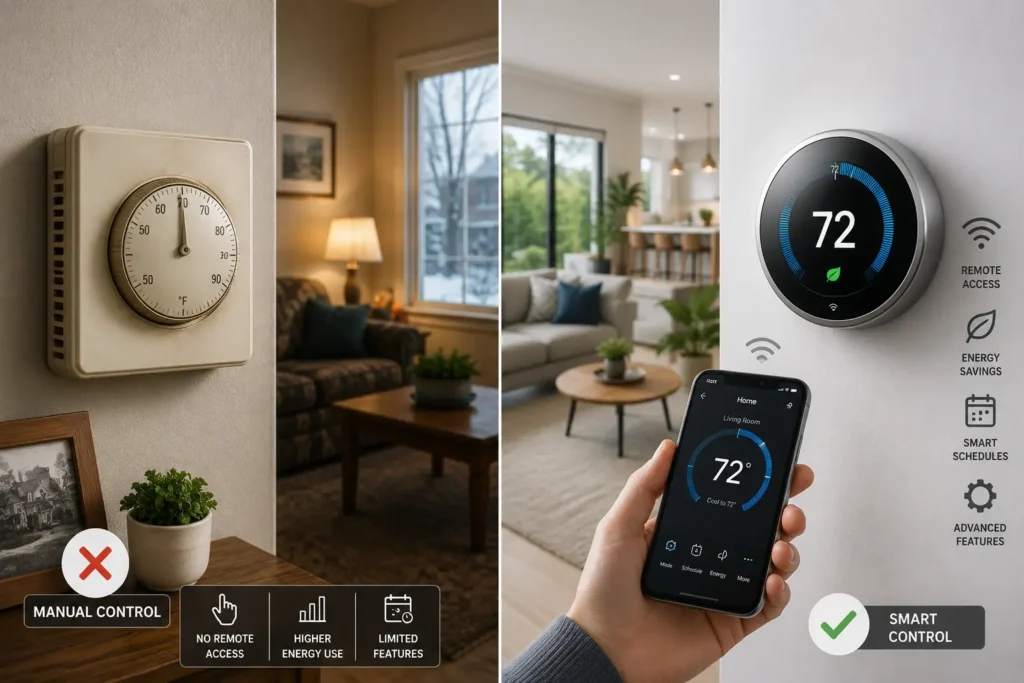
| Feature | Traditional Thermostat | Smart Thermostat |
|---|---|---|
| Temperature control | Manual | Automatic + Remote |
| Wi-Fi connection | No | Yes |
| Smartphone control | No | Yes |
| Learning ability | No | Yes |
| Energy reports | No | Yes |
| Installation cost | Lower | Higher |
| Ease of use | Very simple | Requires setup |
| Smart home integration | No | Yes |
| Long-term savings potential | Limited | Higher |
5. Energy Savings: Do Smart Thermostats Actually Reduce Bills?
This is the question every homeowner asks:
“Will a smart thermostat actually save me money, or is it just another expensive gadget?”
The answer: it depends on how you use it.
A smart thermostat cannot magically reduce your energy bill if your home has poor insulation or an inefficient HVAC system.
However, it can help prevent unnecessary heating and cooling.
According to ENERGY STAR, certified smart thermostats can help homeowners save energy by optimizing heating and cooling schedules.
Research from the U.S. Department of Energy also shows that adjusting your thermostat settings when you are asleep or away can significantly reduce heating and cooling costs.
Source:
https://www.energy.gov/
For many households, the biggest advantage is not the technology itself.
It is behavior.
A smart thermostat makes energy-saving habits automatic.
And automation is powerful.
Because let’s be honest:
Nobody wants to remember thermostat settings every single day.
6. How Much Can You Save?
Savings vary depending on:
- Your climate
- HVAC system
- Home insulation
- Energy prices
- Personal habits
Here is a realistic comparison:
| Situation | Traditional Thermostat | Smart Thermostat |
|---|---|---|
| Forgetting to adjust temperature | Common | Reduced |
| Empty house heating/cooling | Possible | Automatically managed |
| Energy monitoring | Not available | Available |
| Custom schedules | Manual | Automated |
| Monthly optimization | User responsibility | System assistance |
A smart thermostat is not a magic money machine.
But it is a useful assistant that helps you make better decisions.
Think of it like a personal energy coach living on your wall.
7. Real-Life Example: The Weekend Problem
Let me give you a simple example.
Imagine you leave for a weekend trip.
With a traditional thermostat:
You might leave your home temperature unchanged for two full days.
With a smart thermostat:
You can open your phone, change the temperature instantly, or allow the system to adjust automatically.
That small difference can add up over months and years.
8. Traditional Thermostat vs Smart Thermostat: Which One Matches Your Lifestyle?
Choosing between a Traditional Thermostat and a Smart Thermostat is not only about technology.
It is about your lifestyle.
Some homeowners love simple devices that work without updates, apps, or Wi-Fi connections.
Others want a home that automatically adjusts, learns their habits, and helps them manage energy.
The best choice depends on how you live.
Let’s compare both options from a practical homeowner perspective.
Detailed Comparison: Traditional Thermostat vs Smart Thermostat
| Category | Traditional Thermostat | Smart Thermostat |
|---|---|---|
| Initial purchase price | Usually cheaper | Higher upfront cost |
| Installation | Simple | May require compatibility check |
| Daily operation | Manual adjustments | Automatic adjustments |
| Remote access | Not available | Control from anywhere |
| Energy tracking | No reports | Detailed usage reports |
| Smart home compatibility | None | Works with Alexa, Google Home, Apple HomeKit (model dependent) |
| Maintenance | Very low | Requires occasional updates |
| Learning capability | None | Can learn routines |
| Convenience | Basic | Advanced |
| Long-term value | Good for simple needs | Better for connected homes |
9. The Biggest Advantages of a Smart Thermostat
Control Your Home From Anywhere
Have you ever left home and wondered:
“Did I turn off the heating?”
With a traditional thermostat, you have two choices:
- Drive back home
- Accept the mistake
Neither option is fun.
With a smart thermostat, you simply open your smartphone app.
Whether you are at work, traveling, or sitting at your favorite coffee shop, you can adjust your home’s temperature instantly.
This small feature creates a huge difference in everyday comfort.
Automatic Scheduling Saves Time
A traditional thermostat requires you to create your own schedule mentally.
Wake up?
Adjust temperature.
Leave for work?
Adjust temperature.
Come home?
Adjust temperature again.
After a while, most people stop doing it.
We are humans, not robots.
A smart thermostat can automatically manage these changes.
Example:
- 6:30 AM → Comfortable morning temperature
- 8:00 AM → Energy-saving mode when everyone leaves
- 5:30 PM → Warm welcome before you arrive
- 10:30 PM → Lower temperature for sleeping
Your home adapts without constant attention.
Better Energy Awareness
One underrated feature of smart thermostats is information.
Many models provide:
- Energy usage reports
- Monthly summaries
- Suggestions for improvement
- Temperature history
Why does this matter?
Because most homeowners do not know where their energy is going.
A smart thermostat helps answer:
“Why was my energy bill higher this month?”
Knowledge creates better decisions.
10. Pros & Cons: Traditional Thermostat
Pros of Traditional Thermostats
✅ Affordable
The biggest advantage is the price.
A basic thermostat costs significantly less than a smart model.
For homeowners on a tight budget, this matters.
✅ Extremely Simple
No apps.
No passwords.
No Wi-Fi setup.
No software updates.
You adjust the temperature and move on.
Sometimes simple technology is exactly what people need.
✅ Reliable
Traditional thermostats have fewer electronic components.
That means fewer things can fail.
For rental properties, vacation homes, or simple households, this can be a major benefit.
Cons of Traditional Thermostats
❌ No Remote Control
Forgot to adjust the temperature before leaving?
You cannot fix it from your phone.
❌ Limited Energy Management
A traditional thermostat cannot analyze your behavior.
It cannot tell whether your house is empty.
❌ More Human Responsibility
The system depends entirely on you.
And honestly, humans are not always great at remembering small daily tasks.
Pros & Cons: Smart Thermostat
✅ Maximum Convenience
The biggest advantage is comfort.
Your thermostat works quietly in the background.
You spend less time managing temperature settings.
✅ Potential Energy Savings
Smart thermostats can reduce unnecessary heating and cooling by optimizing schedules.
According to ENERGY STAR Smart Thermostat Information, certified models are designed to help consumers save energy through smarter temperature management.
✅ Smart Home Integration
A smart thermostat can become part of your connected home.
You can combine it with:
- Smart speakers
- Smart lights
- Security systems
- Home automation routines
Imagine saying:
“Alexa, I’m leaving home.”
And your thermostat automatically switches to energy-saving mode.
That is the type of convenience modern smart homes aim for.
❌ Higher Initial Cost
Smart technology costs more upfront.
However, many homeowners consider it an investment rather than an expense.
❌ Installation Compatibility
Not every HVAC system works with every smart thermostat.
Before buying, check:
- Wiring compatibility
- HVAC type
- Power requirements
Some homes may need professional installation.
❌ More Technology Involved
For some people, apps and settings feel overwhelming.
If you prefer a completely offline device, a traditional thermostat may be better.
11. Traditional Thermostat vs Smart Thermostat: Who Should Choose What?
| Homeowner Type | Best Choice |
|---|---|
| Budget-conscious homeowner | Traditional Thermostat |
| Technology lover | Smart Thermostat |
| Frequent traveler | Smart Thermostat |
| Rental property owner | Traditional Thermostat |
| Energy-conscious family | Smart Thermostat |
| Older homeowner wanting simplicity | Traditional Thermostat |
| Smart home enthusiast | Smart Thermostat |
12. My Personal Take: What Would I Choose?
If I lived in a modern home and planned to stay there for several years, I would choose a Smart Thermostat.
Why?
Because comfort is not only about temperature.
It is about reducing small daily decisions.
Every morning, we already make hundreds of choices:
- What to wear?
- What to eat?
- What emails need answers?
- What tasks are urgent?
Your thermostat should not be another thing demanding your attention.
However, if you live in a small apartment, rarely adjust your temperature, or simply want the cheapest solution, a traditional thermostat still makes perfect sense.
Smart technology is helpful, but it should solve a problem.
Not create another one.
13. Product Recommendations: Best Smart Thermostats for American Homes
If you decide to upgrade from a traditional thermostat to a smart thermostat, these are some of the most popular choices among homeowners.
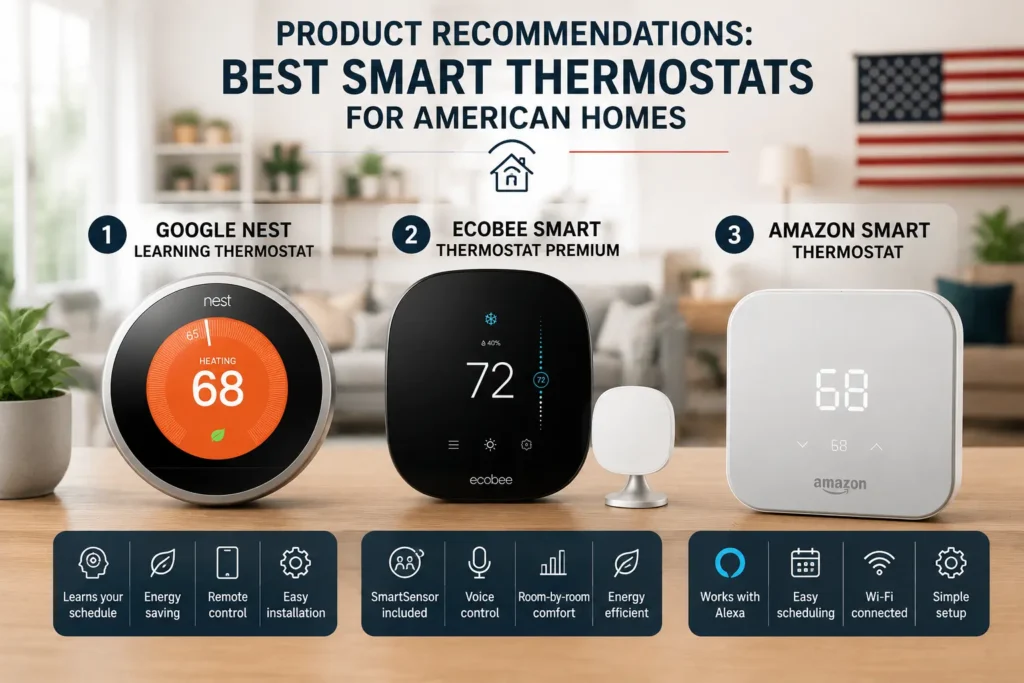
Google Nest Learning Thermostat
Best For: Homeowners who want automatic learning
The Nest Learning Thermostat is one of the most recognized smart thermostats in the United States.
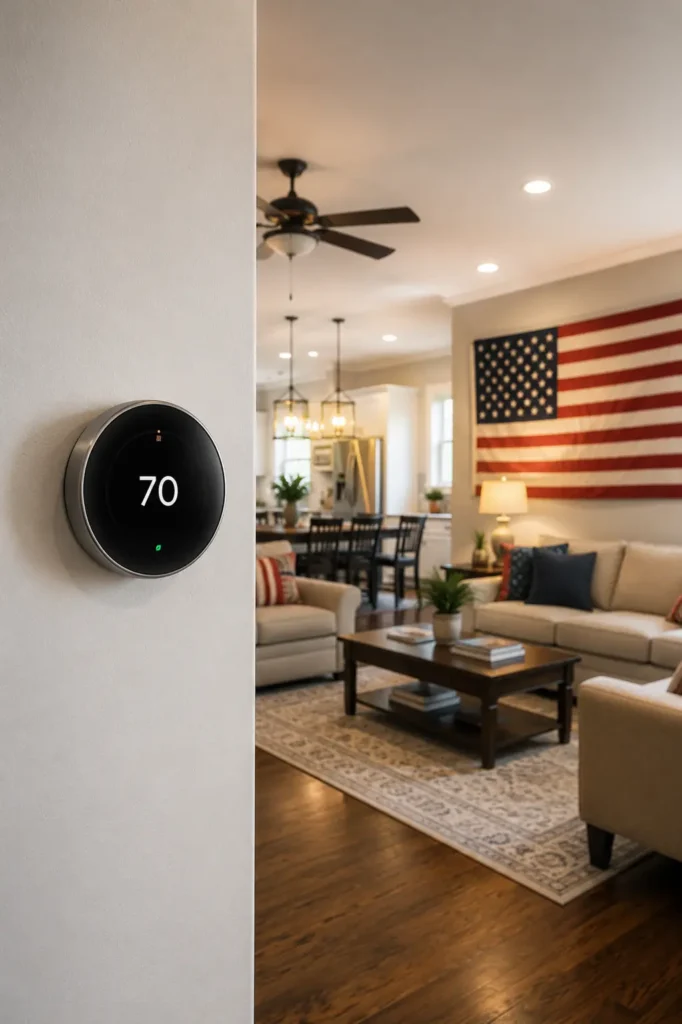
Key features:
- Learns your schedule
- Controls temperature remotely
- Provides energy reports
- Works with many smart home systems
Great choice for people who want a thermostat that becomes smarter over time.
Official information:
Google Nest Thermostat Official Website
ecobee Smart Thermostat Premium
Best For: Families needing room sensors
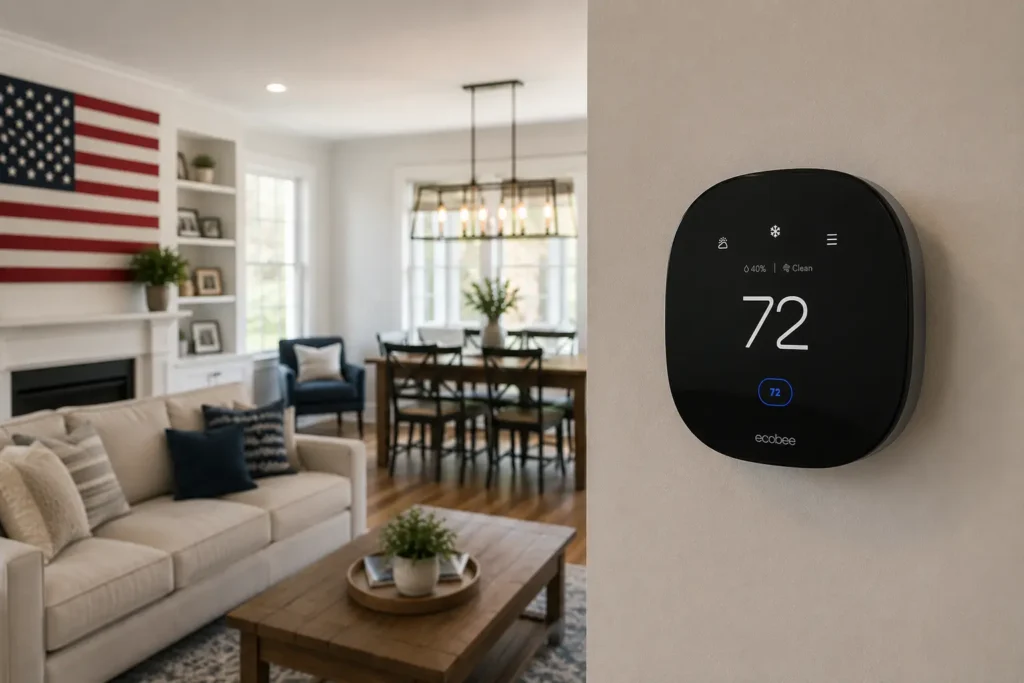
Ecobee focuses heavily on comfort and room-by-room temperature management.
Features include:
- Smart sensors
- Air quality monitoring
- Voice control
- Energy insights
This is a strong option for larger homes where different rooms have different comfort needs.
Official information:
ecobee Smart Thermostats
Amazon Smart Thermostat
Best For: Alexa users looking for affordability
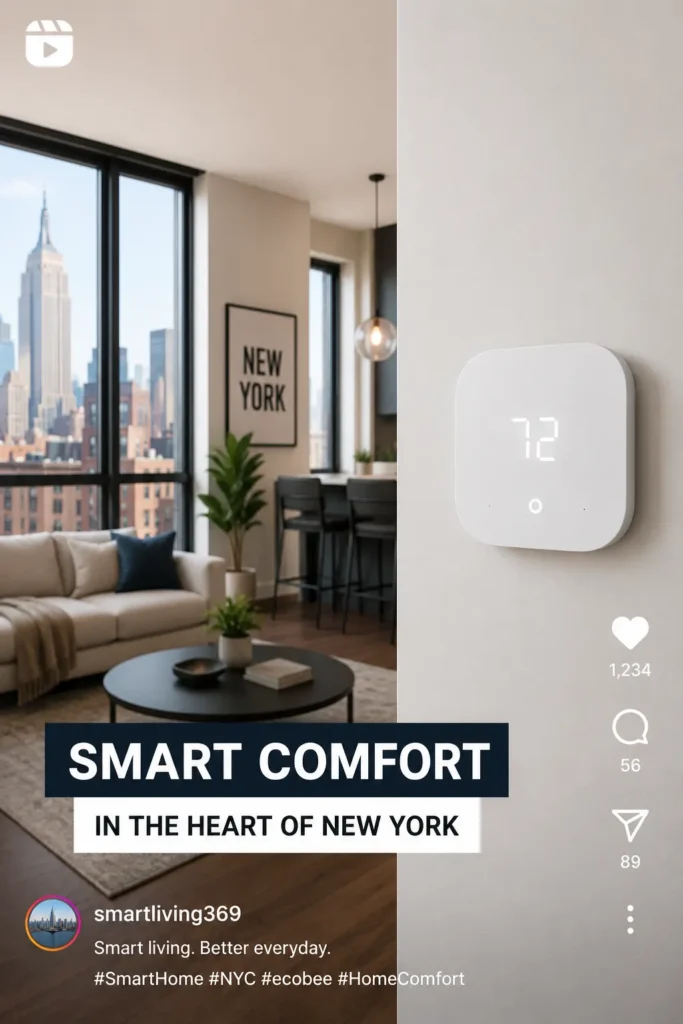
For homeowners already using Alexa devices, Amazon’s thermostat offers smart control at a more accessible price point.
Good option for beginners entering the smart home world.
Official information:
Amazon Smart Thermostat
14. Quick Product Comparison
| Product | Best Feature | Ideal User |
|---|---|---|
| Google Nest Learning Thermostat | Learning technology | Busy homeowners |
| ecobee Smart Thermostat Premium | Room sensors | Families |
| Amazon Smart Thermostat | Affordable smart control | Beginners |
Learn more about why modern homes are adopting smart temperature control in our guide:
👉 https://smartliving369.com/why-every-home-needs-a-smart-thermostat/
15. Frequently Asked Questions (FAQ)
Is a smart thermostat better than a traditional thermostat?
For many homeowners, yes.
A smart thermostat offers more convenience, automation, and energy management features compared to a traditional thermostat.
However, “better” depends on your needs.
If you want:
- Remote control
- Automatic schedules
- Energy reports
- Smart home integration
A smart thermostat is the better choice.
If you want:
- Low cost
- Simple operation
- Minimal technology
A traditional thermostat may be enough.
The best thermostat is the one that fits your lifestyle.
How much money can a smart thermostat save?
Savings depend on your home, climate, HVAC system, and habits.
A smart thermostat can help reduce energy waste by automatically adjusting temperatures when you are away or sleeping.
According to ENERGY STAR Smart Thermostat Savings Guide, certified smart thermostats can help households save energy by improving temperature management.
However, a smart thermostat is not a magic solution.
If your home has old windows, poor insulation, or an inefficient heating system, other improvements may have a bigger impact.
Can I install a smart thermostat myself?
Sometimes yes.
Many homeowners install smart thermostats themselves if their HVAC system is compatible.
However, professional installation may be better if:
- Your wiring is complicated
- You have a heat pump system
- Your HVAC setup is older
- You are unsure about electrical connections
Always check compatibility before purchasing.
Does a smart thermostat work without Wi-Fi?
Yes, but with limitations.
A smart thermostat can usually control your home’s temperature manually without internet access.
However, you may lose features like:
- Smartphone control
- Remote adjustments
- Weather-based optimization
- Cloud energy reports
The “smart” part works best when connected.
Do smart thermostats work with every HVAC system?
No.
Compatibility depends on your heating and cooling equipment.
Before buying, check:
- Number of wires
- HVAC type
- Voltage requirements
- Compatibility information from the manufacturer
A few minutes of research can prevent installation headaches.
Is upgrading from a traditional thermostat worth it?
For many homeowners, yes.
The biggest benefits are not just energy savings.
They are:
- Less daily effort
- More comfort
- Better control
- A more connected home experience
A thermostat may seem like a small device, but it controls one of the biggest energy systems in your house.
16. Traditional Thermostat vs Smart Thermostat: Final Verdict
After comparing both options, the answer becomes clear:
A Traditional Thermostat is still a reliable choice for homeowners who want simplicity and affordability.
It does the basic job:
Set temperature → HVAC responds.
Nothing complicated.
But a Smart Thermostat represents where modern homes are heading.
It transforms temperature control from a manual task into an automated experience.
Instead of constantly asking:
“Should I change the temperature?”
Your home starts answering:
“I already adjusted it for you.”
That difference may seem small, but small improvements create better daily experiences.
17. My Recommendation Based on Different Situations
| Your Situation | Recommended Choice |
|---|---|
| You want the cheapest option | Traditional Thermostat |
| You live in a small home and rarely adjust temperature | Traditional Thermostat |
| You travel frequently | Smart Thermostat |
| You want lower energy waste | Smart Thermostat |
| You already use smart home devices | Smart Thermostat |
| You want maximum comfort | Smart Thermostat |
18. Final Thoughts: Is Your Thermostat Ready for the Future?
Your thermostat is one of the most overlooked devices in your home.
People upgrade their phones every few years.
They buy smart TVs.
They install security cameras.
But many homes still rely on a thermostat that has barely changed in decades.
The truth is simple:
A Traditional Thermostat is dependable.
A Smart Thermostat is adaptable.
The right choice depends on what you value most.
If you love simplicity and want a low-cost solution, keep your traditional thermostat.
But if you want a more comfortable, efficient, and connected home, upgrading to a smart thermostat can be one of the easiest smart home improvements you make.
Your future self — and possibly your energy bill — may thank you.
Ready to Make Your Home Smarter?
At SmartLiving369, we believe a smarter home is not about adding technology everywhere.
It is about choosing technology that improves your everyday life.
A smart thermostat is a small upgrade that can create a noticeable difference in comfort, convenience, and energy awareness.
👉 Explore more smart home ideas and discover how simple upgrades can transform your living space:
Interactive Quiz: Which Thermostat Is Right for You?
Question 1:
How often do you adjust your home’s temperature?
A) Almost never
B) Several times per day
C) Only when seasons change
Answer:
- Mostly A → Traditional Thermostat may be enough
- Mostly B → Smart Thermostat is recommended
- Mostly C → Either option can work
Question 2:
Do you want to control your thermostat from your phone?
A) Yes, absolutely
B) No, I prefer manual control
Answer:
- A → Smart Thermostat
- B → Traditional Thermostat
Question 3:
Are you interested in reducing unnecessary energy use?
A) Yes, I want better efficiency
B) Not really, I just need temperature control
Answer:
- A → Smart Thermostat
- B → Traditional Thermostat
Conclusion: Traditional Thermostat vs Smart Thermostat — Which One Is Right for You?
After comparing the Traditional Thermostat vs Smart Thermostat, the answer depends on the way you live, your comfort needs, and how much control you want over your home.
Still not sure which one fits you best? Your answers from the quiz can make the decision easier:
- If you rarely adjust your home’s temperature and prefer a simple solution, a Traditional Thermostat may be all you need.
- If you change temperatures frequently, want smartphone control, and love convenience, a Smart Thermostat is the smarter choice.
- If you mainly adjust your thermostat during seasonal changes, both options can work — it comes down to whether you value simplicity or automation.
- If saving energy and reducing unnecessary heating or cooling is important to you, a Smart Thermostat gives you more tools to monitor and optimize your usage.
The future of home comfort is moving toward smarter automation. A traditional thermostat still does its job well, but a smart thermostat gives homeowners more flexibility, better insights, and greater control over their living environment.
Choosing the right thermostat is not just about technology — it is about creating a home that works better for your lifestyle.
At SmartLiving369, we believe smart living should make everyday life easier, more comfortable, and more efficient.
Ready to upgrade your home experience? Explore more smart home solutions and discover how small changes can create a smarter, more connected living space.
👉 Visit SmartLiving369 today and start building the home of the future.
[…] For additional guidance, explore our smart thermostat guide and traditional vs. smart thermostat comparison. […]