
A friend gives you a beautiful houseplant as a housewarming gift.
You find the perfect spot for it, add a little water, and admire how much better your room looks.
Then someone tells you something exciting:
“That plant actually cleans the air.”
It’s a comforting idea, isn’t it?
One small living thing, quietly working in the corner while you sleep, read, cook, and go about your day.
And with so many websites calling snake plants, pothos, and peace lilies “natural air purifiers,” it’s easy to believe.
But do indoor plants improve air quality enough to make a real difference in your home?
Scientists have been studying that question for decades, and the answer is more complicated than most plant labels suggest.
Let’s look at seven surprising truths that separate fascinating laboratory results from what actually happens in everyday living spaces.
Quick Answer: Do Indoor Plants Improve Air Quality?
Indoor plants can absorb certain gases in laboratory experiments, but current evidence does not show that normal numbers of potted houseplants significantly improve air quality in typical occupied homes.
The difference comes down to scale.
Experiments often measure pollutant removal in small enclosed chambers, while homes have much larger air volumes, ventilation, and continuous pollution sources.
For meaningful improvements, the EPA recommends reducing pollution sources, increasing ventilation with cleaner outdoor air, and using effective filtration when needed.
1. The NASA Clean Air Study Was Real—But Its Results Are Often Misunderstood
If you’ve ever searched for air-purifying houseplants, you’ve almost certainly encountered references to NASA.
The research exists.
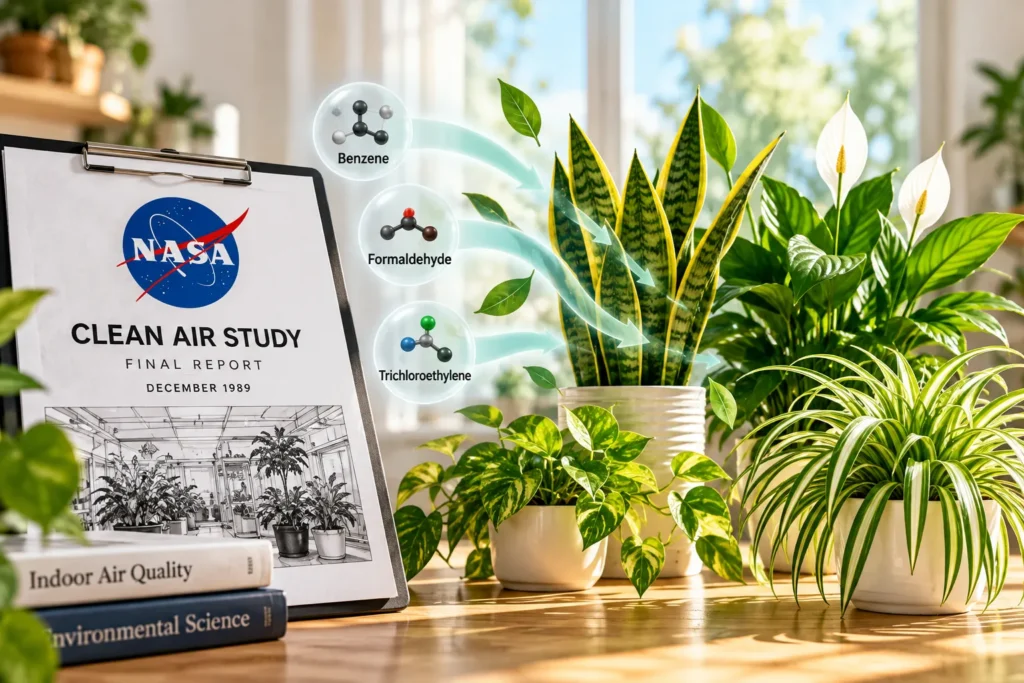
In 1989, a NASA-associated investigation examined whether common interior plants and their growing systems could remove specific organic chemicals from enclosed air.
The researchers studied pollutants such as benzene, formaldehyde, and trichloroethylene.
The results helped establish that plants and associated biological processes can participate in removing certain airborne chemicals under experimental conditions.
So why isn’t that enough to recommend a few plants for pollution control?
Because the conditions were different from those inside an ordinary home.
The experiments involved controlled environments where researchers could measure changes over time.
Real houses have outdoor air exchange, people moving around, cooking emissions, cleaning products, and many other variables.
The surprising truth: The NASA research wasn’t fake. The widespread assumption that its results translate directly into everyday room purification is the problem.
Read the original NASA report for more background.
2. Plants Remove Certain Chemicals, but Usually Very Slowly
Here’s where the science becomes especially interesting.
Researchers have repeatedly examined the ability of potted plants to absorb volatile organic compounds, commonly known as VOCs.
These chemicals may be released by certain cleaning products, paints, adhesives, furnishings, and other materials.
In enclosed experimental chambers, plant-related systems can reduce concentrations of selected VOCs.
But the removal rate matters just as much as the ability to remove them.
Imagine trying to empty a swimming pool using a coffee mug.
Technically, the mug removes water.
It just isn’t an efficient way to empty the pool.
A similar distinction applies when comparing the small measured effects of passive potted plants with the amount of air exchanged or filtered in a building.
In a review published in 2019, researchers Bryan Cummings and Michael Waring analyzed 196 experimental results from 12 studies.
Their calculations suggested that extremely large numbers of plants would be necessary to match normal building ventilation rates.
The takeaway: Something can work scientifically in a small experiment without being practical as a whole-room air-cleaning solution.
3. Photosynthesis Doesn’t Mean Your Bedroom Has Unlimited Fresh Oxygen
img
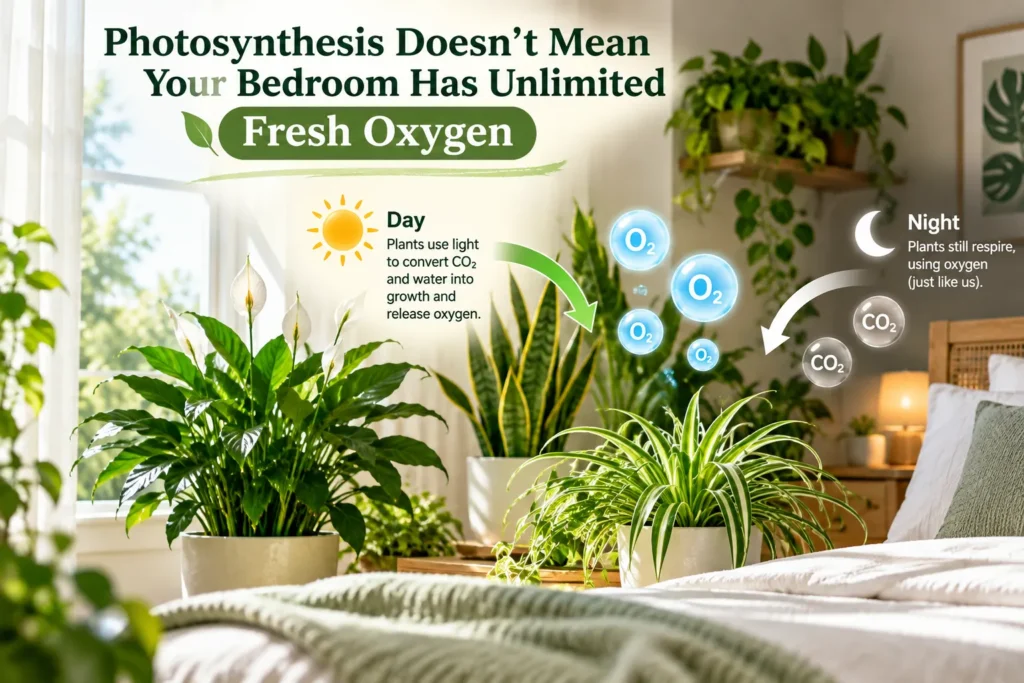
Plants use light energy to convert carbon dioxide and water into organic compounds through photosynthesis, releasing oxygen in the process.
It’s one of the foundations of life on Earth.
But that doesn’t mean placing two plants beside your bed will noticeably increase your bedroom’s oxygen concentration.
The amount of gas exchanged by a small collection of houseplants is generally tiny relative to the volume of air in a room and the effects of ventilation and human occupancy.
Plants also respire.
Like other living organisms, they consume oxygen during cellular respiration, including at night.
Some plants use specialized photosynthetic pathways, but that doesn’t turn them into substitutes for fresh-air ventilation.
Do Indoor Plants Improve Air Quality While You Sleep?
Not in a way that should replace normal ventilation.
If your bedroom feels stuffy overnight, investigate airflow, occupancy, and ventilation conditions rather than relying on a plant to balance oxygen or carbon dioxide levels.
A houseplant can make a bedroom more welcoming.
It shouldn’t be treated as oxygen-generating safety equipment.
4. A Plant Can Be Beneficial Without Being an Effective Air Filter
Here’s a distinction that makes the conversation much more useful.
The benefits of indoor greenery aren’t limited to its ability to remove pollution.
For many people, plants make a living space feel warmer, more personal, and more connected to nature.
Caring for a plant can also become a relaxing routine.
Some scientific reviews have reported associations or experimental findings suggesting potential psychological benefits from indoor greenery.
However, the strength and consistency of this evidence vary, and further research is needed.
It’s reasonable to enjoy plants because their presence makes a room feel pleasant.
It isn’t reasonable to promise that a plant will eliminate stress, treat anxiety, or improve respiratory health.
The important distinction: Emotional comfort, interior design, and measured pollutant removal are different outcomes.
Plants may contribute to one without meaningfully affecting another.
5. Some Indoor Plants Can Make Air Quality Problems More Complicated
img
This might sound strange after all the talk about healthier homes.
But indoor plants aren’t completely maintenance-free.
If you continuously overwater a planter, the growing medium may stay wet enough to encourage unwanted microbial growth.
Excessively damp potting soil can also attract fungus gnats.
Plant-related moisture can become especially frustrating in poorly ventilated rooms or homes already struggling with condensation.
That doesn’t mean houseplants are inherently unhealthy.
It means plant care matters.
How to Avoid Common Indoor Plant Problems
Choose pots with drainage, avoid leaving roots in standing water, and follow species-specific watering needs.
Remove decaying plant material and inspect leaves for pests.
If a room already has visible mold or persistent water damage, address the underlying moisture problem instead of simply adding greenery.
And remember: some popular plants are toxic when ingested by cats or dogs.
A beautiful plant should never come at the expense of pet safety.
6. An Air Purifier and a Houseplant Do Completely Different Jobs
Let’s imagine two objects sitting beside your sofa.
One is a leafy pothos in a ceramic planter.
The other is a HEPA air purifier.
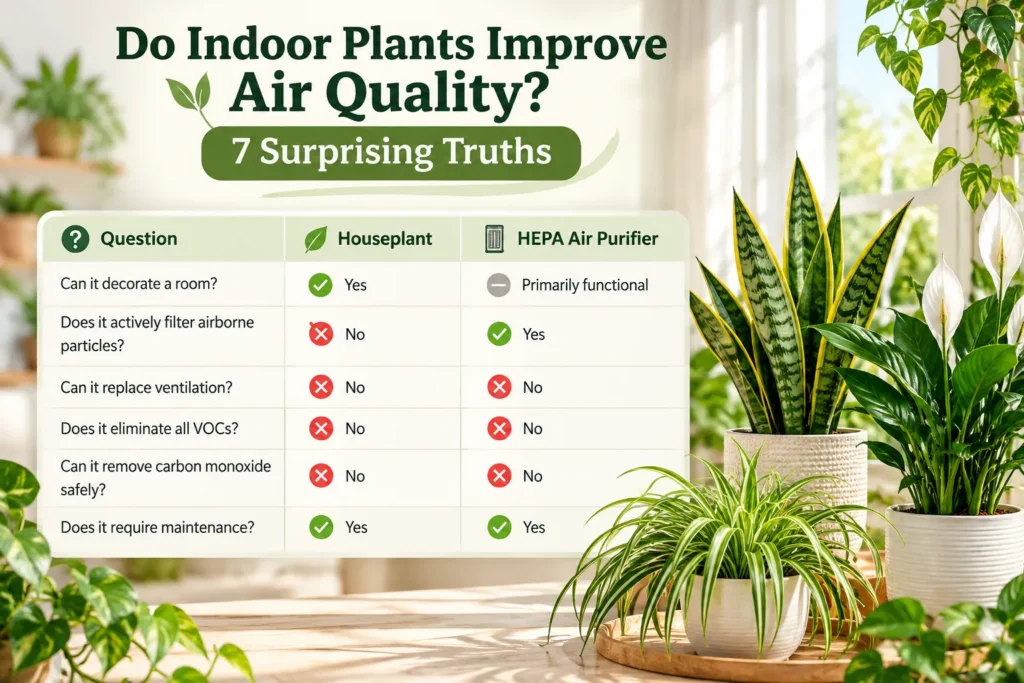
Both may appear in articles about indoor air quality, but their practical functions are very different.
A portable air purifier uses a fan to draw air through filtration media.
When appropriately selected and operated, it can remove a meaningful amount of certain airborne particles.
A passive houseplant does not move large volumes of room air through a particle filter.
Plants vs. Air Purifiers: What Actually Works?
An air purifier isn’t a complete solution either.
HEPA filters mainly capture particles, and ordinary particle filtration does not eliminate every gaseous pollutant.
For that reason, even a high-quality air purifier works best alongside pollution-source control and appropriate ventilation.
Learn how to choose the right equipment in our complete home air purifier guide.
7. The Healthiest Approach Is to Combine Greenery With Proven Air Quality Habits
So, do indoor plants improve air quality?
The most useful answer is that houseplants can be part of an enjoyable home environment, but they shouldn’t be your primary air pollution control strategy.
You don’t have to choose between a beautiful room and a practical approach to cleaner air.
You can have both.
Here is a more reliable approach:
Start with pollution sources. Reduce unnecessary indoor smoke, strong fragrances, and poorly controlled cooking emissions.
Improve ventilation. Use kitchen and bathroom exhaust systems and bring in cleaner outdoor air where appropriate.
Consider filtration. If airborne particles are a concern, select a properly sized purifier or suitable HVAC filtration.
Manage moisture. Repair leaks, avoid persistent condensation, and maintain appropriate indoor humidity.
Add greenery thoughtfully. Choose plants suited to your lighting conditions, schedule, and household.
The plants make the home inviting.
The ventilation and filtration address pollutants.
Neither needs to pretend to do the other’s job.
Frequently Asked Questions: Do Indoor Plants Improve Air Quality?
Do plants purify the air naturally?
Some plants can absorb selected gaseous substances through biological processes. But the measurable pollution-removal effect of normal potted plant collections is generally too small to serve as effective household air purification.
Do indoor plants remove formaldehyde?
Certain plant systems have demonstrated formaldehyde uptake in experimental settings. That does not establish that a handful of houseplants can effectively control formaldehyde exposure in an occupied building.
Can snake plants replace air purifiers?
No. Snake plants are decorative, low-maintenance houseplants, not substitutes for mechanical particle filtration or proper ventilation.
Do indoor plants improve air quality in bedrooms?
Typical household plant collections have not been shown to make significant improvements in bedroom pollutant levels. Bedroom air quality is better addressed through ventilation, source control, and suitable filtration.
Can indoor plants reduce dust?
Ordinary houseplants are not an effective method for removing suspended household dust. Regular cleaning and appropriate particle filtration are more reliable.
Which houseplants are worth buying if air purification isn’t proven?
Spider plants, snake plants, pothos, Boston ferns, and many other varieties can be wonderful choices for decor and plant care. The best selection depends on light, maintenance needs, and pet safety.
For specific recommendations and shopping options, read our 8 best indoor plants for air quality: what science really says.
Final Thoughts: The Truth Makes Houseplants More Enjoyable
There’s something lovely about watching a new leaf unfurl or seeing a small cutting finally take root.
You don’t need to believe that your pothos is secretly operating like a powerful air filtration system to appreciate it.
The real science doesn’t make houseplants less appealing.
It simply gives us a better reason to choose them.
Do indoor plants improve air quality? Under laboratory conditions, some plant systems can remove selected pollutants. In ordinary homes, the effect of a typical plant collection is not large enough to replace proven air-cleaning methods.
Enjoy the greenery, but make informed decisions about the air you breathe.
And if you’re ready to bring some plants into your home, see our guide to the 8 most popular indoor plants, their care requirements, and what science says about them.