
It starts with something small.
You walk into your bedroom after a long day, close the door, and notice that familiar musty smell again.
You’ve already washed the bedding. Vacuumed the carpet. Changed the furnace filter. Maybe you’ve even bought an air purifier.
For a few days, everything seems better.
Then the smell returns.
And suddenly, you’re asking yourself a question you never expected to ask about your own home:
What if something is wrong with the air we’re breathing?
It’s an uncomfortable thought, especially when your home is supposed to be the place where you feel most at ease.
But before spending hundreds of dollars on random tests or another expensive device, there’s a smarter way to investigate.
Indoor air quality services can help identify potential pollution sources, evaluate ventilation, investigate moisture problems, and recommend practical improvements. The key is knowing which professional service you actually need.
Because not every home requires laboratory testing. And not every company offering an air quality assessment provides the same level of expertise.
This guide explains what indoor air quality professionals do, what testing may cost, which warning signs deserve attention, and the nine essential things to know before hiring someone.
What Are Indoor Air Quality Services?
Indoor air quality services are professional assessments designed to identify potential air pollution sources and environmental problems inside homes or buildings.
Depending on the situation, these services may include visual inspections, ventilation assessments, moisture investigations, targeted pollutant testing, laboratory analysis, and recommendations for correcting identified problems.
Professionals may investigate concerns involving:
- Fine airborne particles (PM2.5).
- Mold and moisture damage.
- Volatile organic compounds (VOCs).
- Radon gas.
- Inadequate ventilation.
- Combustion-related pollutants.
- Heating and cooling system problems.
However, there is no single test that checks every indoor air pollutant.
A trustworthy provider should first understand your concerns and then recommend an appropriate investigation.
The goal isn’t simply to collect numbers. It’s to find a problem you can actually do something about.
Indoor Air Quality Services at a Glance
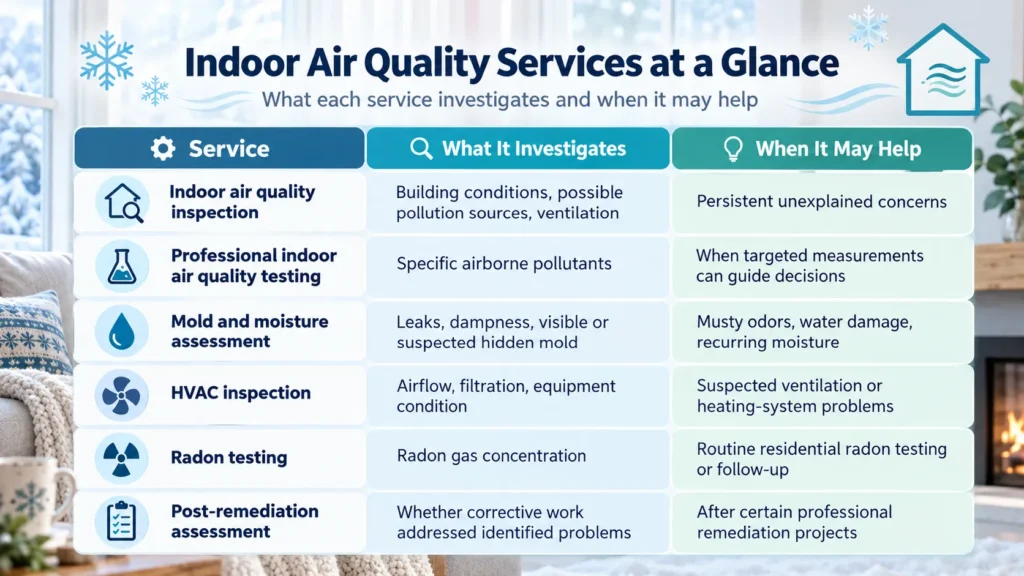
Not every provider offers all of these services. Some specialize in one particular type of investigation.
1. Know What Indoor Air Quality Services Actually Include
When you search for indoor air quality services, you’ll find different types of companies.
Some focus on HVAC systems. Others specialize in environmental sampling, moisture investigations, or radon measurements.
A few provide broad building assessments.
These services are related, but they aren’t interchangeable.
For example, an HVAC technician may be well qualified to evaluate airflow, heating equipment, and filtration. That doesn’t automatically mean they’re qualified to collect or interpret every type of environmental laboratory sample.
Likewise, a mold investigator may understand moisture damage but not provide a comprehensive ventilation assessment.
Inspection vs. Testing vs. Remediation
It’s helpful to understand three terms before making an appointment.
Inspection: Investigating the building, identifying possible pollution sources, and deciding whether measurements are needed.
Testing: Collecting data or samples to evaluate particular pollutants or environmental conditions.
Remediation: Correcting an identified problem, such as repairing moisture damage, addressing a radon issue, or removing contaminated materials when necessary.
A professional indoor air quality inspection may reveal an obvious problem without requiring extensive laboratory testing.
Before hiring: Ask whether the company provides inspections, testing, corrective work, or some combination of these services.
2. Recognize When You Really Need an Indoor Air Quality Inspection
Not every unpleasant smell or dusty room calls for an expensive investigation.
But some situations deserve a closer look.
Consider this example.
You notice a musty odor in your basement after heavy rain. You clean the floor, run a dehumidifier, and open a window when the weather allows.
The odor disappears.
Two weeks later, after another storm, it’s back.
At that point, buying a larger air purifier may not be the answer.
You might have a water intrusion problem that needs to be identified and repaired.
Common Reasons to Request an Indoor Air Quality Inspection
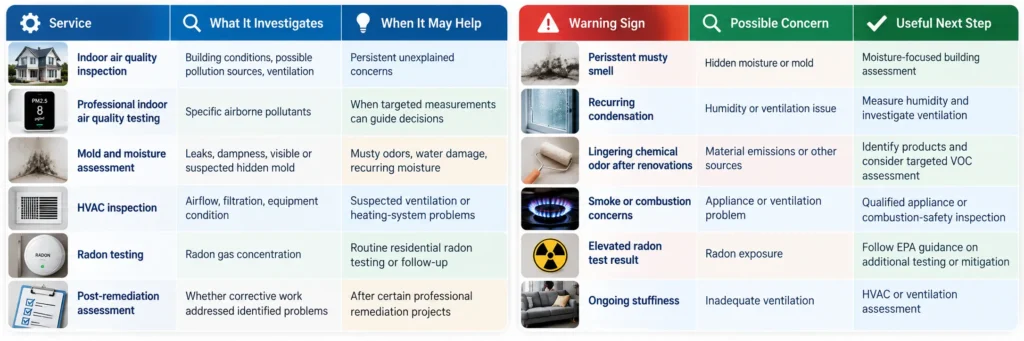
These signs don’t prove that harmful pollutant levels are present.
They help narrow down what should be investigated.
What If Someone in Your Family Has Symptoms?
If someone regularly experiences irritation, coughing, headaches, or other unexplained symptoms, speak with a healthcare professional.
Symptoms alone cannot identify an indoor pollutant.
However, documenting when and where symptoms occur may help a qualified building professional investigate environmental conditions.
Important safety exception: If a carbon monoxide alarm sounds, don’t schedule a routine air quality inspection and wait. Follow emergency instructions, get everyone to fresh air, and contact emergency services.
Indoor air quality services are not a substitute for emergency response.
3. Understand What Professional Indoor Air Quality Testing Measures
One of the biggest misconceptions about indoor air quality testing services is that a technician can walk into your home with one device and identify every possible problem.
Real testing is more specific.
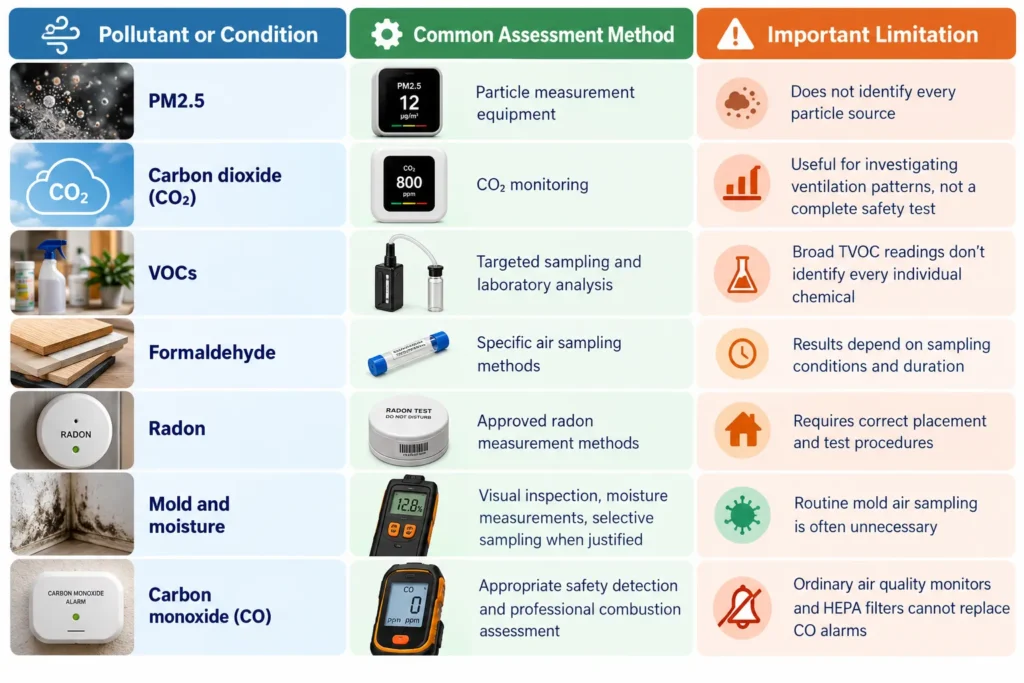
Different pollutants require different measurement methods.
Some can be monitored electronically. Others require specialized sampling or laboratory analysis.
Common Types of Home Air Testing
Is Professional Mold Testing Always Necessary?
No.
This is particularly important because mold testing is often marketed as an essential part of home air quality services.
According to the EPA’s mold-testing guidance, sampling is generally unnecessary when visible mold growth is already present.
The priority is to address the moisture source and clean up the mold appropriately.
Routine mold sampling also has limitations because there are no federal standards establishing universally acceptable airborne mold concentrations in homes.
Professional investigation can still be valuable when suspected hidden mold, complex water damage, or other circumstances require specialized expertise.
The lesson: A good professional should explain why a particular test is necessary and how the results will influence your next decision.
4. Compare DIY Home Air Testing With Professional Services
Before booking professional indoor air quality testing, you may wonder whether a home monitor or DIY test kit would be enough.
Sometimes it is.
Other times, it isn’t.
For example, a digital hygrometer can help you identify a humidity problem without a full inspection.
A properly selected radon test kit may also provide useful information when used according to instructions.
But a consumer air quality monitor can’t tell you everything about your home’s environment.
DIY vs. Professional Indoor Air Quality Services
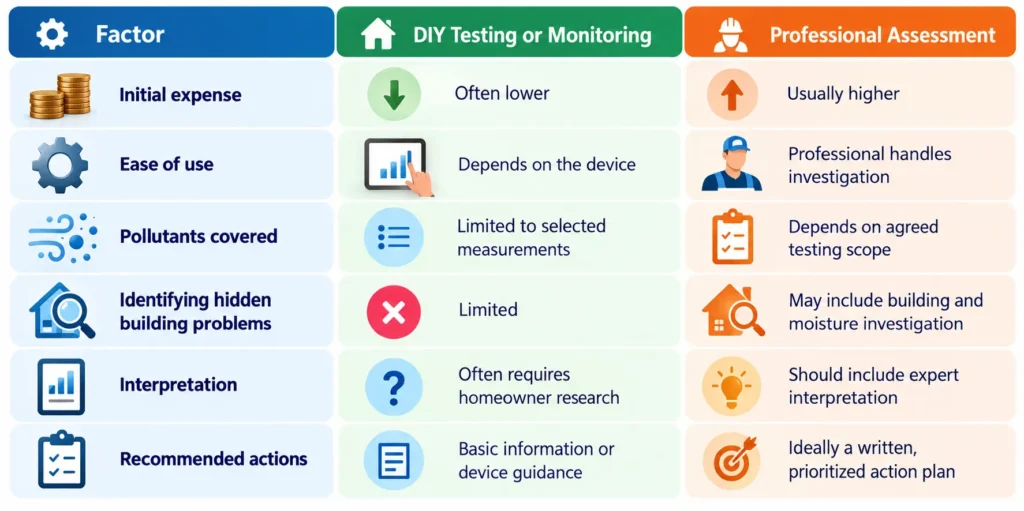
The EPA notes that low-cost indoor monitors vary in their performance and only detect pollutants or conditions they are designed to measure.
For example, a monitor measuring PM2.5 cannot tell you whether your home contains radon.
Learn more from the EPA’s guide to low-cost indoor air pollution monitors.
When Is DIY Home Air Testing Enough?
Start with DIY measurements when you have a clearly defined question and an appropriate method.
If you want to know whether your bedroom humidity is consistently too high, a reliable hygrometer may be a reasonable starting point.
If you suspect hidden moisture behind a wall following a leak, professional investigation may be much more useful.
The best option depends on what you’re trying to discover—not which test sounds more sophisticated.
5. Know How Much Indoor Air Quality Services Cost in 2026
Let’s talk about the question most homeowners ask before scheduling an appointment.
How much does indoor air quality testing cost?
There isn’t one fixed price across the United States.
A straightforward assessment in a small apartment may cost considerably less than a detailed investigation involving multiple rooms, laboratory samples, and specialized equipment.
According to Angi’s September 2026 cost guide, a reported typical range for professional indoor air quality testing is approximately $303–$616, with an average around $443.
These are marketplace estimates, not guaranteed prices or an official national fee schedule.
Your actual quote may be outside that range.
What Affects Indoor Air Quality Testing Costs?
Several factors can change the price:
- Home size: Larger properties may require more inspection time.
- Type of testing: Radon, VOCs, and other pollutants may require different methods.
- Number of samples: Laboratory charges may increase with additional samples.
- Location: Labor rates and travel costs vary.
- Investigation complexity: Hidden moisture or complicated ventilation issues may take longer to evaluate.
- Written reporting: Confirm whether interpretation and recommendations are included.
- Follow-up visits: Additional assessments or verification work may be billed separately.
Don’t Pay for Tests You Don’t Understand
Imagine receiving a $900 quote for a complete indoor air testing package.
Before agreeing, ask what that amount includes.
Does it involve a full building inspection?
How many samples will be collected?
Which contaminants will be measured?
Will you receive laboratory reports and an explanation of the findings?
Could a smaller, targeted assessment answer your concern?
An expensive package isn’t necessarily more informative.
Money-saving tip: Request written quotes from at least two or three qualified providers and compare the actual services—not just the final price.
6. Learn How to Choose Reliable Indoor Air Quality Services Near You
Searching for “indoor air quality service near me” may produce dozens of results.
But the company appearing first isn’t automatically the most qualified.
Start by identifying the specific problem.
If you’re dealing with a suspected radon issue, look for qualified radon measurement professionals.
If moisture is the main concern, prioritize relevant building investigation and moisture-assessment experience.
If you’re concerned about ventilation, an HVAC professional with appropriate diagnostic capabilities may be a better fit.
7 Questions to Ask Before Hiring an Indoor Air Quality Professional
1. What qualifications do you have for this investigation?
Ask about relevant training, licenses, certifications, and experience with similar properties. Requirements vary by state and specialty.
2. What exactly will you inspect or test?
The provider should explain the scope before work begins.
3. Why are these tests necessary?
A professional should be able to connect each test to a specific concern.
4. What equipment or laboratory methods will you use?
Ask how measurements will be collected and interpreted.
5. Will I receive a written report?
You should know what documentation is included before paying.
6. Do you also sell remediation or equipment?
A company can provide more than one service, but potential financial conflicts should be transparent.
7. What happens after you find a problem?
Look for clear explanations of practical next steps rather than immediate pressure to buy expensive add-ons.
Are Indoor Air Quality Inspectors EPA-Certified?
Be careful with this claim.
The EPA does not operate a general certification program for mold inspectors or mold remediation firms.
Relevant state requirements and professional qualifications may still apply.
For radon services, the EPA recommends contacting your state radon program and checking recognized professional proficiency programs.
See the EPA’s guidance on finding qualified radon professionals.
Practical advice: Verify any claimed government certification through the appropriate agency rather than accepting a logo on a contractor’s website.
7. Understand What Happens During an Indoor Air Quality Inspection
If you’ve never booked indoor air quality services before, the process may sound intimidating.
In practice, a carefully planned assessment should begin with questions about your home.
Step 1: Discuss Your Concerns
The professional may ask:
- When did the problem start?
- Is it worse in one room?
- Has there been water damage?
- Have you recently renovated?
- Does the issue change when the heating or cooling system runs?
- Have you noticed changes after cooking or using certain products?
These details can be more valuable than immediately collecting random air samples.
Step 2: Inspect the Building and Possible Sources
Depending on the agreed scope, the assessor may examine moisture-prone areas, ventilation equipment, visible damage, and possible pollutant sources.
Some investigations involve evaluating indoor and outdoor conditions together.
Step 3: Perform Targeted Measurements
If measurements are needed, the professional should explain what is being sampled and why.
The methods and duration depend on the pollutants being investigated.
Some measurements provide immediate readings, while others require laboratory analysis.
Step 4: Interpret the Results
A number on a report doesn’t explain itself.
An elevated reading may reflect a temporary activity, a ventilation issue, or a persistent source.
Results need to be interpreted in the context of the building and how the measurements were collected.
Step 5: Recommend Corrective Actions
A useful report should describe:
- What was investigated.
- What was observed or measured.
- What the findings may mean.
- What remains uncertain.
- Which actions should be prioritized.
- Whether follow-up measurements are necessary.
Ask for explanations in plain English. You’re paying to understand the problem, not just to receive a document full of technical abbreviations.
8. Watch for Red Flags When Comparing Indoor Air Quality Testing Services
A professional assessment should help you make informed decisions.
Unfortunately, some marketing claims can make the process more confusing.
Be cautious if a provider:
- Promises to identify every indoor pollutant with one quick measurement.
- Insists that all homes require comprehensive mold sampling.
- Refuses to explain the purpose of each test.
- Cannot clearly describe its qualifications.
- Pressures you to purchase remediation before explaining the findings.
- Claims that an air purifier eliminates all harmful gases.
- Refuses to provide a written scope or estimate.
- Uses alarming language without evidence to support its conclusions.
Be Particularly Careful With Unnecessary Air Duct Cleaning
Dust inside an HVAC system doesn’t automatically mean your home needs professional duct cleaning.
According to the EPA’s air duct cleaning guidance, routine duct cleaning has not been shown to prevent health problems.
There are situations where cleaning may be justified, including substantial visible mold growth in appropriate components, pest infestation, or excessive deposits of debris.
But an inspector should be able to show or document the actual problem.
The same principle applies to many indoor air quality services:
A good recommendation should follow evidence, not a sales script.
9. Know What to Do After Professional Indoor Air Quality Testing
You’ve paid for an inspection.
You’ve received the report.
Now comes the part that matters most.
What should you do with the results?
The answer depends on what the investigation found.
If the Problem Is Poor Ventilation
You may need better kitchen exhaust, bathroom ventilation, HVAC adjustments, or improvements to a mechanical ventilation system.
An air purifier cannot supply fresh outdoor air.
If the Problem Is Airborne Particles
Reducing particle sources and improving filtration may help.
That could involve maintaining HVAC filters or using a portable purifier with sufficient Clean Air Delivery Rate (CADR) for the room.
Our complete guide to air purifiers for home explains the filtration features worth comparing.
If smoke particles are your main concern, see our guide to air purifiers for smoke.
If the Problem Is Excess Moisture or Mold
Fix the source of unwanted moisture.
That may involve plumbing repairs, improved drainage, ventilation changes, or professional remediation when needed.
An air purifier cannot repair a leak or remove mold growing inside a damaged wall.
If the Problem Is Radon
Follow the EPA’s radon testing and mitigation guidance.
A qualified radon professional can help evaluate appropriate corrective measures.
If the Problem Is Pet Dander
Cleaning, allergen management, and suitable particle filtration may help reduce airborne exposure.
See our air purifiers for pets guide for a closer look at filtration options.
Don’t Forget to Verify the Solution
After corrective work, it may be useful to confirm whether the original problem has been addressed.
The appropriate follow-up depends on the pollutant and the intervention.
For example, radon mitigation requires appropriate follow-up testing.
A moisture repair may be assessed through inspection and moisture measurements.
Not every project needs another full laboratory testing package.
How to Find Indoor Air Quality Services Near Me
If you’re ready to contact a professional, start by narrowing your search.
Rather than choosing the first general service listing, match the provider to your concern.
For example:
indoor air quality services near me— Broad local service search.indoor air quality testing services— Companies offering targeted measurements.indoor air quality inspection near me— Building-focused investigation.professional home air testing— Residential testing providers.radon testing professionals— Specialized radon measurement.indoor moisture inspection— Moisture and potential hidden damage assessment.
Check the company’s service area, qualifications, independent reviews, and written scope.
For specialized regulated work, verify relevant state licensing or certification requirements.
If you contact several companies, describe the same problem to each.
That makes their proposals easier to compare.
A Simple Message to Request a Quote
You don’t need a long explanation.
You can write:
“I’m looking for an indoor air quality assessment for my home. We’ve noticed [describe the concern] in [room or area]. Could you explain what your inspection includes, whether testing is necessary, and the estimated total cost? I’d also like to know whether a written report and recommendations are included.”
A clear question often leads to a more useful quote.
Are Indoor Air Quality Services Worth the Money?
Indoor air quality services can be worth the cost when a qualified assessment helps identify an unresolved problem and leads to effective corrective action.
But they’re not always the first thing a homeowner needs.
If you already know your kitchen fills with smoke every time you cook, improving kitchen exhaust may be a more direct first step.
If your home’s radon level has never been measured, an appropriate radon test is more relevant than a general-purpose particulate monitor.
And if you see obvious moisture damage, fixing the water problem may be more urgent than purchasing a broad air testing package.
When Professional Testing Makes Sense
Consider professional help when:
- A persistent concern remains unexplained after reasonable basic checks.
- You suspect hidden building damage.
- Specialized measurements or technical interpretation are needed.
- You require documentation for a property-related decision.
- A qualified professional recommends testing to answer a specific question.
When You May Be Able to Start With Simpler Solutions
Basic steps may be enough when:
- You only need to measure room humidity.
- Your concern is routine dust control.
- You need to replace a neglected HVAC filter.
- A readily identifiable pollution source can be eliminated.
- A suitable DIY testing method can answer a specific question.
The goal is to solve the right problem—not to pay for the longest list of tests.
Frequently Asked Questions About Indoor Air Quality Services
What are indoor air quality services?
Indoor air quality services are professional inspections, evaluations, and targeted tests used to investigate possible air pollution or environmental problems inside buildings. Services may address ventilation, moisture, airborne particles, gases, or specific contaminants. The exact work depends on the building and the concern being investigated.
How much do indoor air quality services cost?
Professional indoor air quality testing commonly costs several hundred dollars, but prices vary widely. Angi’s September 2026 estimate places many projects between $303 and $616. Your cost depends on location, property size, tests required, laboratory work, and whether reporting or follow-up visits are included.
Is professional indoor air quality testing worth it?
Professional indoor air quality testing is most useful when it answers a specific question that cannot be resolved through simpler inspection or measurement. A qualified professional can help investigate complex ventilation issues, suspected hidden contamination, or specialized pollutant concerns. Broad testing without a clear purpose may offer limited value.
How do I find reliable indoor air quality services near me?
Start by searching for professionals who specialize in your particular concern, then verify their experience, credentials, references, and scope of work. Ask whether a written report is included, confirm relevant state requirements, and compare multiple quotes before hiring. Don’t choose a company solely because it appears first in search results.
What does an indoor air quality inspection include?
An indoor air quality inspection typically begins with reviewing concerns, inspecting possible sources, evaluating relevant building conditions, and recommending targeted measurements where justified. Some inspections include sampling and laboratory analysis, while others focus on moisture, ventilation, or HVAC performance. Always confirm the written scope before the appointment.
Can indoor air quality services detect mold?
A qualified moisture or mold assessment can identify visible mold, investigate damp areas, and help locate possible hidden moisture problems. However, routine mold air testing isn’t always necessary. The EPA generally recommends addressing visible mold and its underlying moisture source rather than relying on sampling alone.
How long does professional home air testing take?
The time required depends on the inspection scope and measurement methods. A basic visit may be relatively short, while complex building investigations take longer. Some instruments provide immediate measurements, but laboratory-based tests can require additional processing time. Ask when you’ll receive results and a completed report.
Can air purifiers replace indoor air quality testing services?
No. Air purifiers are designed to reduce certain airborne pollutants, not diagnose every indoor environmental problem. They cannot identify hidden water damage, test for radon, repair ventilation faults, or make carbon monoxide hazards safe. An appropriately sized air purifier may still be useful after a problem has been assessed.
How often should homeowners schedule indoor air quality testing?
There is no universal schedule requiring every home to receive comprehensive indoor air quality testing every year. The right timing depends on the pollutant, local recommendations, past results, building changes, and specific concerns. Radon testing has its own guidance, while other assessments are often prompted by a particular problem.
What is the difference between an indoor air quality inspection and home air testing?
An indoor air quality inspection examines the building and possible sources of pollution, while home air testing measures selected pollutants or environmental conditions. An inspection can help determine whether testing is necessary. The strongest assessment connects observations and measurements to practical decisions.
Can indoor air quality testing identify the cause of allergies?
Testing may identify certain environmental conditions or airborne contaminants, but it cannot diagnose an allergy or prove which exposure is causing someone’s symptoms. A healthcare professional is the appropriate person to evaluate allergy symptoms. Building assessments may help identify environmental concerns worth addressing.
Final Thoughts: Your Home Deserves Answers, Not Guesswork
Nobody wants to feel uncertain about the air inside their own home.
Especially when the concern keeps returning, despite your best efforts to clean, ventilate, or improve the space.
It’s tempting to buy another device or book the most comprehensive testing package available.
But more equipment and more testing don’t automatically mean better answers.
The best indoor air quality services start by understanding your specific problem. They use appropriate methods, explain the findings clearly, and help you decide what to do next.
Sometimes that means a professional building investigation.
Sometimes it’s a targeted radon test, a ventilation repair, or fixing a hidden moisture source.
And sometimes, a few straightforward changes are all you need.
Before you hire anyone, remember three things:
Know what you’re trying to investigate. Ask what you’re paying for. Expect recommendations you can understand.
Because a healthier home isn’t built on guesswork or fear.
It’s built on good information and practical decisions.
Your next step: Write down your main air quality concern, identify which kind of professional can investigate it, and request a clear, itemized quote before booking.