
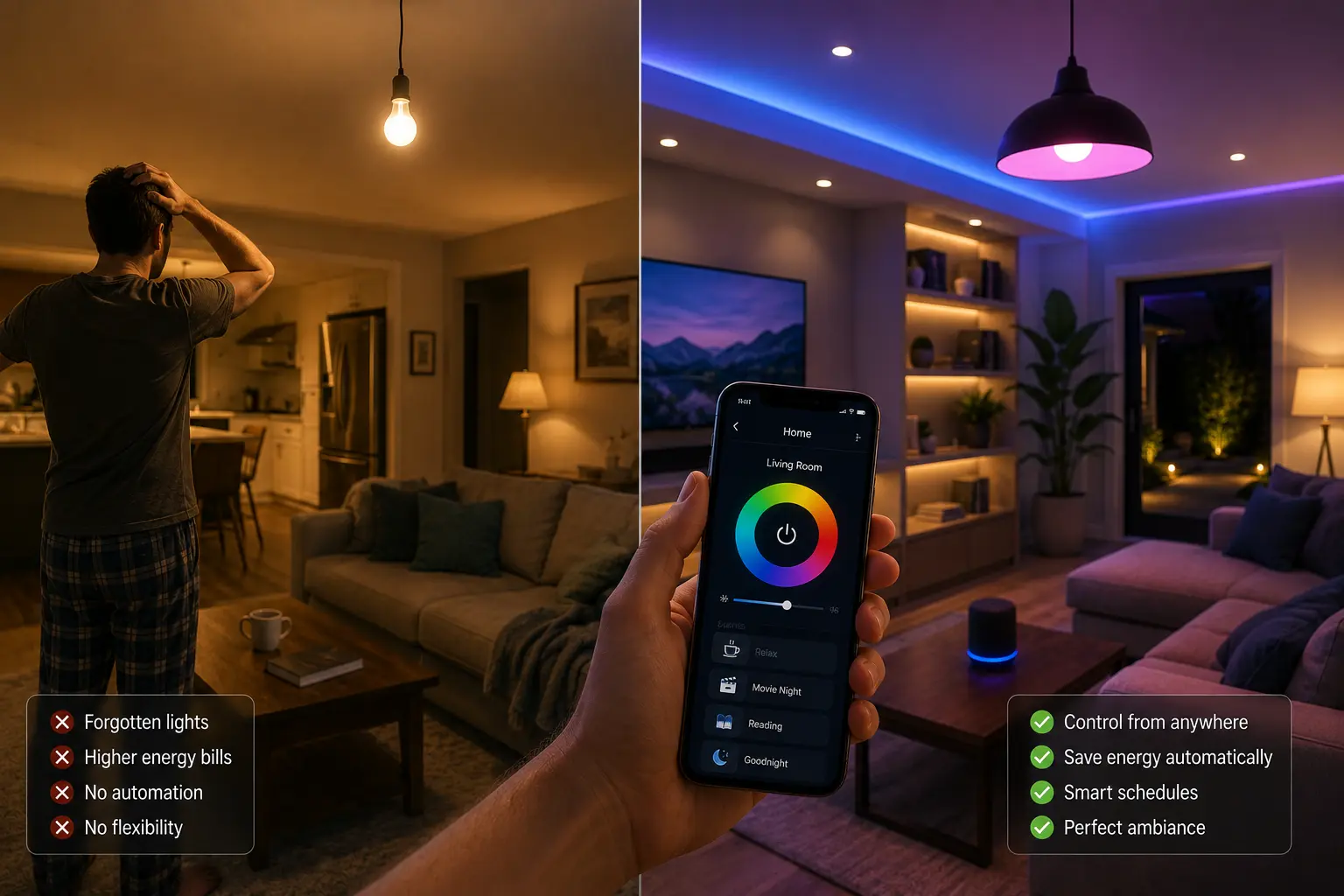
It’s 10:47 PM.
The movie is about to start.
You get comfortable on the couch.
Then…
You stand up.
Walk across the room.
Turn off the kitchen light.
Walk back.
Sit down.
Realize the hallway light is still on.
Get up again.
We’ve all been there.
Now imagine this instead.
With one tap—or a simple voice command—your lights automatically dim, the living room glows with a warm, cozy ambiance, and every unnecessary light switches off.
No extra effort.
No wasted electricity.
No interruptions.
It might sound like a luxury.
But after talking with homeowners and testing smart home technology over the years, I’ve realized it’s quickly becoming the new normal.
If you’ve been wondering whether Smart Lighting vs Traditional Lighting is just another marketing battle or a real upgrade worth making, you’re in the right place.
By the end of this guide, you’ll know exactly which option fits your lifestyle, your budget, and your home.
👉 Let’s discover whether smarter lighting really leads to smarter living.
Why This Comparison Matters More Than Ever
Lighting is something most of us rarely think about.
We flip a switch.
The room lights up.
End of story.
Or is it?
Today, lighting has evolved far beyond simply helping us see in the dark.
It can now:
- adjust automatically throughout the day
- improve your evening routine
- reduce unnecessary energy use
- increase home security while you’re away
- create different moods with a single tap
That’s why the debate around Smart Lighting vs Traditional Lighting has become much more relevant than it was just a few years ago.
It’s no longer just about bulbs.
It’s about how our homes work around us.
One Decision Changed Everything in Toronto
Last winter, I came across the story of a young couple living in Toronto, Canada.
Like many first-time homeowners, they had just bought a beautiful townhouse.
Everything looked perfect.
Modern kitchen.
Fresh paint.
New furniture.
Yet every month, their electricity bill seemed higher than expected.
They blamed the heating system.
Then the appliances.
Even their teenagers.
One Saturday afternoon, they decided to do something simple.
Instead of replacing expensive appliances, they replaced just six of their most frequently used bulbs with smart LED bulbs.
Nothing else.
Over the next few weeks, they started experimenting.
The porch light turned on automatically at sunset.
The hallway lights switched off after ten minutes.
The living room dimmed automatically during movie nights.
The kids’ bedroom lights turned off at bedtime.
Little by little…
Their home began working with them instead of against them.
What surprised them wasn’t just the convenience.
It was how quickly those tiny automations became everyday habits.
One year later, they admitted something funny.
“We don’t even think about our lights anymore.”
And that’s probably the biggest compliment smart lighting can receive.
Good technology disappears into the background.
What Exactly Is Smart Lighting?
Before comparing Smart Lighting vs Traditional Lighting, let’s make sure we’re talking about the same thing.
Traditional lighting is simple.
You flip a switch.
The light turns on.
You leave the room.
Sometimes…
You forget to turn it off.
Smart lighting adds intelligence.
Using Wi-Fi, Bluetooth, Zigbee, Matter, or Thread, smart bulbs and switches can communicate with your smartphone, voice assistant, or automation system.
That means your lights can:
- Turn on before you arrive home.
- Dim automatically in the evening.
- Change color temperature throughout the day.
- Create custom lighting scenes.
- Respond to motion sensors.
- Help simulate occupancy while you’re traveling.
Instead of controlling your lights…
Your lights start helping you.
Smart Lighting vs Traditional Lighting at a Glance
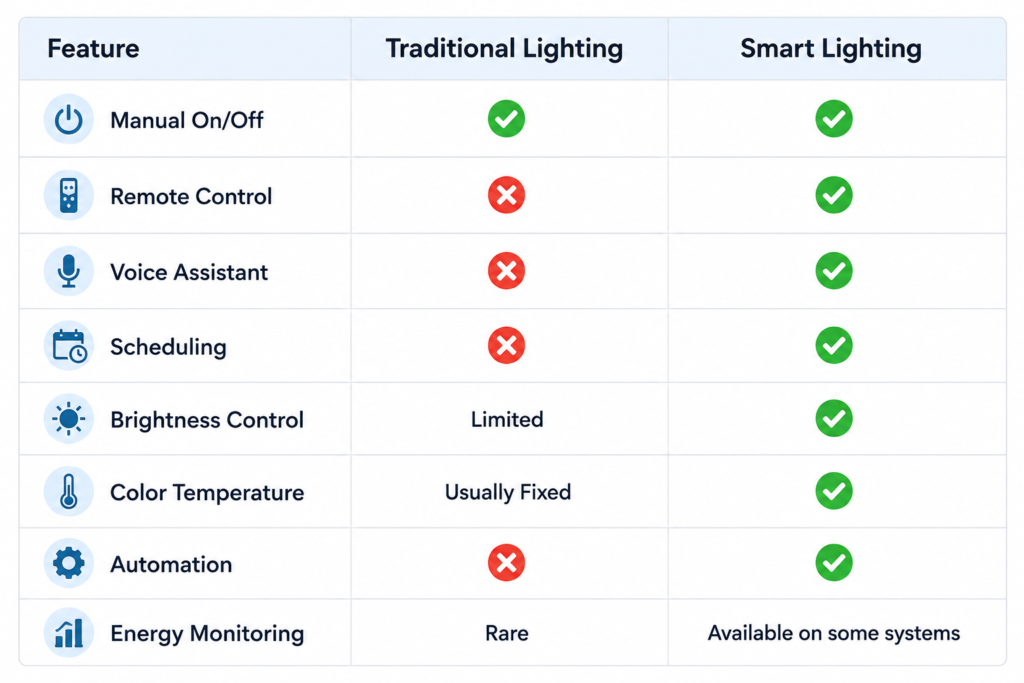
At first glance, the difference may seem obvious.
But features alone don’t tell the whole story.
The real question is this:
Do these extra features actually improve everyday life?
Let’s find out.
More Than Convenience
When people hear “smart home,” they often imagine flashy technology.
Color-changing lights.
Voice commands.
Phone apps.
Those things are fun.
But after using smart lighting for a while, I realized the biggest benefit wasn’t convenience.
It was peace of mind.
Think about leaving for vacation.
Instead of wondering,
“Did I leave the lights on?”
Your home already knows what to do.
Lights turn on at sunset.
Turn off at bedtime.
Everything looks natural.
The house never appears empty.
Or imagine coming home carrying groceries.
No searching for switches.
No walking through a dark hallway.
The lights simply welcome you home.
Sometimes technology doesn’t need to impress us.
It simply needs to make ordinary moments a little easier.
Why Millions of Homes Are Making the Switch
Across North America, Europe, and parts of Asia, smart home adoption continues to grow every year.
According to the U.S. Department of Energy, LED lighting already uses at least 75% less energy than traditional incandescent bulbs, and connected lighting systems can help households save even more by reducing unnecessary usage through scheduling and automation.
Similarly, ENERGY STAR highlights that replacing older lighting with efficient LEDs is one of the easiest ways to reduce household energy consumption.
That means upgrading your lighting isn’t just about buying new gadgets.
It’s about using electricity more intelligently.
💡 SmartLiving Tip
If your budget is limited, don’t replace every bulb at once.
Start with the rooms you use the most:
- Living room
- Kitchen
- Bedroom
- Entryway
You’ll notice the benefits much faster—and spread the investment over time.
Is Smart Lighting Always Better?
Not necessarily.
That’s something many reviews won’t tell you.
If you live alone in a small apartment and only use two or three lights every evening, traditional lighting may already meet your needs.
But if you have:
- a family,
- children,
- pets,
- a larger home,
- or you’re already using devices like Alexa or Google Home,
the value of smart lighting grows significantly.
The best technology isn’t the one with the most features.
It’s the one that quietly makes your daily routine simpler.
And that’s the question we’ll explore next.
A Family in Munich Finally Stopped Arguing About the Lights
If you’ve ever lived with teenagers, you probably know this sentence.
“Who left the kitchen light on?”
In a quiet neighborhood in Munich, Germany, the Schneider family had this conversation almost every evening.
It wasn’t about the electricity bill.
It was about habit.
Lights stayed on upstairs.
The hallway remained illuminated all night.
Someone always forgot the garage light.
Eventually, they upgraded only three areas of the house.
The entrance.
The hallway.
The living room.
Nothing extravagant.
Motion sensors.
Smart schedules.
Automatic shut-off after ten minutes.
After one month…
Nobody mentioned forgotten lights anymore.
Not because everyone suddenly became more responsible.
Because the house quietly handled it.
That story perfectly illustrates the real difference between Smart Lighting vs Traditional Lighting.
One relies entirely on human memory.
The other quietly fills the gaps we all have.
Which One Saves More Money?
Let’s answer one of the biggest questions.
Will smart lighting actually lower my electricity bill?
The answer is…
Yes—but not for the reason most people think.
Many people assume smart bulbs consume dramatically less power than traditional LEDs.
That’s not entirely true.
Most modern smart bulbs are already LED bulbs.
Their biggest advantage isn’t lower wattage.
It’s using light only when you actually need it.
Think about your own home.
How often do you:
- Leave the bathroom light on?
- Forget the porch light overnight?
- Leave the bedroom light running while watching TV downstairs?
We’ve all done it.
Smart schedules and motion sensors reduce these small moments of waste.
Individually, they seem insignificant.
Over an entire year…
They start adding up.
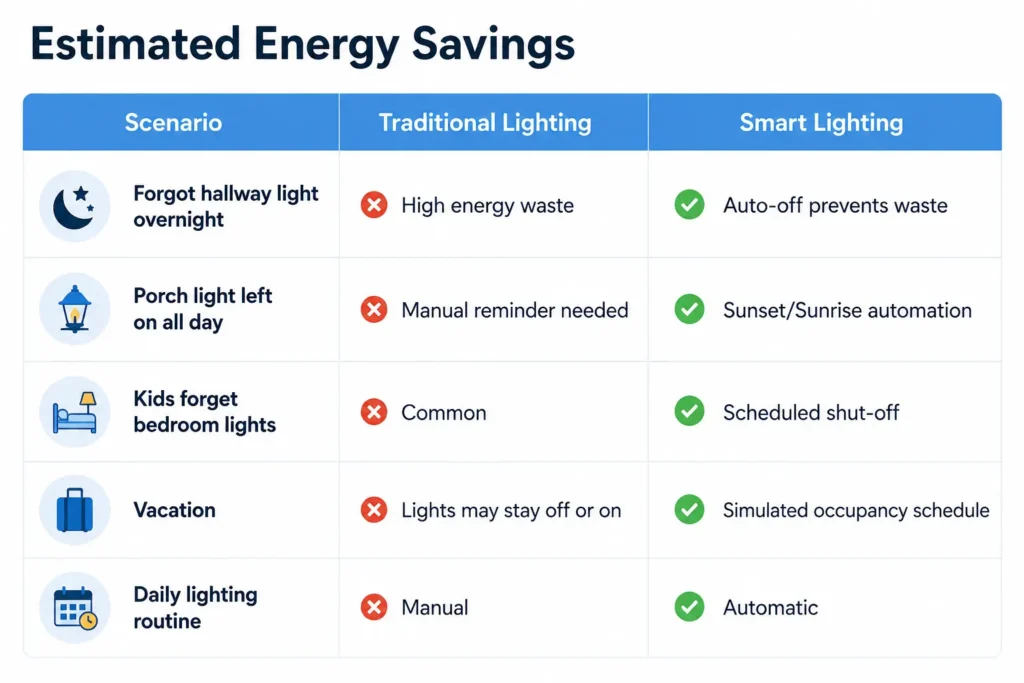
Notice something?
The biggest savings don’t come from brighter technology.
They come from better habits.
What Official Studies Say
Lighting efficiency has improved dramatically over the last decade.
According to the U.S. Department of Energy, LED bulbs use at least 75% less energy than traditional incandescent bulbs and can last up to 25 times longer.
Meanwhile, ENERGY STAR reports that replacing older lighting with ENERGY STAR-certified LEDs can significantly reduce household electricity use over the lifetime of the bulbs.
Smart lighting builds on those savings by helping homeowners avoid unnecessary usage through schedules, timers, occupancy sensors, and remote control.
In other words…
Efficiency is only half the story.
Automation completes it.
Everyday Life: Which One Feels Better?
Imagine arriving home after work.
It’s raining.
Your hands are full of groceries.
Traditional lighting says:
“Find the switch.”
Smart lighting says:
“Welcome home.”
The hallway lights gently turn on.
The kitchen lights brighten automatically.
Soft music starts playing.
Your thermostat adjusts the temperature.
No, this isn’t science fiction.
It’s simply a home responding to your routine.
That’s why, when comparing Smart Lighting vs Traditional Lighting, convenience often becomes the deciding factor.
After a few weeks…
It feels strange to go back.
The “Dad Patrol”😂
Every family has one.
The unofficial Light Inspector.
Usually Dad.
Walking through the house saying…
“Who left this light on?”
“Why is the garage light still on?”
“Does money grow on trees?”
Smart lighting doesn’t replace Dad.
But it might finally let him retire from patrol.
👍 Pros & Cons
Smart Lighting
Pros
✔ Remote control from anywhere
✔ Voice assistant compatibility
✔ Automatic schedules
✔ Motion sensor support
✔ Energy-saving routines
✔ Adjustable brightness
✔ Warm and cool white lighting
✔ Better home security while traveling
Cons
✖ Higher upfront cost
✖ Requires Wi-Fi or compatible ecosystem
✖ Some systems need a hub
✖ More setup than traditional bulbs
Traditional Lighting
Pros
✔ Lower purchase price
✔ Extremely easy installation
✔ Works without internet
✔ No apps required
Cons
✖ No automation
✖ Easy to forget lights
✖ Fixed brightness on many bulbs
✖ No scheduling
✖ No voice control
SmartLiving Tips💡
If you’re considering upgrading, don’t replace every bulb on day one.
I always recommend starting with rooms where automation makes the biggest difference.
My priorities would be:
🥇 Entryway
🥈 Living room
🥉 Bedroom
🏅 Hallway
Those four areas provide the biggest daily impact.
Once you experience smart routines there…
You’ll naturally know whether expanding to the rest of the house is worth it.
Common Mistakes When Switching to Smart Lighting
1. Buying the Cheapest Bulbs
Low-cost bulbs often have unreliable apps and slower response times.
2. Ignoring Compatibility
Always check whether your bulbs work with:
- Alexa
- Google Home
- Apple Home
- Matter
- Thread
3. Installing Smart Bulbs Everywhere
Not every room needs automation.
Focus on areas you actually use.
4. Forgetting Wi-Fi Coverage
A weak Wi-Fi signal can make smart devices feel unreliable.
5. Making Automation Too Complicated
Keep it simple.
A few helpful routines are better than fifty confusing ones.
Smart Homes Aren’t About Showing Off
One thing I’ve noticed after talking with smart home users from Canada, Germany, South Korea, and the Netherlands…
Almost nobody talks about controlling lights with their phone anymore.
Instead, they say things like:
“I never think about the lights now.”
That’s interesting.
Because the goal of technology isn’t to make us interact with it more.
The goal is to make us think about it less.
That’s exactly where Smart Lighting vs Traditional Lighting becomes more than a comparison of products.
It’s a comparison of experiences.
One asks you to remember.
The other quietly remembers for you.
One Small Upgrade Changed Every Evening in Sydney
Sarah and Michael live in Sydney, Australia with their two young children.
Like many busy parents, evenings felt… chaotic.
Someone was always looking for a light switch.
The kids forgot to turn off bedroom lights.
The backyard stayed illuminated until morning.
Movie nights began with everyone walking around turning lights off.
Nothing terrible.
Just lots of tiny interruptions.
One weekend, Michael decided to automate only five lights.
Nothing more.
The front porch turned on automatically at sunset.
The hallway switched off after five minutes of inactivity.
The living room dimmed every evening at 8 PM.
The children’s bedroom lights slowly faded out over twenty minutes, giving them a gentle reminder that bedtime was approaching.
Three months later, Sarah laughed while telling a friend:
“The funny thing is… we barely notice the smart lights anymore.”
And that’s probably the biggest compliment you can give smart home technology.
When it works well…
It becomes invisible.
Best Smart Lighting Products Worth Buying in 2026
Choosing the right system can feel overwhelming.
Hundreds of bulbs.
Dozens of brands.
Different ecosystems.
If I were helping a friend build a smart home today, these are the products I’d confidently recommend.
🥇 Philips Hue White Ambiance
Best Overall
If you’re looking for reliability, automation, and long-term value, Philips Hue remains one of the strongest choices.
Best for
- Whole-home automation
- Families
- Alexa & Google Home users
- Apple Home users
Pros
✔ Excellent build quality
✔ Reliable app
✔ Huge accessory ecosystem
✔ Great automation features
Cons
✖ Premium price
🥈 Govee Smart Bulbs
Best Value
Govee has become incredibly popular because it offers excellent features without the premium price tag.
Perfect for beginners.
Pros
✔ Affordable
✔ Easy setup
✔ Fun lighting scenes
✔ Great smartphone app
Cons
✖ Smaller ecosystem than Philips Hue
🥉 TP-Link Kasa Smart Bulb
One of the easiest smart bulbs to recommend.
Reliable.
Simple.
Excellent for first-time users.
Pros
✔ No complicated setup
✔ Works with Alexa
✔ Great value
⭐ Nanoleaf Essentials
If you’re already using Apple Home or Matter-compatible devices, Nanoleaf deserves serious consideration.
Its Adaptive Lighting feature automatically changes color temperature throughout the day.
Exactly the kind of automation many homeowners are looking for.
Which Smart Lighting System Is Right for You?
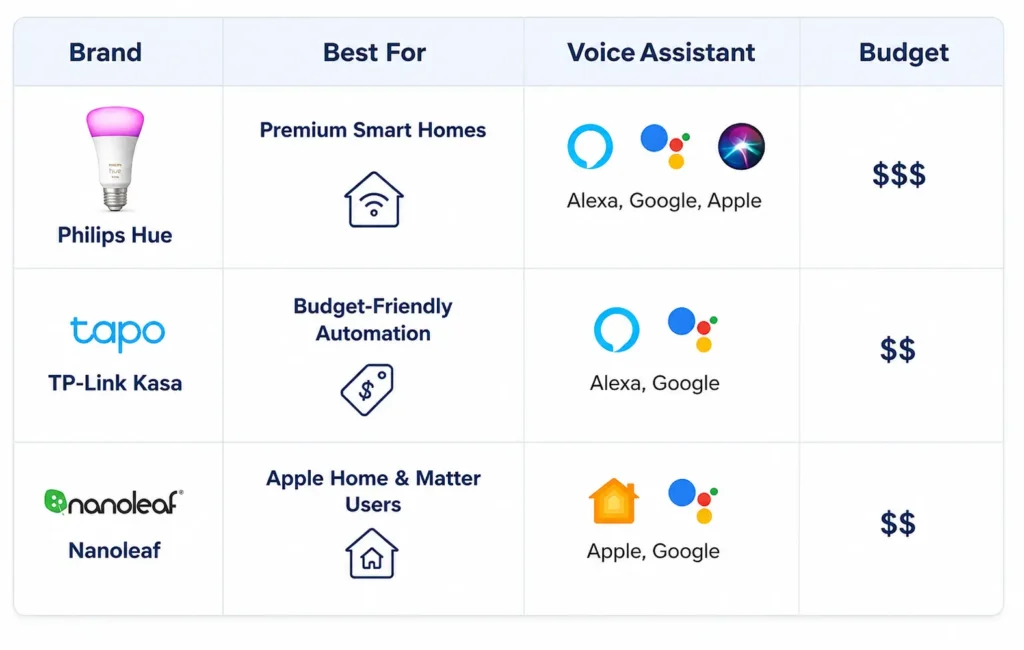
There isn’t one “perfect” smart lighting system.
There is only the one that fits your home.
So… Is Smart Lighting Really Worth It?
After comparing Smart Lighting vs Traditional Lighting, my answer is surprisingly simple.
If your only goal is to illuminate a room…
Traditional lighting still works perfectly.
But if you want your home to become:
- more comfortable,
- more efficient,
- more secure,
- and easier to live in,
smart lighting offers benefits that traditional bulbs simply can’t match.
It’s not about replacing every switch overnight.
It’s about making small improvements that quietly simplify your daily life.
SmartLiving Tip💡
Don’t think of smart lighting as buying “smart bulbs.”
Think of it as designing experiences.
Imagine saying:
“Goodnight.”
And your home automatically:
✔ Turns off downstairs lights.
✔ Locks compatible smart devices.
✔ Leaves a dim hallway light on.
✔ Gradually darkens the bedroom.
That isn’t just convenience.
That’s thoughtful living.
Final Pros & Cons
Smart Lighting
Pros
- Better convenience
- Automation saves time
- Supports energy-saving habits
- Improved home security
- Voice control
- Personalized lighting scenes
- Excellent for families
- Easily expandable
Cons
- Higher upfront investment
- Learning curve for beginners
- Internet connectivity may affect some features
Traditional Lighting
Pros
- Lower initial cost
- Simple installation
- No apps required
- Works immediately
Cons
- No automation
- No scheduling
- Easy to forget lights
- Less flexible
- Fewer energy-saving opportunities
Quick Quiz
1. What’s your biggest reason for upgrading?
A. Saving energy
B. Convenience
C. Better ambiance
D. Home security
2. How many lights do you usually forget each week?
A. Never
B. Occasionally
C. Quite often 😅
D. Almost every day
3. Which room would you automate first?
A. Living room
B. Bedroom
C. Hallway
D. Entire home
Results
Mostly A
Energy efficiency should be your priority.
Mostly B
You’ll probably love automation.
Mostly C
Start with smart scenes and dimmable bulbs.
Mostly D
Welcome to the smart home club!
Technology Should Feel Human
When I think about the families we’ve met in this article…
Toronto.
Munich.
Sydney.
They’re all different.
Different climates.
Different homes.
Different lifestyles.
Yet they shared one thing.
None of them wanted a house filled with complicated technology.
They wanted a home that made everyday life a little easier.
A home that remembered small things.
A home that quietly worked in the background.
That’s what impressed me most.
Not the apps.
Not the voice commands.
Not even the automation.
The fact that technology became almost invisible.
And in my opinion…
That’s exactly how good technology should feel.
Conclusion: A Smarter Home Starts With One Simple Switch
The debate between Smart Lighting vs Traditional Lighting isn’t really about bulbs.
It’s about how you want your home to support your daily life.
Traditional lighting has served us well for decades.
It’s reliable, simple, and affordable.
But smart lighting takes a step further.
It helps you reduce wasted energy, create personalized routines, improve comfort, and even strengthen your home’s security—all while blending seamlessly into your everyday life.
You don’t need to automate every room overnight.
Start with one space.
Your bedroom.
Your hallway.
Your living room.
Live with it for a few weeks.
You may be surprised by how quickly those small changes become habits you never want to lose.
At SmartLiving369, we believe the best smart home isn’t the one with the most gadgets—it’s the one that genuinely makes life easier.
Whether you’re exploring lighting, improving your sleep environment, or building a more energy-efficient home, every thoughtful upgrade brings you one step closer to smarter living.
👉 Ready to transform your home?
Discover more practical guides on SmartLiving369, explore our expert recommendations, and start building a home that’s not only smarter—but also more comfortable, more efficient, and designed around the way you live.
Discover More Smart Living Guides
Continue your smart home journey with these expert articles:
- Smart Lighting for Sleep: How It Can Dramatically Improve Your Sleep Quality in 2026
- 11 Powerful Solar Energy Devices That Can Transform Your Home
- Best Smart Air Purifiers for Allergies That Actually Work
[…] article made you curious about how lighting can do more than decorate, take a look at our guide on smart lighting vs traditional lighting. It will help you understand which option fits your home, your habits, and the kind of atmosphere […]