
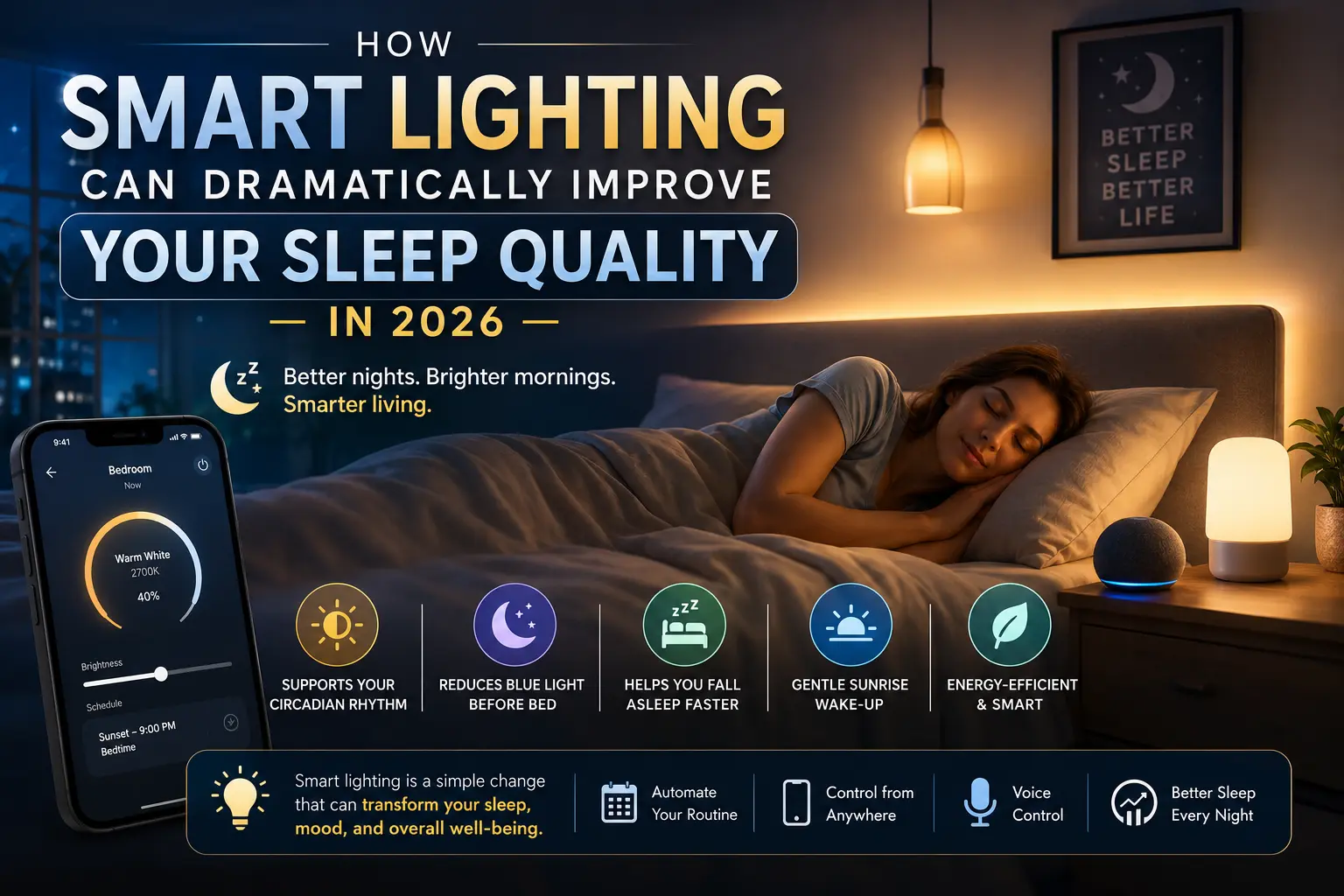
What If the Real Reason You Can’t Sleep… Is Hanging From Your Ceiling?
It’s 11:42 PM.
You’re lying in bed.
Your body feels exhausted.
Your mind doesn’t.
You close your eyes.
Open them again.
Check your phone.
“Only five minutes,” you tell yourself.
Suddenly it’s midnight.
Then 12:30.
You start doing the math.
“If I fall asleep now… I’ll still get six hours.”
Sound familiar?
For years, I thought stress was stealing my sleep.
Maybe you blame coffee.
Or work.
Or your noisy neighbor.
Those things certainly matter.
But what surprised me most was discovering that one of the biggest sleep disruptors was something I had never questioned:
The light inside my own home.
Not just my phone.
Not just my laptop.
The ceiling light I turned on every evening.
The bright white bulb above my kitchen table.
The bathroom light that felt like a miniature sun at midnight.
Once I understood how light affects our biological clock, everything started to make sense.
And here’s the exciting part…
Today’s Smart Lighting for Sleep doesn’t just illuminate your home.
It helps your body understand when it’s time to relax… and when it’s time to wake up naturally.
If you’ve ever struggled to fall asleep—even after a long day—this article might completely change the way you think about your home’s lighting.
Why Your Brain Cares More About Light Than You Think
Our bodies follow a natural 24-hour cycle called the circadian rhythm.
Think of it as your internal clock.
Every morning, sunlight tells your brain:
“Wake up. It’s time to be alert.”
Every evening, darkness tells your body:
“Slow down. Prepare for sleep.”
But modern homes confuse that clock.
Bright LEDs…
Computer screens…
Televisions…
Kitchen lighting…
Even hallway lights.
Instead of signaling bedtime, they tell your brain:
“It’s still daytime.”
That delays the release of melatonin, the hormone that helps us feel sleepy.
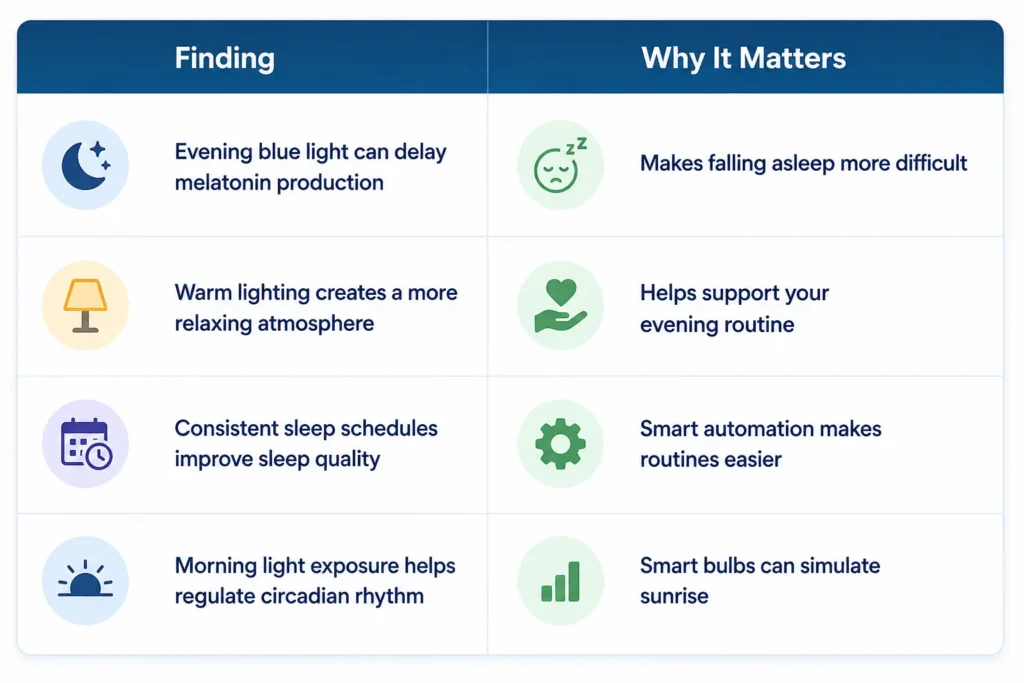
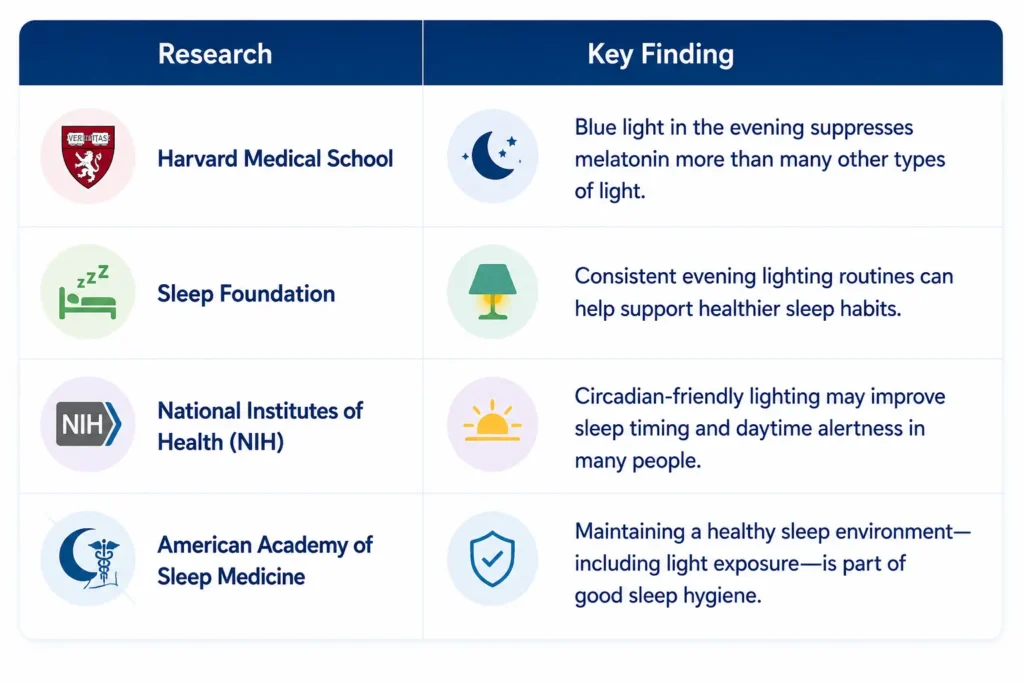
According to the Sleep Foundation, exposure to bright or blue-rich light during the evening can make it harder to fall asleep and reduce overall sleep quality.
Meanwhile, researchers at Harvard Medical School explain that blue light has a stronger effect on suppressing melatonin than many other wavelengths, making evening light exposure particularly important to manage.
That’s why Smart Lighting for Sleep is becoming one of the simplest upgrades for creating a healthier bedroom environment.
Story 1 – Emily’s Apartment in Boston
Emily works as a graphic designer.
Like many creatives, inspiration often arrived late at night.
She would finish work around 10 PM.
Then cook dinner.
Then watch Netflix.
By midnight…
She was exhausted.
Yet she couldn’t sleep.
She bought a new mattress.
Nothing changed.
She tried herbal tea.
Still awake.
She even blamed her coffee.
One evening she noticed something unusual.
Her apartment was filled with bright daylight-colored LED bulbs.
Kitchen.
Bedroom.
Bathroom.
Living room.
Every room looked like a photography studio.
Instead of replacing her entire bedtime routine, she made one simple change.
She installed smart bulbs that automatically shifted from cool white during the day to warm amber light after sunset.
The first night?
Nothing magical happened.
But after two weeks…
She noticed something.
She stopped scrolling on her phone.
She started feeling sleepy around the same time every evening.
For the first time in months…
Her body seemed to know when bedtime had arrived.
Was it only because of the lights?
Probably not.
But they became an important signal that helped her brain transition from work mode to rest mode.
Sometimes better sleep doesn’t begin with a new mattress.
Sometimes…
It begins with a different light bulb.
What Science Says About Evening Light
💡 SmartLiving Tip
Think of your lights as part of your bedtime routine.
You probably brush your teeth every night.
Maybe you read a few pages of a book.
Why not let your lights tell your brain:
“It’s time to rest now.”
We’re Living Under Artificial Suns
Here’s something that makes me smile.
Our ancestors worried about keeping a fire alive.
We worry about turning our lights off.
We’ve become so good at creating artificial daylight…
…that sometimes our brains simply forget it’s nighttime.
It’s a little ironic, isn’t it?
Technology created part of the problem.
Now…
Technology is helping solve it.
And that’s exactly where Smart Lighting for Sleep shines—not by replacing healthy habits, but by supporting them in a way that feels almost effortless.
What Makes Smart Lighting Different?
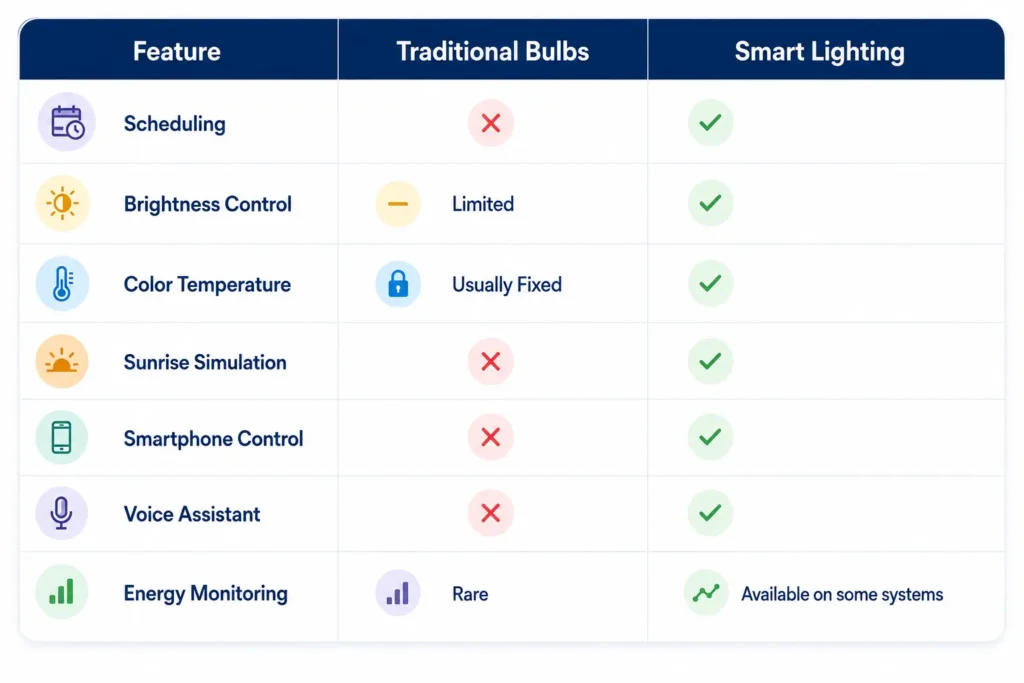
Unlike traditional bulbs, smart lighting systems can automatically adjust:
- 🌅 Brightness throughout the day
- 🌙 Color temperature after sunset
- ⏰ Timers and bedtime schedules
- 📱 Smartphone control
- 🗣️ Voice commands with Alexa or Google Assistant
- 🌞 Sunrise simulations for gentler mornings
Instead of remembering to dim every light manually, your home quietly does the work for you.
And sometimes…
That’s the kind of help we all need.
Story 2 – Tokyo Never Sleeps… But Ken Wanted To
If you’ve ever visited Tokyo, you know the city glows long after midnight.
Neon signs.
Convenience stores.
Office buildings.
It almost feels like daylight at 11 PM.
Ken, a 34-year-old software engineer, loved his job.
What he didn’t love was lying awake until two in the morning—even when he felt exhausted.
He blamed deadlines.
Coffee.
Even his mattress.
One evening, after reading about circadian rhythms, he noticed something he had never questioned before.
His apartment was lit by cool white LEDs from morning until bedtime.
His office.
His kitchen.
His bedroom.
Every room looked exactly the same, whether it was 9 AM or 11 PM.
So he made one small experiment.
Instead of changing his routine overnight, he programmed his smart bulbs.
At 7 PM, the lights became warmer.
At 9 PM, brightness automatically dropped to 40%.
By 10 PM, only soft amber lighting remained in the bedroom.
Nothing dramatic happened on the first night.
Or the second.
But after three weeks, something changed.
He no longer felt wide awake at midnight.
His evenings became quieter.
His brain seemed to receive a simple message:
“The day is ending.”
No miracle.
Just better cues.
Sometimes that’s exactly what our bodies need.
Your Brain Loves Routines More Than Gadgets
Many people buy expensive sleep products hoping for an instant transformation.
I’ve done that too.
The truth?
Your brain doesn’t care how expensive your light bulb is.
It cares about consistency.
When your environment follows the same pattern every evening, your body starts anticipating sleep.
That’s where Smart Lighting for Sleep becomes more than a gadget.
It becomes part of a healthy routine.
Think about it.
Every sunset tells nature it’s time to slow down.
Your home can do the same.
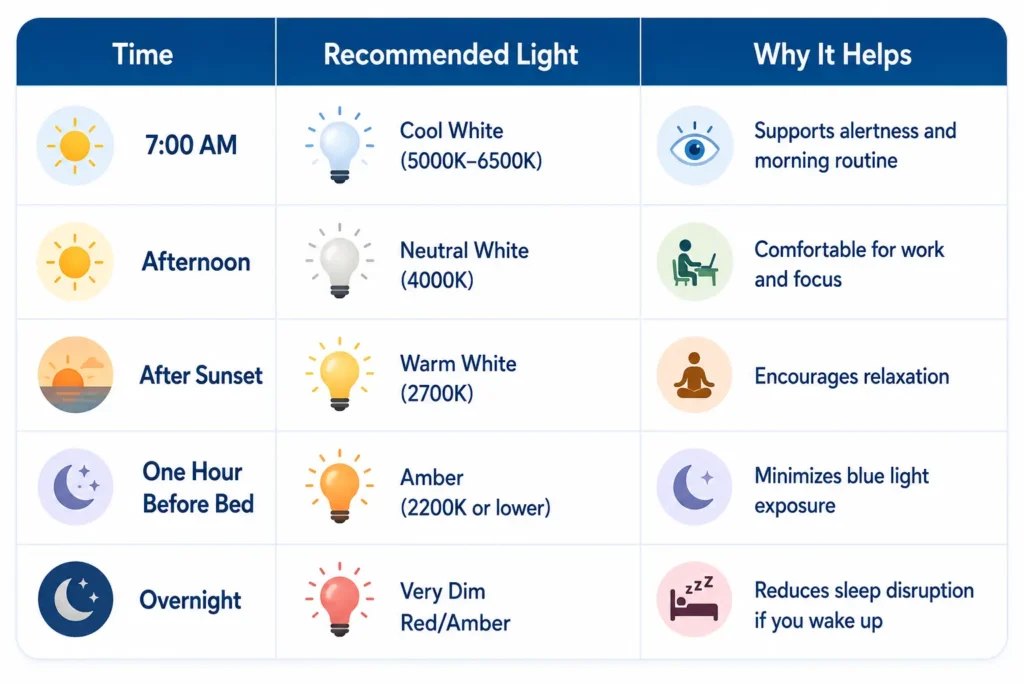
Best Light Colors for Every Part of the Day
💡 SmartLiving Tip
If you have to get up during the night, avoid switching on bright bathroom lights.
A small warm night light is often enough and is much gentler on sleepy eyes.
We’ve All Done This…
You tell yourself…
“I’m just going to watch one episode.”
Three episodes later…
Your living room looks brighter than an operating room.
Your brain thinks it’s lunchtime.
Your alarm thinks otherwise.
We’ve all been there.
Technology sometimes steals our sleep.
The good news?
It can also help us get it back.
Seven Common Smart Lighting Mistakes
Even the smartest bulbs won’t help if they’re used the wrong way.
1. Using Daylight Bulbs Right Before Bed
Bright daylight-colored bulbs are excellent for working.
Not for relaxing.
2. Keeping Every Room Equally Bright
Your bedroom shouldn’t feel like your office.
Create different lighting zones throughout your home.
3. Ignoring Brightness
Brightness matters almost as much as color.
Even warm light can be too intense before bedtime.
4. Sleeping With Decorative LEDs On
That tiny strip of blue LEDs under your TV?
Your brain still notices it.
5. Forgetting Morning Light
Healthy sleep doesn’t begin at night.
It begins when you wake up.
Expose yourself to bright natural light—or a smart sunrise lamp—as early as possible.
6. Thinking Smart Lights Are Magic
Lighting supports healthy sleep.
It doesn’t replace:
- regular sleep schedules
- exercise
- stress management
- limiting late-night screen time
7. Buying the Cheapest Smart Bulb Without Checking Features
Not every smart bulb allows you to adjust color temperature.
Look for models that offer:
✔ Warm white
✔ Scheduling
✔ Sunrise/Sunset automation
✔ Voice assistant compatibility
Best Smart Lights for Better Sleep (2026)
🥇 Philips Hue White Ambiance
If I had to recommend just one ecosystem for most homes, this would be it.
Why?
Because it makes creating healthy lighting routines incredibly easy.
Perfect for
✅ Bedrooms
✅ Families
✅ Whole-home automation
Pros
✔ Excellent color temperature control
✔ Reliable app
✔ Alexa & Google compatible
✔ High build quality
Cons
✖ More expensive than competitors
🥈 Govee Smart Bulbs
Govee has become one of my favorite brands for affordable smart lighting.
Their app is intuitive, schedules are easy to create, and the value for money is excellent.
Pros
✔ Affordable
✔ Easy setup
✔ Great mobile app
✔ Warm lighting scenes
Cons
✖ Slightly fewer integrations than Philips Hue
🥉 Nanoleaf Essentials
Already using Apple HomeKit?
Nanoleaf is worth considering.
Its adaptive lighting automatically changes throughout the day to support your body’s natural rhythm.
Pros
✔ Adaptive Lighting
✔ Thread support
✔ Beautiful ecosystem
Cons
✖ Smaller product lineup
Story 3 – A Family in Amsterdam Changed Bedtime Without Realizing It
Emma and David had two young children.
Every evening felt the same.
Lights everywhere.
TV on.
Kitchen still bright.
Kids jumping around at 9 PM.
One day, they decided to automate the entire house.
Not for convenience.
For bedtime.
At 7:30 PM…
The living room lights slowly became warmer.
At 8 PM…
The hallway dimmed.
At 8:15…
The children’s bedroom glowed with soft amber light.
The parents didn’t need to remind anyone that bedtime was approaching.
The house itself did.
Children thrive on routines.
Adults do too.
Sometimes…
Our homes can quietly encourage healthier habits without us even noticing.
Smart Lighting vs Traditional Lighting
Story 4 – A Retired Couple in the Netherlands Rediscovered Mornings
Peter and Anne had lived in the same house for almost thirty years.
As they grew older, sleeping became more difficult.
Not because they weren’t tired.
Because they kept waking up before sunrise… and struggled to fall asleep again.
Their daughter bought them a sunrise alarm clock connected to their smart lighting system.
At first, Peter laughed.
“A lamp is supposed to help me sleep? That’s a good one.”
Two months later…
He admitted something surprising.
He no longer woke up feeling like someone had dragged him out of bed.
Instead of an aggressive alarm…
The bedroom slowly filled with soft golden light.
Just like a natural sunrise.
“It’s probably the gentlest way I’ve ever started a morning,” he told his daughter.
That story reminded me of something important.
Sometimes technology isn’t about adding more screens to our lives.
Sometimes…
It’s about bringing nature back into our homes.
What the Research Says
Smart lighting isn’t just another trend.
Researchers have spent years studying how light affects sleep and overall health.
Here are a few key findings:
💡 SmartLiving Tip
Don’t think of smart lighting as a sleep cure.
Think of it as one piece of a healthier evening routine—alongside consistent bedtimes, reduced screen time, and a comfortable bedroom.
Product Recommendations
If friends asked me which products I’d actually recommend—not because they’re expensive, but because they’re practical—this would be my list.
🥇 Philips Hue White Ambiance
⭐ Best Overall
Perfect if you want complete control over brightness, schedules, and color temperature.
Ideal for:
✔ Bedrooms
✔ Families
✔ Whole-home automation
🥈 Hatch Restore 3
More than a bedside lamp.
It combines:
- Sunrise alarm
- Relaxing sounds
- Guided wind-down routines
- Smart bedtime automation
Perfect if falling asleep is harder than waking up.
🥉 Govee Smart Bulbs
The best value for most homeowners.
Affordable.
Reliable.
Easy to install.
A fantastic first step into smart lighting.
⭐ Lumie Bodyclock
One of the best sunrise alarm clocks available.
Especially helpful during winter when mornings stay dark.
⭐ Casper Glow Light
A beautifully designed bedside light that creates a calm atmosphere without feeling overly “techy.”
Sometimes simplicity is exactly what we need.
Pros & Cons of Smart Lighting for Sleep
Pros
✔ Supports healthy evening routines
✔ Reduces exposure to bright blue-rich light before bed
✔ Creates a relaxing bedroom atmosphere
✔ Sunrise simulations make waking up more pleasant
✔ Voice control and automation save time
✔ Can reduce unnecessary energy use through scheduling
Cons
✖ Initial cost is higher than standard bulbs
✖ Some systems require a hub
✖ Wi-Fi setup can be confusing for beginners
✖ Smart lighting alone won’t solve chronic sleep disorders
Build Your Perfect Evening Routine
Here’s a simple routine anyone can try.
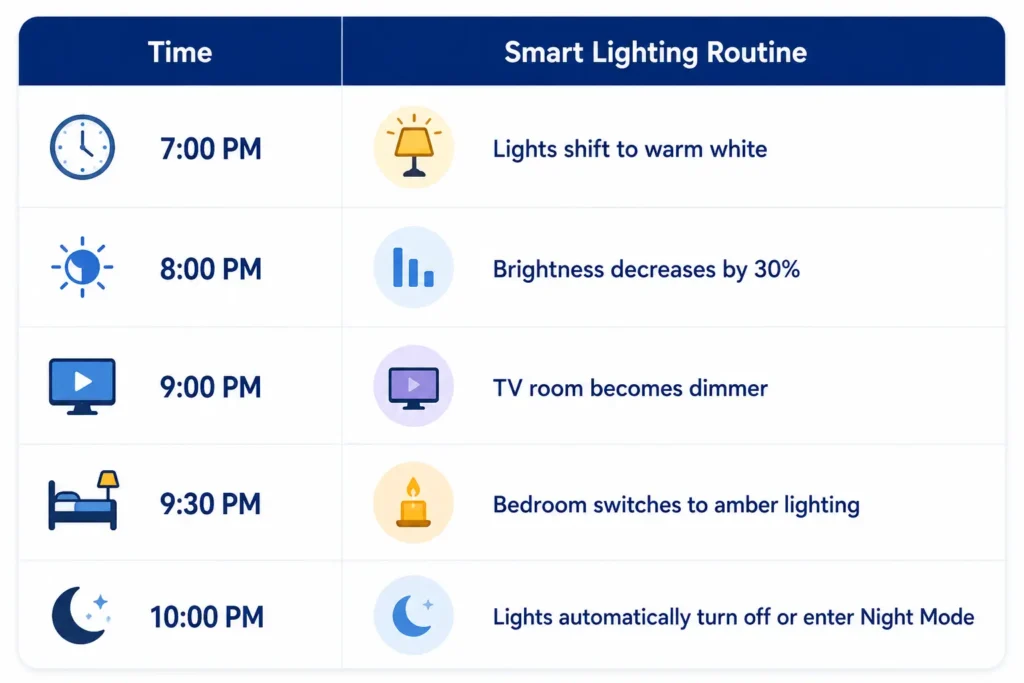
Sometimes it’s the tiny habits we repeat every day that create the biggest changes.
One Last Thing Before You Go
We spend hundreds of dollars on mattresses.
Thousands on smartphones.
Yet many of us still sleep under lighting that makes our brains think it’s noon.
Maybe our light bulbs deserve a little more respect.
Frequently Asked Questions
Does smart lighting really improve sleep?
Smart lighting can support better sleep by reducing bright, blue-rich light in the evening and helping maintain consistent daily routines. While it isn’t a medical treatment, many people find it easier to relax when their home lighting follows a natural day-to-night pattern.
What’s the best light color before bed?
Warm white or amber light (around 2200K–2700K) is generally preferred because it minimizes blue light exposure and creates a calming atmosphere.
Can smart bulbs replace blackout curtains?
No.
They complement each other.
Blackout curtains help keep unwanted outdoor light out, while smart bulbs help you control indoor lighting.
Are smart lights worth the money?
If you already use smart home devices—or simply want a more comfortable evening routine—they can be a worthwhile investment, especially when paired with automations.
Do I need a smart home hub?
Not always.
Many newer smart bulbs connect directly via Wi-Fi, Matter, or Thread without requiring a separate hub.
Quick Quiz
1. When do you usually struggle to sleep?
A. Falling asleep
B. Waking during the night
C. Waking up tired
D. All of the above
2. What kind of lighting do you currently use?
A. Bright white LEDs
B. Warm bulbs
C. Smart lighting
D. I have no idea 😄
Results
Mostly A
➡️ Try automating warm evening lighting.
Mostly B
➡️ Reduce overnight light exposure.
Mostly C
➡️ Fine-tune your schedules and sunrise routines.
Mostly D
➡️ Congratulations—you’ve just discovered your next smart home upgrade.
More Than Just Better Sleep
When I think about Emily in Boston…
Ken in Tokyo…
Emma and David in Amsterdam…
Peter and Anne in the Netherlands…
One thing connects all of them.
None of them were searching for a fancy gadget.
They were searching for something much simpler.
A peaceful night.
More energy in the morning.
A home that felt calm instead of chaotic.
Smart lighting didn’t change who they were.
It changed the environment around them.
And sometimes…
Changing your environment is the easiest way to change your habits.
Conclusion: Better Nights Start with Better Lighting
For years, many of us focused on mattresses, pillows, supplements, or sleep trackers.
Those can all help.
But we often overlook one of the most powerful signals our brain receives every single day:
Light.
Creating a healthier bedroom doesn’t have to mean renovating your home or spending thousands of dollars.
Sometimes it starts with replacing a few light bulbs, setting an automatic evening schedule, or waking up with a gentle sunrise instead of a blaring alarm.
That’s the beauty of Smart Lighting for Sleep.
It quietly works in the background, helping your body follow the rhythm it was designed for.
At SmartLiving369, we believe that the smartest homes aren’t filled with the most technology—they’re filled with technology that genuinely improves everyday life.
Whether you’re exploring better sleep, cleaner indoor air, energy-saving gadgets, or healthier living spaces, every small upgrade brings you one step closer to a home that works with you instead of against you.
Discover More Smart Living Guides
Whether you’re looking to sleep better, breathe cleaner air, or create a more connected home, these expert guides will help you make smarter everyday decisions.
[…] Smart Lighting for Sleep: How It Can Dramatically Improve Your Sleep Quality in 2026 […]
[…] Air Purifiers for Home: The Complete Guide […]