
Have You Ever Wished Your Home Could Think for Itself?
Picture this…
You leave for work in a hurry.
Halfway down the road, you suddenly wonder:
“Did I turn off the lights?”
Then another thought pops into your head.
“Did I lock the front door?”
And just when you think you’re done worrying…
“Wait… is the thermostat still heating an empty house?”
We’ve all been there.
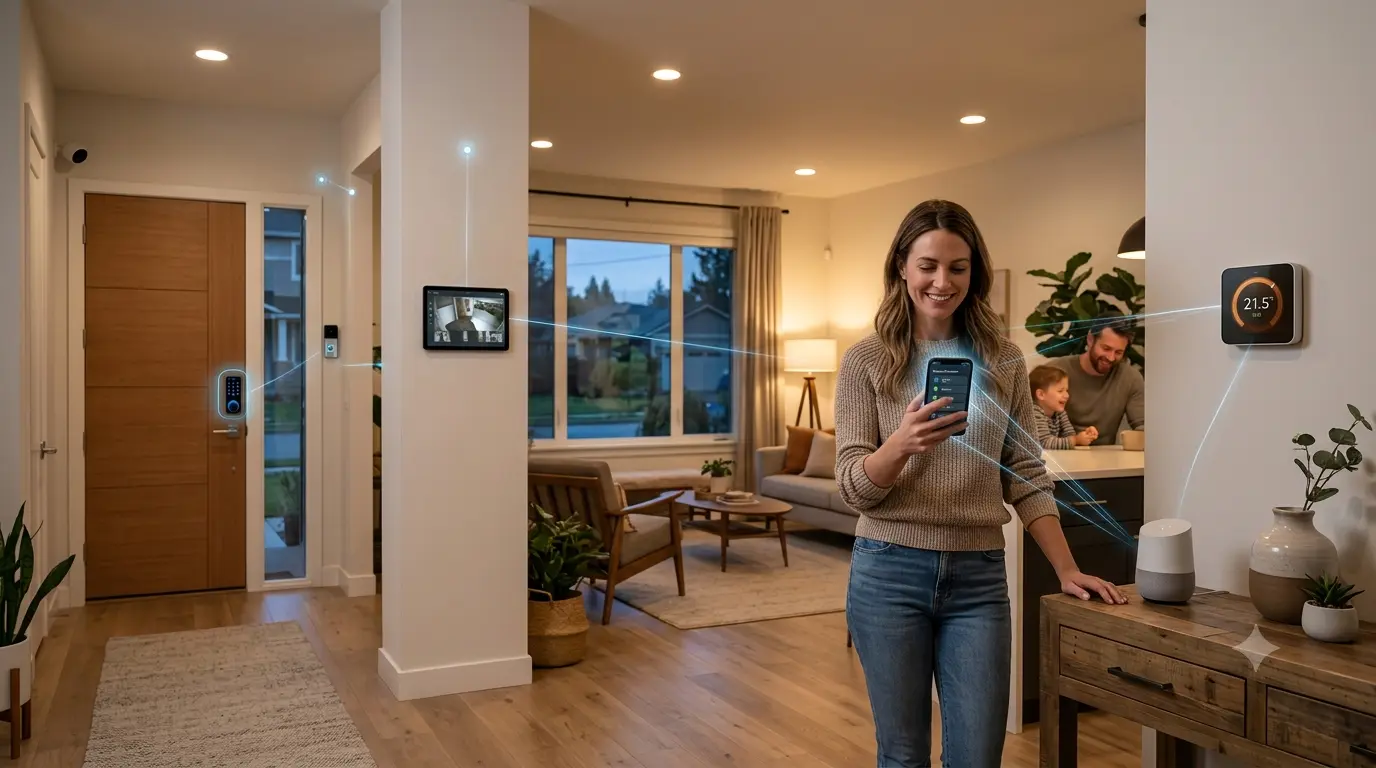
Now imagine opening one app on your phone and seeing everything.
Your lights are off.
Your front door is locked.
Your thermostat has switched to Eco Mode.
Your security camera confirms everything is safe.
Sounds like something from a science fiction movie?
Not anymore.
Welcome to the world of the Home Automation System, where your home doesn’t just respond to you—it works with you.
Whether you’re building your very first smart home or upgrading room by room, this guide will help you make confident decisions without wasting money on gadgets you don’t need.
👉 Stay with me until the end. I’ll also show you the biggest mistakes homeowners make when creating a smart home—and how you can avoid them.
Quick Answer: What Is a Home Automation System?
A Home Automation System connects your smart devices—such as lights, thermostats, locks, cameras, plugs, and sensors—so they can communicate and work together automatically.
Instead of controlling each device separately, you manage everything from one central app, smart hub, or voice assistant.
The result?
- More convenience
- Better home security
- Lower energy consumption
- Greater comfort
- More control—even when you’re miles away
Think of it as giving your house a brain.
What Exactly Is a Home Automation System?
Let’s keep it simple.
A Home Automation System is a network of connected smart devices that work together to automate everyday tasks.
Instead of manually turning off lights, adjusting the thermostat, locking doors, or checking security cameras, your home can do many of these tasks automatically.
For example:
- Your lights turn on when you arrive home.
- Your thermostat lowers the temperature when everyone leaves.
- Your smart lock secures the front door every night at 10 PM.
- Your security camera sends an alert if unexpected motion is detected.
The goal isn’t to replace you.
The goal is to make your daily life easier.
And honestly?
Once you experience a well-designed smart home, it’s surprisingly hard to imagine going back.
Why Is Home Automation Becoming So Popular?
Here’s something interesting.
Technology used to be a luxury.
Today, it’s becoming an everyday convenience.
According to Parks Associates, the majority of U.S. households now own at least one smart home device, and adoption continues to grow as connected products become more affordable and easier to use.
As more homeowners experience the convenience of connected living, interest in complete Home Automation Systems continues to rise.
It’s not about showing off fancy gadgets.
It’s about solving everyday problems.
Home Automation System vs Traditional Home
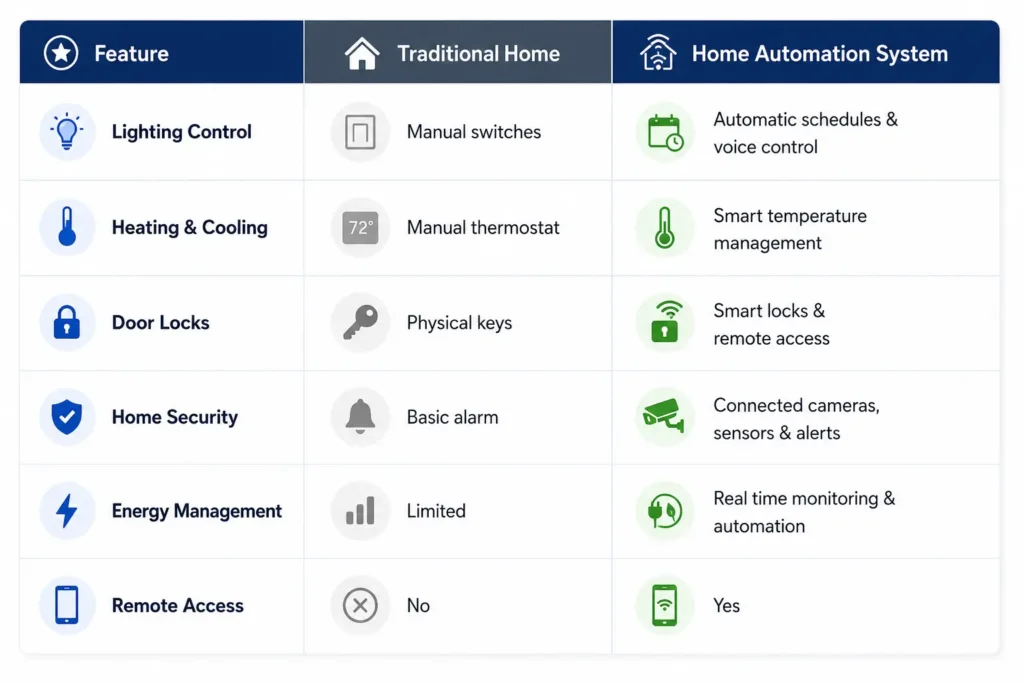
Looking at the comparison, one thing becomes clear.
A smart home isn’t just more convenient.
It’s more responsive.
Your home adapts to you instead of expecting you to adapt to it.
How Does a Home Automation System Work?
At first, it may sound complicated.
The good news?
It’s actually much simpler than most people think.
A typical Home Automation System is built around four key components:
Smart Devices
These are the products that perform the work.
Examples include:
- Smart bulbs
- Smart thermostats
- Smart locks
- Security cameras
- Motion sensors
- Smart plugs
- Video doorbells
Each device has a specific job, but their real power comes from working together.
Connectivity
Your devices need a way to communicate.
Most smart homes use technologies such as:
- Wi-Fi
- Zigbee
- Z-Wave
- Thread
- Matter
- Bluetooth
Don’t worry if these names sound technical.
The important thing is choosing products that are compatible with the same ecosystem.
That decision will save you a lot of frustration later.
A Smart Hub or Ecosystem
Think of this as the “brain” of your smart home.
Popular options include:
- Amazon Alexa
- Google Home
- Apple Home
- Samsung SmartThings
- Home Assistant
This is where automations are created.
For example:
IF nobody is home
THEN turn off all lights, lock the doors, and reduce the heating.
That’s automation doing the thinking for you.
Automation Rules
This is where the magic happens.
Instead of pressing buttons every day, you create routines once.
Examples include:
- Turn on outdoor lights at sunset.
- Lock every door at 10 PM.
- Start the robot vacuum after everyone leaves.
- Turn off all downstairs lights when you say, “Good night.”
Small automations save only seconds.
But together, they save hours over a year.
💡 Expert Tip
Don’t try to automate your entire house in one weekend.
Start with one room.
Learn what works.
Then expand gradually.
The smartest homes aren’t built overnight—they evolve one useful upgrade at a time
The Biggest Benefits of a Home Automation System
So why are millions of homeowners investing in smart technology?
Because the benefits go far beyond convenience.
Here’s what you can expect.
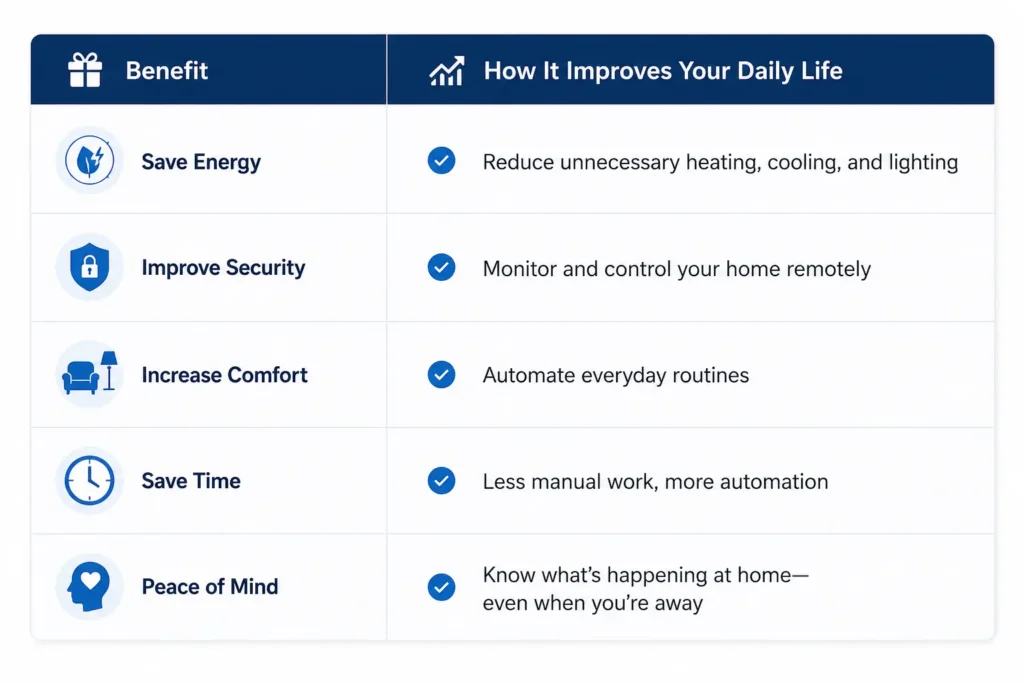
And perhaps the biggest benefit of all?
Your home starts working for you instead of asking for your attention every few minutes.
Building Your Smart Home Step by Step
A complete smart home doesn’t happen in a day.
In fact, I usually recommend starting with two devices that provide the biggest everyday impact:
- A smart thermostat to improve comfort and reduce energy use.
- A smart lock to simplify access and strengthen home security.
Once those are in place, adding lights, cameras, sensors, and voice assistants becomes much easier.
Remember: the goal isn’t to own the most gadgets.
The goal is to build a Home Automation System that genuinely makes your life simpler.
Powerful Reasons to Invest in a Home Automation System
Technology should make life easier—not more complicated.
That’s exactly why more homeowners are embracing a Home Automation System.
Let’s explore the biggest benefits you’ll notice from day one.
Save Energy Without Thinking About It
Imagine leaving your home every morning knowing your lights, thermostat, and unused devices automatically switch to energy-saving mode.
No reminders.
No stress.
Just smart automation doing the work for you.
According to the U.S. Department of Energy, heating and cooling account for the largest share of residential energy use, making smart temperature management one of the easiest ways to improve efficiency.
👉 Learn more: https://www.energy.gov/energysaver
The cheapest energy is the energy you never waste.
Improve Home Security 24/7
Your home never sleeps.
Why should your security?
A modern Home Automation System lets you:
- Lock doors remotely
- View live security camera feeds
- Receive instant motion alerts
- Monitor smart sensors
- Automate outdoor lighting
Instead of reacting to problems, you stay one step ahead.
Peace of mind is one of the biggest reasons homeowners upgrade.
Make Everyday Life Effortless
Let’s be honest.
Most of us repeat the same little tasks every day:
Turn off lights.
Adjust the thermostat.
Lock the door.
Close the garage.
Now imagine those tasks happening automatically.
That’s not laziness.
That’s efficiency.
A smart home gives you more time for the things that actually matter.
Home Automation System: Daily Life Comparison
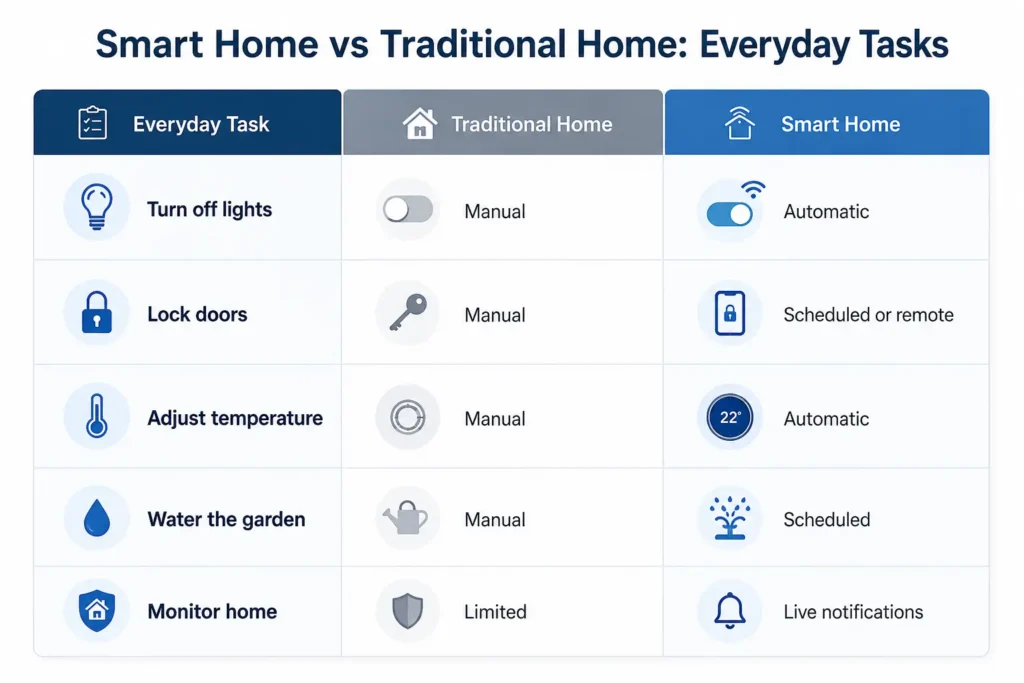
Sometimes it’s the smallest automations that create the biggest improvements.
Control Your Home From Anywhere
Whether you’re at work, on vacation, or visiting family, your home stays within reach.
Forgot to turn off a light?
Tap.
Need to unlock the door for a delivery?
Tap.
Want to check if the garage is closed?
Tap.
Your smartphone becomes your home’s remote control.
And honestly…
Once you get used to it, it’s hard to imagine living any other way.
Build Routines That Work for You
Automation is more than remote control.
It’s about creating routines.
Imagine saying:
“Good Night.”
Immediately:
- The doors lock.
- The lights turn off.
- The thermostat adjusts.
- The security system arms.
- Outdoor lights switch on.
One command.
Five actions.
That’s the beauty of automation.
Increase Your Home’s Value
A smart home isn’t just convenient today—it may also make your property more attractive to future buyers.
Features like smart thermostats, smart locks, video doorbells, and connected lighting are increasingly seen as desirable upgrades.
While they don’t guarantee a higher sale price, they can enhance your home’s appeal in a competitive market.
Think of automation as an investment in both comfort and long-term value.
Wired vs Wireless Home Automation System
One question I hear all the time is:
“Should I choose a wired or wireless system?”
Here’s a simple comparison.
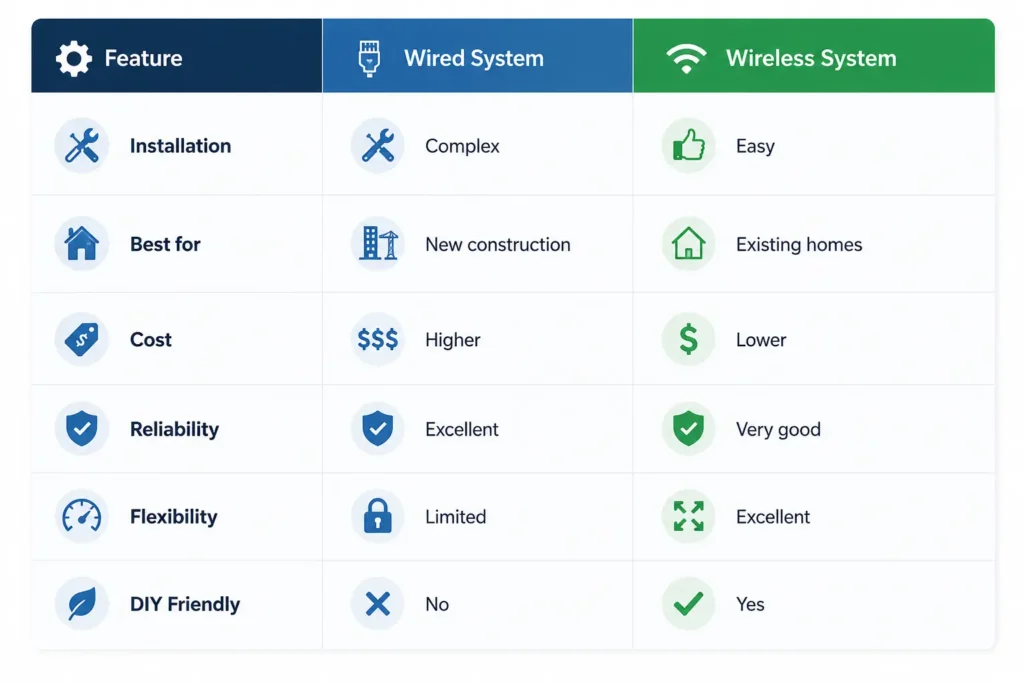
For most homeowners, a wireless Home Automation System is the easiest and most practical choice.
It grows with your needs and usually requires little or no renovation.
Better Accessibility for Everyone
Smart homes aren’t only about convenience.
They can also improve accessibility.
Voice control, automatic lighting, smart door locks, and scheduled routines can make daily life easier for:
- Older adults
- People with limited mobility
- Busy families
- Caregivers
Technology becomes truly valuable when it helps people live more independently.
Which Smart Home Ecosystem Should You Choose?
Choosing one ecosystem early will save you time—and frustration.
Here’s a quick overview.
| Ecosystem | Best For | Strength |
|---|---|---|
| Amazon Alexa | Beginners | Huge device compatibility |
| Google Home | Android users | Excellent voice assistant |
| Apple Home | Apple users | Strong privacy & security |
| Samsung SmartThings | Advanced users | Broad automation options |
| Home Assistant | Tech enthusiasts | Maximum customization |
There’s no universal winner.
The best ecosystem is the one that fits the devices you already use.
Automation Helps Reduce Daily Stress
Here’s something people rarely mention.
Automation isn’t just about gadgets.
It’s about reducing decision fatigue.
Instead of asking yourself:
“Did I…?”
Your home already knows what to do.
Small conveniences add up.
Less worrying.
Less forgetting.
More enjoying your home.
And isn’t that the whole point?
Prepare Your Home for the Future
Smart home technology is evolving rapidly.
New standards like Matter are making devices from different brands work together more easily than ever before.
That means your Home Automation System can continue to grow over time instead of becoming outdated.
Start small.
Expand gradually.
Build a home that adapts with you.
Common Mistakes to Avoid
Even the best smart devices can’t fix poor planning.
Avoid these common mistakes:
❌ Buying Random Devices
Choose products that work within the same ecosystem whenever possible.
❌ Ignoring Wi-Fi Coverage
A weak signal leads to slow or unreliable automations.
Consider improving your home network before adding dozens of smart devices.
❌ Automating Everything at Once
More automation isn’t always better.
Start with the routines you’ll actually use every day.
❌ Forgetting Security
Protect your smart home by:
- Using strong passwords
- Enabling two-factor authentication
- Keeping firmware updated
- Buying devices from trusted brands
A smart home should be convenient—but also secure.
💡 Expert Tip
If you’re just starting out, focus on upgrades that provide the biggest daily impact.
A smart thermostat can help optimize comfort and energy use, while a smart lock adds convenience and security.
As your confidence grows, expand your Home Automation System with lighting, cameras, sensors, and voice assistants.
Remember: every smart home starts with a single smart decision.
Pros & Cons of a Home Automation System
Let’s be honest.
No technology is perfect.
Even the best Home Automation System has strengths and a few trade-offs.
The good news?
For most homeowners, the advantages far outweigh the disadvantages.
Here’s a balanced look before you decide.
| Pros | Cons |
|---|---|
| ✅ Control your home from anywhere | ❌ Higher upfront investment |
| ✅ Improve home security | ❌ Some devices require Wi-Fi |
| ✅ Reduce energy waste | ❌ Learning curve for beginners |
| ✅ Automate repetitive tasks | ❌ Occasional firmware updates |
| ✅ Voice control and routines | ❌ Battery replacement for certain devices |
| ✅ Increase convenience | ❌ Compatibility matters when mixing brands |
Expert Opinion
If someone asked me where to spend money first in a smart home, I wouldn’t recommend buying ten gadgets at once.
I’d recommend building a reliable ecosystem slowly.
A well-planned Home Automation System will always outperform a house filled with random smart devices that don’t communicate with each other.
Best Home Automation Products for Beginners
Choosing the right products is easier when you focus on reliability rather than buying everything at once.
These categories offer the biggest everyday impact.
🏆 Best Smart Hub
Samsung SmartThings Hub
Why I recommend it
It supports a wide range of devices and works well for homeowners who want flexibility as their smart home grows.
Best for:
✔ Beginners
✔ Families
✔ Growing smart homes
👉 CTA: Check Today’s Price
🌡️ Best Smart Thermostat
A smart thermostat is often the first upgrade I recommend.
Why?
Because it improves comfort while helping reduce unnecessary energy use.
If you haven’t explored this topic yet, don’t miss our guide:
👉 https://smartliving369.com/why-every-home-needs-a-smart-thermostat/
This upgrade often delivers noticeable benefits from day one.
🔒 Best Smart Lock
A quality smart lock combines convenience with better access management.
Look for features such as:
- Fingerprint unlock
- Temporary guest codes
- Remote access
- Activity history
💡 Best Smart Lighting
Smart bulbs are one of the easiest ways to experience home automation.
Popular features include:
- Voice control
- Motion activation
- Sunset schedules
- Vacation mode
📹 Best Security Camera
Smart cameras help you stay connected to your home wherever you are.
Features worth considering include:
- Night vision
- Motion detection
- Cloud or local recording
- Mobile alerts
Build Your Smart Home in the Right Order
Many beginners ask me:
“Where should I start?”
Here’s the roadmap I usually recommend.
| Priority | Smart Device | Why Start Here? |
|---|---|---|
| ⭐⭐⭐⭐⭐ | Smart Thermostat | Comfort + energy savings |
| ⭐⭐⭐⭐⭐ | Smart Lock | Security + convenience |
| ⭐⭐⭐⭐ | Smart Lights | Easy automation |
| ⭐⭐⭐⭐ | Video Doorbell | Better awareness |
| ⭐⭐⭐ | Security Cameras | Extra protection |
| ⭐⭐⭐ | Smart Plugs | Low-cost automation |
| ⭐⭐⭐ | Smart Sensors | More intelligent routines |
Notice something?
You don’t need twenty devices.
You only need the right ones.
Frequently Asked Questions
Is a Home Automation System worth it?
For most homeowners, yes.
It helps simplify everyday routines, improves home security, and gives you greater control over your home—even when you’re away.
How much does a Home Automation System cost?
It depends on your goals.
A beginner setup may cost only a few hundred dollars, while a fully connected home can cost significantly more.
The good news?
You can build your system gradually.
Can I install everything myself?
Many smart home devices are designed for DIY installation.
Products such as smart bulbs, plugs, thermostats (depending on your HVAC system), and smart locks often include step-by-step instructions.
If you’re unsure, hiring a professional is always an option.
Which ecosystem is best?
There isn’t one perfect answer.
Choose the ecosystem that matches the devices you already own and the level of automation you want.
Amazon Alexa, Google Home, Apple Home, and SmartThings are all excellent options for different needs.
More Frequently Asked Questions About Home Automation Systems
What is the first thing I should automate in my home?
If you are new to smart technology, start with devices that solve everyday problems.
My personal recommendation:
- Smart thermostat
- Smart lock
- Smart lighting
- Security camera
- Smart sensors
The best Home Automation System is not the one with the most devices.
It is the one that makes your daily life easier.
Does a smart home need Wi-Fi all the time?
Most smart homes use Wi-Fi, but not every device depends entirely on it.
Some products communicate through:
- Zigbee
- Z-Wave
- Thread
- Bluetooth
A good smart home design combines reliability with convenience.
Can a Home Automation System save money?
Yes, especially when it helps reduce wasted energy.
Examples:
- Smart thermostats adjust heating and cooling automatically.
- Smart lights turn off when rooms are empty.
- Smart plugs reduce unnecessary standby power.
The savings depend on your habits, your home, and the devices you choose.
Are smart homes secure?
Security should always be part of your smart home strategy.
A connected home can actually improve security through:
- Real-time alerts
- Smart locks
- Cameras
- Motion sensors
- Automated lighting
However, remember:
A smart device is only as secure as the habits behind it.
Use strong passwords.
Enable two-factor authentication.
Keep your devices updated
Can I create a smart home if I live in an apartment?
Absolutely.
In fact, apartments are often perfect for beginner automation.
You can start with:
- Smart bulbs
- Smart plugs
- Smart speakers
- Smart curtains
- Smart security cameras
No major renovation required.
Does home automation increase property value?
Smart technology can make a home more attractive to buyers.
Features like:
- Smart thermostats
- Smart security systems
- Smart lighting
- Smart locks
are increasingly expected by many modern homeowners.
While automation alone does not guarantee a higher selling price, it can improve the overall appeal of your property.
What is Matter and why does it matter?
Great question.
Matter is a smart home standard designed to help devices from different brands communicate more easily.
The goal?
Less compatibility frustration.
More choice.
A smoother smart home experience.
For beginners, this means choosing devices that are more likely to work together in the future.
Quick Quiz: How Much Do You Know About Home Automation?
What is the main purpose of a Home Automation System?
A. Buying expensive gadgets
B. Making your home work automatically and efficiently ✅
C. Replacing all furniture
D. Increasing internet speed
Which device is commonly recommended as a first smart home upgrade?
A. Smart thermostat ✅
B. Smart refrigerator
C. Smart mirror
D. Smart coffee machine
What allows smart devices to communicate?
A. Connectivity protocols ✅
B. Paint colors
C. Furniture design
D. Home decoration
Which technology helps different smart home brands work together?
A. Matter ✅
B. HDMI
C. USB
D. Bluetooth headphones
What improves smart home security?
A. Weak passwords
B. Ignoring updates
C. Two-factor authentication ✅
D. Sharing passwords
Can smart homes be built gradually?
A. Yes ✅
B. No
Which device helps control your home’s temperature automatically?
A. Smart thermostat ✅
B. Smart speaker
C. Smart bulb
D. Smart camera
What is one benefit of smart lighting?
A. Automatic schedules ✅
B. Faster internet
C. Bigger rooms
D. Stronger furniture
Should you buy random smart devices from different ecosystems?
A. Always
B. No, compatibility matters ✅
What makes a smart home truly valuable?
A. The number of devices
B. How well it solves your daily problems ✅
Final Thoughts: Building a Smarter Home Starts With One Smart Decision
A few years ago, controlling your lights with your voice sounded futuristic.
Today?
Millions of homeowners do it every day.
Technology is changing the way we live, but the goal of a smart home has never been about having the newest gadget.
It is about creating a home that understands your needs.
A well-designed Home Automation System can help you:
- Save energy
- Improve security
- Reduce daily stress
- Save time
- Enjoy more comfort
But remember something important:
The smartest home is not the one with the most technology.
It is the one where technology quietly improves your life.
Your home should not feel like a complicated machine.
It should feel like a helpful partner.
Ready to Build Your Smart Home?
Start small.
Choose one problem you want to solve.
Maybe you want better security.
Maybe you want lower energy bills.
Maybe you simply want more convenience after a long day.
One smart upgrade can become the foundation of a complete connected home.
Explore more smart home guides on SmartLiving369.com and discover practical ways to make your home safer, smarter, and more comfortable.
👉 Your smarter home does not start with hundreds of devices.
It starts with one smart choice today.
[…] to take the next step? Explore our ultimate home automation system guide and discover how to build a connected home around your actual […]